
 |
 |

|

 The Forest
Maiden
|
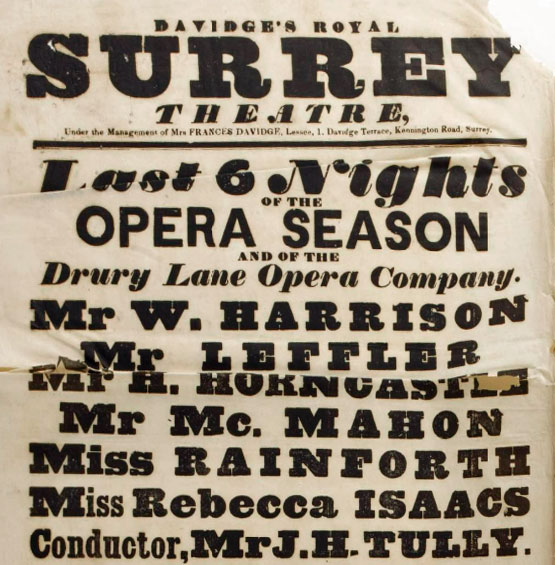
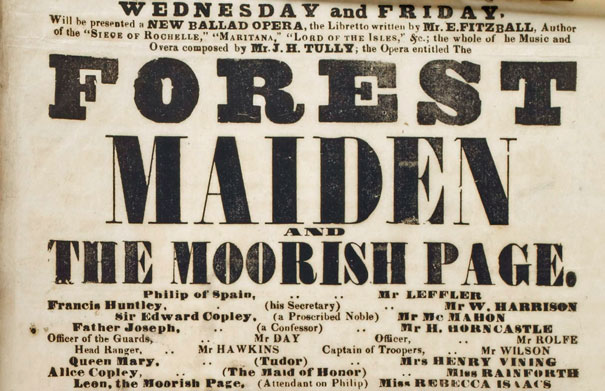
| Sir Edward Copley a proscribed heretic Father Joseph, the Queen's confessor Philip of Spain Francis Huntley Leon, the Moorish page Alice Copley Mary Tudor |
-
Mr McMahon - Henry Horncastle - Adam Leffler - William Harrison - Rebecca Isaacs - Elizabeth Rainforth - Mrs Henry Vining (Amelia Quantrell) |
Conductor - James Howard Tully
History
|
Frances Davidge, manager of the Surrey theatre, took advantage of the early termination of Bunn's management at Drury Lane at the beginning of May, 1847, to take on some of his Drury Lane company, including the music director James Tully, for a short season of opera beginning on May 24, 1847. The season was extended twice concluding eventually on July 17, 1847. It is not clear whether the composer, Tully and the librettist Edward Fitzball had an opera in mind already or whether they saw an opportunity with the move to the Surrey. The manuscript sent to the Examiner stated that it was to be performed on May 24, but, in the event, it was premiered on May 31, 1847. In his autobiography, Fitzball does not claim any antecedent for the opera although it was his common practice to adapt some existing, usually continental, play[1]. The Observer (June 6, 1847) spoke vaguely of it being "founded on an episode in the life of Philip of Spain". The quality of the opera and its staging at the Surrey pleasantly |
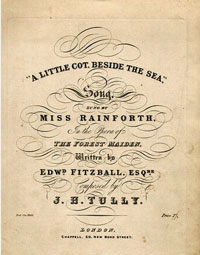
One of the songs from the opera |
surprised many critics but it was only modestly successful, probably just 13 performances in all.
It was never revived; Tully did not even include it with any of his touring companies. It was described as a ballad opera, which would usually be thought of as a spoken play with solo songs (often using current popular tunes) but here Tully seemed to have used his own melodies and included ensembles and probably other incidental music.
[1] Fitzball's only comment on the plot of the opera in his autobiography Thirty Five Years of a Dramatic Author's Life. Vol. 2 (London: T.C. Newby, 1859), p.375, was that "The story laid in the reign of Queen Mary, was very interesting". He commented that "the music sweet and natural".
Plot
The plot according to the Morning Advertiser (June 5, 1847) was:
Queen Mary is jealous of the attention paid by her husband, Philip, to her Maid of Honour, Alice Copley, and she employs the services of Leon, the Moorish Page, attendant upon Philip, to aid her in obtaining proofs to substantiate the charge of the King's infidelity. The first act opens with a meeting of the King and Alice in Windsor forest, when he assails the virtue of Alice by a declaration of his passion. She indignantly repulses him, and effects her escape pursued by the King. In the struggle Alice drops a letter addressed to her by her father, who is proscribed, and who had written to her appointing a meeting. This letter is picked up by the Page, who had been in concealment watching the King and Alice and he resolves, for ulterior purposes, to give it into the possession of the Queen. The latter ultimately has Alice arrested and sent to the Tower on a charge of heresy, founded on the letter addressed to her by her father.
In order to favour his designs, the King gets his Secretary Huntley appointed Lieutenant of the Tower, ignorant that Huntley was then the received suitor of Alice. The Page, bitterly bitterly regretting the part he had taken against Alice, obtains her partial release from custody, upon a promise held out to the Queen, that such release would lead to the discovery of the guilty party with the King. In a subsequent scene the Page is discovered to be an assumed character, supported by one of the victims of Philip's intrigues, and who now appears as Leonora de Castro, to upbraid him with her dishonour, and to implore him to desist in his attempts upon Alice. She then gives the appointed signal to the Queen, having previously used a poisonous rose. The Queen immediately enters, while Philip is declaring himself still passionately attached to Leonora. The latter then declares herself the guilty party, and expires in the arms of her attendants. Justice is of course done to the injured Alice and the piece concludes.
Reception
Critical comment of the opera was fairly limited no doubt because of a reluctance by some to go to the Surrey with its reputation for lurid melodrama. Even those who did venture gave it a briefer account than was usual for operas at Drury Lane, no doubt judging it a lesser significant operatic event. The Times does not appear to have reviewed it and even The Era, which was increasingly becoming the main carrier of theatrical news, only thought of reviewing it because, "as we hear, it was successful". In fact, its promised review for the June 13 edition never materialised.
The Observer (June 6, 1847) wrote that "This opera does the author great credit as well for the purity of the melodies in which it abounds, as for the skill with which he has managed the instrumentation". "Mr Harrison was not in good voice, but he appeared to exert himself creditably. The character of Alice was very efficiently rendered by Miss Rainforth, and Miss Isaacs played the page Leon in a manner which won for her the loudest applause".
The Satirist (June 6, 1847) thought that
its preparation and execution may compare favourably with any on the English stage; although the music of Mr Tully is by no means free from plagiarism, and is suggestive of many reminiscences. The libretto is superior to many...there is much feeling and occasionally poetry therein. The indifferent orchestra is the main drawback, though not great enough to materially damage the opera, or prevent its having a respectable run.
Douglas Jerrold's Weekly Newspaper (June 5, 1847) wrote that
The music is entitled to the highest praise. The overture... is instrumented with much skill, and put together more artistically than many we have lately been in the habit of hearing before our modern English opera.
The finales to the acts, although written on the models bequeathed to us by the best masters, display a vigour and originality of thought which stamp the composer as a creative artist, and not a servile imitator. Many of the concerted pieces are admirably voiced, and there is a vein of melody throughout them which prevented any sense of heaviness amongst the auditors.
Harrison sang somewhat coarsely, but pleased his hearers... Leffler invariably disappoints us. He ought to be a good singer, but he is not, and, we much fear, never will be. Miss Rainforth was extremely successful...and Miss Isaacs fully realized the predictions we ventured on first hearing her. She is destined to occupy a very high rank in her art
The Illustrated London News (June 5, 1847) judged the opera had been very well mounted but that "Mr Tully's music was... worthy of a better libretto...of a better locality, and of better execution generally". As other critics, it thought he had "a happy flow of melody and his orchestral treatment is admirable" other than his tendency to overload the score with trombones, drum etc perhaps from "a desire to propitiate the taste of his audience or from the weakness of his stringed players in the orchestra". The main singers were praised except Mr Leffler who "failed to impart interest in his two songs".
The Morning Post (June 1, 1847) was of a similar opinion to the above. "The general character of the music is conventional and noisy". "The finale, though possessing many good points, is not clearly developed and is overloaded with brass and sheepskin". However, it was particularly full of praise for Isaac's song "Ev'ry joy of my childhood is gone",
it is full of passion, and has a delicious melody; the instrumentation is graceful the muting the stringed instruments gave an infinite delicacy and tenderness to the colouring; the execution was perfect, and the purity of the sustained notes... was quite Lindish [1].
Miss Rainforth's final solo was "after the stereotyped fashion of modern opera, full of vocal difficulties and uninteresting phrases". Finally, it noted that the dresses and scenery were excellent and that the opera was completely successful.
[1] A reference to Jenny Lind then at the start of her British success
Comment
The Lower Classes and Opera
Sections of the upper and middle classes throughout the Victorian era became very exercised about the state and intentions of the lower classes, the late 1840s being a particularly sensitive time with the rise of Chartism. For many this was just a question of physical repression but there was a section that sought a more liberal answer in the education and improvement of the lot of the lower classes, both physically and morally. Music was seen as a key element of this by some [1]. The best known promoter of this view later in the century was the Rev. H. R. Haweis, who believed that music [2]
would help [the lower classes] to save, it would keep them from drink, it would recreate them wholesomely, and teach them to govern their feelings - to use, and not invariably abuse, their emotions.
One can see something of these ideas earlier in the century in Douglas Jerrold's Weekly Newspaper's comments on the 1847 opera season at the Surrey Theatre, best known as a lower class establishment offering melodrama, pantomime and similar popular fare.
The enjoyment of opera is a new pleasure which has been so thoroughly appreciated by the masses wherever a chance has been given to them
Even on the Surrey side of the water ... ample proof has been given that a genuine taste for what is good in art was there, and required but small aid for its true development.[3]
Unfortunately, the paper's hopes were not met and, although there were short opera seasons over much of the next decade, it never took root there.
[1] Paul Watt, Music, Morality and Social Reform in Nineteenth-Century Britain (Boydell & Brewer, 2023) looks at these questions in much greater breadth and detail.
[2] Reverend Hugh R. Haweis, My Musical Life. 2nd edition. (London: W.H. Allen & Co., 1886), p.209. His best known book was Music and Morals. (London: Strahan & Co., 1871), which ran through numerous editions. An appreciative article on Haweis can be found at Edward Green, "Music and the Victorian Mind: The Musical Aesthetics of the Rev. H. R. Haweis" on The Victorian Web website
[3] Douglas Jerrold's Weekly Newspaper (June 5, 1847)
The Libretto
The libretto manuscript appears to have been a copyist's version when compared with the libretto of Balfe's Diadeste, which was almost certainly in Fitzball's handwriting. The copying was somewhat slapdash. Notwithstanding praise from some quarters, the libretto seems a particularly poor specimen with inconsistencies in the plot and sometimes trivial and almost nonsensical verses. This may have been down to the speed with which it was put together.
Racial aspects
The term "Moor" is a very vague one and was used to cover a range of skin colour and origin from North African Arab to sub-Saharan Africans and often but not always of the Moslem religion. As Anthony Barthelemy [1] says "The only certainty... is that the person referred to is not a European Christian". Here the term was not used to connote evil in any way, as was often the case, but was probably chosen because of the association of the Moors with Spain and to give a certain exoticism to the story. No aspect of the story required that Leonora should be a Moor and it explicitly says that she was born in Spain. However, the plot is in line with a number of plays and operas around this time, e.g. Balfe's The Maid of Artois (1836), where the non-white character exerts themselves for the benefit of the white characters rather than for themselves [2]. The existence of a non-white mistress for Philip was probably seen as more acceptable than impugning the character of a white aristocrat.
[1] Anthony Gerard Barthelemy, Black Face, Maligned Race (Baton Rouge: Louisiana State University Press, 1987), p.7. Pages 1-17 include a wider discussion of the origin and uses of the term, Moor.
[2] See Michael William Balfe, an unwitting cultural bellwether
Happy Ending
English romantic opera was remorseless in achieving a happy ending or at least a socially acceptable ending. Here the white characters achieved that, although that of the Queen and Philip was rather more ambiguous. The one who clearly did not was Leon but as a mistress and thus outside the accepted social family framework she was expendable in engineering such a conclusion, as seen most notably a year later in Alexandre Dumas' La dame aux camélias. Her non European Christian background emphasised this separation.
Scores and librettos
The libretto manuscript was lodged in the Lord Chamberlain's plays (Add MS 43004, ff.192- 213 b). A transcript can be found here. There is a printed libretto at Cambridge University (MR463.b.80.10). There are a few differences between manuscript and printed libretto in the dialogue and, as might be expected, the printed libretto has more stage directions. There are some extra songs and verses in the printed libretto. The main differences are noted in the transcript footnotes. Overall the two sources are quite similar. No sign off has been found for any extra pieces in the printed libretto.
The British Library has the vocal scores for five of the numbers: “The Dream of Love”, “How softly calm the moonbeams sleep”, “I will be to thee a sister dear”, “Like the lily in the valley” and “A little cot beside the sea”. The song “Beautiful morn” with words by Mark Lemon, which was seemingly composed separately from the opera and then inserted in it, can be found at HathiTrust
Recordings
No recordings of any numbers are known
Books, Articles, Online
No books, articles or online content about the opera are known
 |
 |
 |

 |
|
|