  |
 |

|
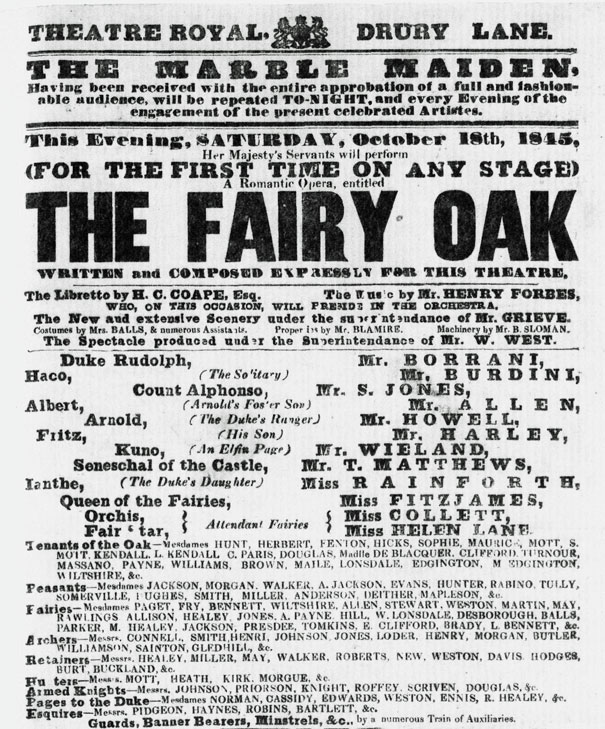
  The Fairy OakMusic by Henry ForbesLibretto by Henry Coe Coape
Theatre Royal, Drury Lane,
London
|
|
Duke Rudolph Haco (the Solitary) Count Alphonso Albert (Arnold's Foster Son) Arnold (The Duke's Ranger) Fritz (His Son) Kuno (An Elfin Page) Seneschal of the Castle Ianthe (The Duke's Daughter) Queen of the Fairies
Orchis
(Attendant Fairies) |
Conductor - Henry Forbes
History
To judge from the Illustrated London News (Oct 25, 1845), the opera was instigated by the librettist, Henry Coape, who then chose a composer, Henry Forbes. Coape as a member of the General Committee of the Drury Lane Theatre was clearly in a good position to ensure its staging and possibly also covered some or all of the expenses. Edward Fitzball [1] claimed that he had been brought in to improve the libretto and had cut out much dialogue and reduced the scenes from twenty five to three.
In subject the opera differed from the mainly historically based plots of recent operas and harked back to the magical ideas of Barnett's The Mountain Sylph (1835) and Weber's Der Freischütz (1821) and Oberon (1826). It was given three times as the main work of the evening and by October 24, 1845, the Monthly Times was pronouncing it a total failure. However, it or an act from it was given a further three times as a filler to Balfe's The Bohemian Girl (1843) or The Enchantress (1844). Not unexpectedly it was never revived and no numbers seem to have been included in any later concerts, although, at least, one song was published, " Oh brightly the day-star"[2].
[1] Edward Fitzball, Thirty Five Years of a Dramatic Author's Life. Vol. 2 (London: T.C. Newby, 1859), p.130
[2] Universal-Handbuch der Musikliteratur, Vol. 8 (Wien: Pazdírek, 1904) , 450
Plot
The plot was claimed to derive from an Hungarian folktale. Rudolph believes that he has had his brother's son, Albert, assassinated enabling him to usurp the title of Duke of Lowenstein. In fact Albert was spared and is living as the foster son of Arnold, the Duke's ranger. The Duke has entrusted his daughter, Ianthe, to the fairies, who live in a large oak near the castle, until she reaches the age of eighteen. This is to prevent her falling in love, as the Duke believes a prophecy that the object of such love would overthrow him. He plans to recover his daughter from the fairies and to marry her off to Count Alphonso. However, Albert has already met Ianthe and, although he thinks she is possibly a fairy, they have fallen in love. During the marriage procession for Ianthe and Alphonso, Albert realises that the woman he had fallen in love with was Ianthe and attempts to rescue her but is marched off to prison.
|
Haco, a retainer of the previous Duke, has lived as a hermit in the forest for many years. He is aware of Albert's parentage and now conspires with Arnold to rescue Albert and overthrow the Duke, having also asked the Emperor for help. The Duke and Alphonso come to Haco to know what the future holds but leave dissatisfied with his vague answers. Kuno, an elfin page, rescues Ianthe and Albert but the Duke finds them. He condemns Albert to death but fails to find someone willing to do it. He decides to do it himself but is thwarted by Haco, the Emperor's troops arrive and Albert is released and acclaimed Duke. The overthrown Duke gives his permission for Albert to marry Ianthe and everyone rejoices. |
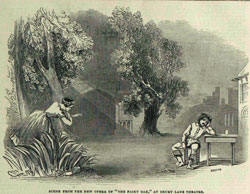
Illustrated London News (Oct, 25, 1845) |
Reception
The Era (Oct 19, 1845) was not impressed, "The music is not of a description to relieve the inherent dullness of the drama; it is without melody, color, or originality". The only exception was a trio for three female voices. The singing of Allen and Rainforth was mentioned as "a relief to the general monotony of the opera".
Bell's New Weekly Messenger (Oct 19, 1845) was more sympathetic writing that "The verdict was favourable, but the applause was we think rather meant as an encouragement to the composer than a reward for the merit displayed in his present performance". The libretto was judged "a poor affair" and the music "plaintive and in some parts pleasing" although "the instrumentation is, generally speaking, poor and feeble". The main singers were complimented.
Bell's Life in London (Oct 19, 1845), while a bit more positive about the libretto, thought the music "was not at all of a high order . It was laborious and not unlearned; but... it has scarcely a shred of melody to float it down the tide of public favour". It added that the piece was "mounted in the most costly manner, and,... there is no ground of reproach on the score of liberality".
The Weekly Chronicle (Oct 19, 1845) did not mince its words, "it was never our fate to sit out so perfectly vapid a performance. Not one flash of genius broke the dead level of mediocrity. Not one melody dwelt upon the mind or relieved the heaviness of common place" . However, the singers and Wieland and Harley were praised and it was noted that "the machinist has certainly done his work to perfection. The scene where the oak opens and shows its branches thronged with fairies [1], is one of the most beautiful things we have ever seen".
Henry Chorley (The Athenaeum, Oct. 25, 1845) thought that "nothing more meagre or absurd than the story of The Fairy Oak has been represented [on the stage] in our recollection" and that "the opera is not strong enough to last; nor has it a single captivating melody or commanding chorus". He did like the scene with the fairies and the tree and thought the singers had done very well given "music so characterless". He could not understand why an opera by a more established composer, of which there were several, had not been given.
Rather as with De Pinna's The Rose of the Alhambra (1836), Edward Fitzball [2] was possibly a little over generous in his memories claiming here that the opera ran for "many nights, the music being greatly encored, and generally approved".
The Times (Oct 20, 1845) [3] was a bit more sympathetic and talked of if being produced "with the external manifestations of a great success", although later he implied that a claque was very much at work with references to a lack of discrimination in their choice of encores and "reckless applause". As other critics had noted, Forbes did not make the most of the orchestra in trying to produce any dramatic effects but was largely content with a ballad opera in the early 19th century style, essentially a melodrama with songs to a simple accompaniment. The librettist's poetry for the songs was thought quite good but judged less successful in the construction of the drama.
[1] Edward Fitzball, Thirty Five Years of a Dramatic Author's Life. Vol. 2 (London: T.C. Newby, 1859), p.131 claimed that there were 80 girls dressed as fairies in the tree flitting about.
[2] Loc.Cit.
[3] Possibly James Davison
Comment
Bell's Life in London touches on the science ("not unlearned") v melody debate that was seen with both Barnett and Benedict's operas.
Scores and librettos
Although the Lord Chamberlain's Day Book (Add 53702) states that the opera was signed off on October 18, 1845 (the day of first performance), no manuscript seems to have been included in the main collection.
Printed editions of the libretto can be found at the National Art Library , Cornell University and Warwickshire Record Office. A transcript of the one held at Warwick can be found here.
Recordings
None are known
Books, Articles, Online
No dedicated articles or books on the opera are known
 |
 |
 |
  |
|
|