  |
 |

|
  The Brides of VeniceMusic by Julius BenedictLibretto by Julius Benedict and Alfred Bunn
Theatre Royal, Drury Lane, London
|

|
Doge of Venice Count Alberto
Giotti (Venetian noblemen) Count Orio Soranzo (the Pirate Chief) Naama (an Arab page) Leontio (Lieutenant of the Pirate band)
Geraltiero (other Pirates) Geraldo (a Pirate boy) Francesca (Heiress of the Morosini Family) |
Conductor - Jules Benedict
History
Given the comparative success of his opera, The Gipsy's Warning, as well as his growing stature as a conductor, it is not surprising that Benedict should seek to compose another opera. Sporadic press announcements (e.g. The News (Jan. 13, 1839), Planet (Nov 28, 1841)) occasionally heralded a new one but it was not until 1844, when Benedict was musical director at Drury Lane, that The Brides of Venice appeared. The Morning Post (Apr.23, 1844) claimed that the opera had been "put in rehearsal thirteen times and withdrawn from some untoward event". Even its appearance on April 22 seems to have been threatened by "the usual amount of those squabbles and petty contentions of rival singers" and the withdrawal three days before the premiere of George Stretton as Leontio [1].
The opera was moderately successful and was performed (or occasionally an act from it) 26 times until the end of the season on May 31, 1844. It was revived for a few performances at the start of the 1844-1845 season. Very unexpectedly, probably over 50 years after its previous performance, the Rose Hersee company performed the opera at Crystal Palace on August 25, 1877 and then a month later in Manchester [2]. The opera was planned to be given in Germany in 1845 and 1846 and a translation was made but it is not clear how many performances were given. Loewenberg's Annals of Opera lists one performance in Cassel on August 20, 1845.
As often with English opera, a few numbers continued to be sung long after the demise of the opera, the most notable example here being Jenny Lind's inclusion of "By the sad sea waves" in her American tour, 1850-1852. Benedict was her accompanist.
[1] The Atlas (April 27, 1844)
[2] Manchester Evening News (Sep 28, 1877). It was also scheduled for Liverpool in early October but did not not happen, the management deciding that the opera was not well enough known to bring in an audience, Liverpool Albion (Oct 6, 1877)
Plot
The text is based on a story from Venetian history and was instigated and begun by Benedict, Bunn being careful in the libretto's preface to point out which parts he had contributed. The Morning Post (Apr. 23, 1844) reckoned that others had been involved but had then denied their involvement.
The action begins in Count Soranzo's villa, where the Count, leader of a group of pirates, having escaped from the Turks has come back with the aim of winning the hand of the heiress, Francesca Morosini, in order to get his hands on her fortune. She is betrothed to Count Alberto and is not interested. Her answer comes in a letter brought by the Count's Arab servant, Naama, who had been in love with Soranzo and had followed him disguising herself and acting as his page [1]. Soranzo sends her back to ask Francesca for a brief interview before he leaves. While Naama is asking, Count Alberto returns from foreign campaigns trying to capture the pirates. Soranzo and Leontio also now enter but Francesca again repulses Soranzo, whom Alberto recognises. Francesca's wedding to Alberto is to be one of the annual festival of brides, a mass wedding. The wedding is underway when the pirates attack disarming Alberto and bearing off the brides, including Francesca, to a castle held by Soranzo.
|
Alberto has pursued them but his ship is wrecked and he is captured by the pirates. Naama comforts and advises first Francesca and then Alberto, whose page she once was. On her advice, Alberto tells the pirates that he wants to join them. Unknown to his followers, Sozanzo has Francesca put in a secret dungeon underneath the banquetting room (picture) in order to force her to marry him. His plan is to leave with her and leave his followers to their fate. Naama takes Alberto through a secret passage to see Francesca. The pirates gather for a banquet above the dungeon when Naama enters and tells Soranzo that Francesca still refuses him. Soranzo determines to go down into the dungeon to confront her but the pirates, seeing him disappear, think that he is going to check on the treasure, which they think he should share with them. |
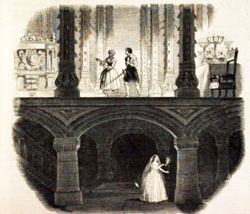
Illustrated London News (April 27, 1844) |
The Venetian fleet is approaching and Leontio and the other pirates, needing to find the treasure quickly, force Naama to show them the way Sorenzo has gone. The pirates confront Sozenzo while Alberto and Francesca escape. Venetian soldiers arrive and capture the pirates while the Doge, nobles etc who have come with them rejoice with Francesca, Alberto and Naama.
[1] At points, the text shows that Soranzo knows she is a woman and who she is but it is not clear then why she needs to disguise and act as his page.
Reception
Although The Illustrated London News (April 27, 1844) gave the impression of some confusion about the plot giving only the sketchiest of outlines, it was enthusiastic about the music. It thought the overture "full of new and charming thoughts", the opening chorus "very spirited" and singled out out the main soloists' contributions. However, the aspect that really caught its attention was the use of the dual stage, as shown in the illustration [1], which although not new had "never before...been so effectively carried out".
The Morning Chronicle (Apr. 23, 1844) thought that good use had been made of the opportunities for melodramatic spectacle and the Benedict made the most of opportunities for musical effects but "The dramatic action of the piece, however, moves somewhat heavily; and the slowness of itas march sometimes weakens the effect of the most admirable music." It devoted a long paragraph to Mary Shaw who "made the part [Naama] quite charming and deeply interesting", although it did note some "uncertainty of intonation to which of late she has been liable". The other three were bundled into a much shorter paragraph, with a line of praise each.
The Examiner (Apr. 27, 1844) saw two fundamental problems: Benedict's lack of melodic invention and the inadequacies of the libretto. "Never did composer afford clearer conviction of his technical skill, or less gratification at the poetic beauty of his work". The only exception was Mary Shaw's song "By the sad sea waves". It noted that Benedict "has had a most feeble and unmeaning libretto, to work upon", although this overlooked the fact that Benedict had instigated it and contributed part. Its lack of any dramatic interest and momentum was only saved by Mary Shaw who "by her interesting deportment as an Arab slave, by the earnestness of her action, and the judicious delivery of her recitative, is enabled to produce an effect which clothes the character with peculiar interest. However, Shaw's deteriorating voice, which it put down to overstraining, was "now too often evident". Of the other soloists, only Harrison was praised unreservedly. It concluded that the staging was "splendid and it is on that the attractive power of the opera will depend".
Other publications followed much the same line on Benedict's strengths and weaknesses. The Musical World (Apr. 24, 1844) praised the technical excellence but noted "a slight complaint as to want of melody", whose deficiency "will probably interfere with its permanency on the boards of the theatre". The Weekly Dispatch (Apr. 28, 1844) acknowledged "The great musical skill of Benedict" although noting that "his style of composition is, however, more to be enjoyed by the musician than by a general audience...with whom melody is held in greater estimation than difficult and elaborate harmony". It found something to compliment in all the singers. The Weekly Chronicle (Apr. 27, 1844) after extolling the excellence of the staging noted that in "scientific skill and power, Mr Benedict must be ranked as infinitely the superior [to Mr Balfe]; but Balfe has greater general aptitude to the public taste - more pliability of disposition, and a remarkable facility for turning out a popular ballad".
The Times (Apr. 23, 1844) saw greater blame to attach to the libretto. "It is a passionless subject. There is scarcely an opportunity for the composer to display the eloquence of music, or for the vocalist to display the eloquence of singing". The Atlas (Apr 27, 1844) saw things much the same but was more hopeful in that the "disadvantages of a radically defective drama [passionless and unsuggestive], and incomplete rehearsal" might well have spelled failure but once the drama was "curtailed in its most tedious portions, and the increased confidence of the performers unfolds so many new beauties in the music... it now bears every likelihood of creeping ... into substantial and enduring favour". Notwithstanding its growing success, it saw its faults as "a want of broad and strong outline ... a too great abundance of recitative ... and a scarcity of good concerted music"[2]. It put this lack down to the "utter meagreness of the libretto ... which it would be difficult to imagine one less adapted for musical display". Of the main soloists, Harrison got the most unqualified praise. Mary Shaw's otherwise excellent effort was judged to have been heavily undermined by her "habit of singing so deplorably flat".
Few commented on its revival in October 1844, when Elizabeth Rainforth replaced Shaw, despite her being a soprano rather than contralto. The Morning Post (Oct. 11, 1844) thought her singing was excellent "though lacking the dramatic power of Mrs Alfred Shaw". Overall it judged the opera "lacks impulse , imagination, and the divine spark of genius; wanting these, all its admitted merit will ever fail to render it work for the multitude". Unfortunately no review of reactions to its 1877 revival have been found.
[1] This staging is referred to in Joel H. Kaplan 's "Musical Iconography in The Illustrated London News: An Introduction", Fontes Artis Musicae, Vol. 29, No. 4 (Oktober-Dezember 1982), pp. 161-169. The Spectator (Apr. 27, 1844) thought it "an absolute triumph of carpentry, though little serviceable to poetical illusion".
[2] In fact others disagreed, e.g. the Sunday Times (Apr. 28, 1844) thought the concerted pieces much better than the solos and the Morning Chronicle (Apr. 23, 1844) thought all the choruses and concerted pieces excellent.
Comment
The Atlas referred to the "really good and worthy application of that 'helping' system, too often used to prop up worthless productions". Thus it implied that the efforts of the claque had helped keep the opera afloat long enough for a more genuine liking to develop. This begs the question as to how genuine the enthusiastic reception recorded by other papers was.
The opposition between music that relied on "science" , essentially seen as Germanic and that that relied on melody, seen as Italian, which surfaced in comments on Barnett's operas, rose again here with Benedict and was contrasted with the Italianate Balfe. To judge from The Examiner's comments some of Benedict's supporters got themselves into a degree of difficulty trying to maintain that the opera was "replete with melody, but free from 'vulgar tunes' ". Clearly though for both critics and public, it lacked melody as commonly understood.
Scores and librettos
The libretto manuscript submitted to the Lord Chamberlain is in the British Library at Add MS 42974, ff, 694-725b. It was received by the Examiner on April 12, 1844 and signed off on April 14, 1844. A printed libretto (London: W.S.Johnson, 1844) can be found online at Google books and the Goethe Universität, Frankfurt. The manuscript and printed libretto are almost identical. The printed libretto has more detailed stage directions.
The score of "By the sad sea waves" can be downloaded from Baylor University and from Hathi Trust. That for "At morn upon the beach I stood" from Hathi Trust. The British Library has a vocal score of the opera and of "Strew, strew joyously, villanella" , "There is not on earth" and "Tonight the deed I have" as well as the two previously mentioned.
The German version, Die Bräute von Venedig, is available at the Library of Congress. A physical copy of the vocal score is available at the Bayerische Staatsbibliothek
Recordings
A guitar only version of "By the sad sea waves" can be found at https://www.youtube.com/watch?v=Dq_c9F6iAR0 . Otherwise none are known
Books, Articles, Online
No dedicated articles, books or webpages on the opera are known
 |
 |
 |
  |
|
|