|
 
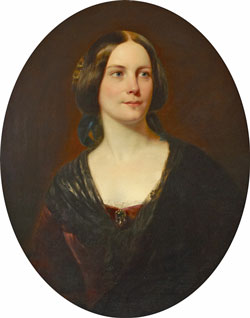
Shaw, Mrs Alfred - Mary Postans
1814-1876
|
Shaw was a very highly
regarded contralto even though she had a comparatively short
career. She studied at the Royal Academy of Music and then in
Italy. In 1838, Mendelssohn invited her to sing in Germany after
which, in 1839, she again went to Italy and La Scala, Milan,
where she performed in Verdi's first opera, Oberto. Up
to that point she had concentrated on concerts and oratorio [1]
and her stage career lasted only about five years. Much
of this was spent in Italy or singing
Italian opera in English back in England. The only English
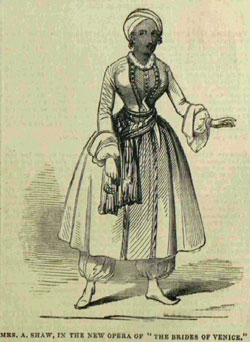
opera she performed in was Benedict's The Brides of Venice
at Drury Lane that premiered on April 22, 1844 [2]. One of its songs,
"By the sad sea waves", became widely associated with her. She
did not sing in its October 1844 revival and had reverted to
concerts.
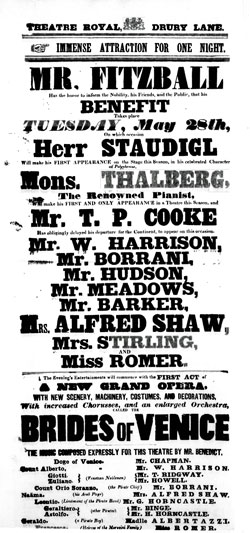
Her prominence at that time can be seen in the
playbill below for Edward Fitzball's benefit on May 28, 1844,
that included the first act of The Brides of Venice.
Her name has clear precedence over the other singers including
two of the best known English singers of the day, Emma
Romer and William Harrison.
In 1843, she
had begun to suffer vocal problems, which some have seen as
stemming from the death of her infant son and
|
National Trust Images |
|
Illustrated London News (Apr. 27, 1844)
|
|
her husband being declared
insane. By the last
half of 1846,
she was drastically
curtailing her appearances
supposedly due
to her increasing number of
private engagements (Observer,
June 7, 1846) but more
likely
because her vocal problems
had become too severe. By
March, 1847, she was said to
have retired (Pictorial Times,
Mar 27, 1847). However, she did make occasional appearances at
low profile concerts until at least 1850. She also taught.
Mrs. Cornwall
(Margaret) Baron Wilson, Our Actresses. Volume 2 (London:
Smith, Elder & Co., 1844), pp. 235-238, has, on her own
admission, little to say about her career but characterises
her voice as "not of very great compass, but is most
flexible, melodious, and rich in tone; and she has acquired
the highest degree of musical expression". She extolls her
"amiable and honourable character" and her "steady
perseverance in the path of rectitude" in the face of "many
afflicting domestic circumstances". Finally, she praises her
for sticking with her English name rather than "appending a
Signora or Madame".
There are several more
modern accounts.
Kurt Gänzl, Victorian Vocalists, (Abingdon, UK:
Routledge, 2017), pp. 615-621, has a chapter on her and there is a web
page at
https://momh.org.uk/exhibitions/mrs-alfred-shaw-1814-1876/.
|
|
|
Matildie Wium, "Reporting on
the Tribulations of Mary
Shaw", in Christine Fuhrmann
and Alison Mero, Opera
and British Print Culture in
the Long Nineteenth Century.
(Clemson: Clemson University
Press, 2023), pp. 87-103,
has a short biography as
well as discussing how the
press handled her career and
how it fitted into wider
cultural concerns and ideas
of the time.
|
|
|