
 |
 |

|

 The BondmanMusic by Michael William BalfeLibretto by Alfred Bunn
Theatre Royal, Drury Lane, London
|
| The Marquis de Vernon | - Willoughby Weiss |
| Count Floreville (his Son) | - John Rafter |
| Ardenford (The Bondman) | - William Harrison |
| The Viscount Morliere (His Friend) | - Henry Horncastle |
| The Baron de Laville (His Friend) | - Mr Galli |
| Mal-a-pro-pos (The Valet of Ardenford) | - Mr Harley |
| Jaloux (An Innkeeper) | - Mr S. Jones |
| Michel (Servant to the Marquis) | - Mr Connell |
| Attrappe (A Police Officer) | - Mr Howell |
| First Huntsman | - Mr Hodges |
| Keeper | - John Birt |
| Notary | - Mr Sanger |
| Madame Julia Corinne (A Creole Widow) | - Emma Romer |
| Frivole (Her Lady's Maid) | - Mrs Hughes |
| Grisette (Wife of Jaloux) | - Rebecca Isaacs |
Conductor - Michael William Balfe / Francesco Schira [1]
[1] Balfe only conducted the opening night and then left things to Schira, the musical director (Barrett, p.189), see history.
History
Alfred Bunn had promised a new opera by Balfe at the start of the 1846-1847 season [1] and Balfe came back from Vienna to supervise rehearsals for this new opera, The Bondman. Bunn provided the libretto based on a play, Le Chevalier de Saint-Georges, by Mélesville (Anne-Honoré-Joseph Duveyrier) and Roger de Beauvoir that was staged in Paris in February, 1840 and the St. James, London, in January, 1845 [2]. It was also given in an English translation at the Princess's in May 1845.
The Spectator (Dec.11, 1846) claimed that The Bondman premiere had to be quickly brought forward because the audiences for the previous offerings, The Maid of Artois and Loretta, had fallen away faster than Bunn had anticipated. Balfe conducted the first performance but then abruptly left it to Schira, the Musical Director. The Musical World (Dec. 19, 1846) referred to a fracas on the Friday night that caused Schira to be brought in at a moment's notice to conduct on the Saturday. The fracas was a quarrel between Bunn and Balfe with Balfe complaining about the poor quality of the staging, possibly the result of its hasty assembly. Supposedly, Frederick Chappel, Balfe's music publisher, had to beg Bunn to let the run continue, although one finds it difficult to believe that Bunn would not have run what promised to be a successful opera [3]. Given how mutually beneficial the relationship had been, the quarrel was soon patched up with Balfe sending a note of apology [4].
Towards the end of December, Harrison, in the title role, had to cry off for several days with a cold and, early in January, Donald King took over his part for a short time, Harrison still not being fully fit. Despite these setbacks, the opera continued but performances started to become more irregular in February. The Morning Post (Jan. 11, 1847) carried an unusual line in its advertisement for the coming evening. It claimed that over 26000 people had seen it up to that point (probably 19 performances), an average of under 1500 a performance in a theatre that, at that time, could have taken around 3000 [5]. Although the Sun (Mar.8, 1847) claimed that it was still drawing when it was replaced, this looks unlikely. It was supposed to have been replaced by Wallace's Matilda of Hungary on February 15, 1847, but that had to be postponed a week because Emma Romer was ill [6] and The Bondman was given instead. It was still given occasionally after that, Bunn choosing it for his benefit on March 15. Its final performance that season was on April 27, 1847. In all it reached nearly 50 performances during the season, which the Musical World (May 8, 1847) rated a "successful run". Bunn staged it again when he took over the Surrey for a short season in September 1847 and when he took over Covent Garden for a short season in the autumn of 1848 [7], but it was hardly on account of its popularity [8].
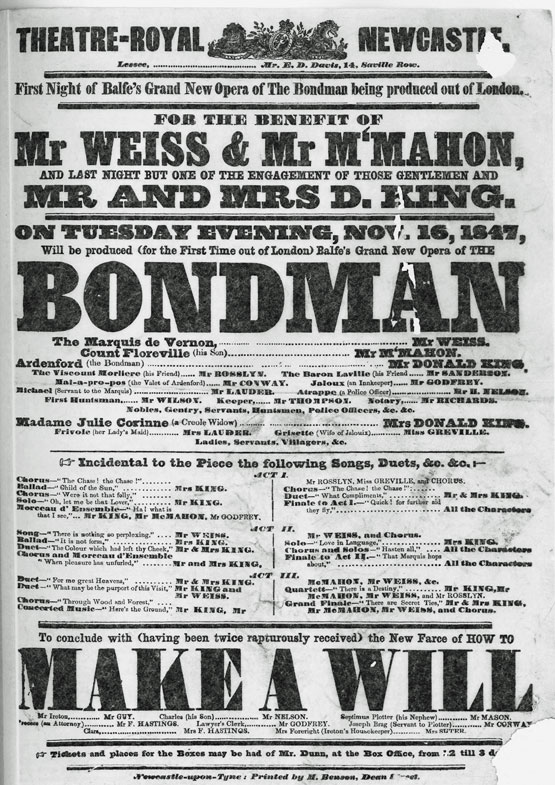
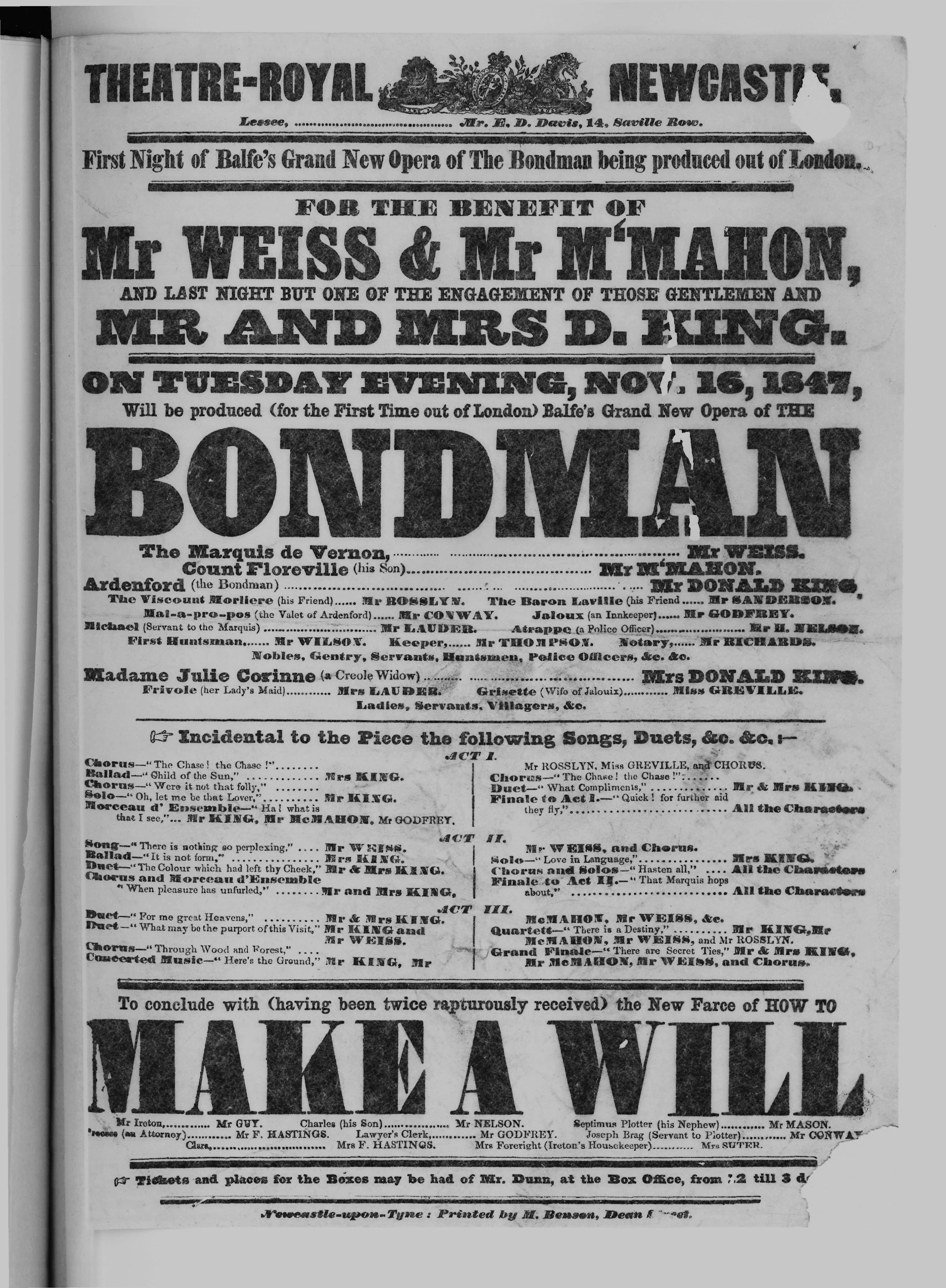
Donald King was in several provincial productions, with his wife, Anne, in Newcastle in 1847, in Bath in 1849 and in Manchester in 1850 and with Elizabeth Poole in Dublin in 1848. Early in 1849 a company, which included Harrison reprising the title role, toured Liverpool, Dublin and possibly elsewhere. No further UK performances are known. Carl Rosa prepared parts and is said to have used them [9], but no press notice of a performance has been found. A few numbers and, particularly, the overture made occasional appearances for a time.
The opera was translated into German by J.C. Grunbaum and performed as Der Mulatte in Berlin on January 25, 1850 (Loewenberg). The Sun (Apr. 26, 1847) reported that Balfe had been paid 4000f (florin?) and £80 for Austrian performance rights, "being the first instance on record of an English (sic) composer having secured a musical copyright on the continent". The Illustrated London News (Oct. 30, 1847) claimed that it was in rehearsal in Vienna but no report of performances have been found either there nor in any other countries; clearly, given its plot, it would probably not have gone down well in the U.S. at that time.
[1] Morning Advertiser (Dec. 12, 1846). It also mentioned operas by Lavenu and Wallace
[2] Tyldesley (p.133) gives a picture of some uncertainty over the libretto's origins but most of the press gave the Mélesville/Beauvoir origin and a comparison shows the similarity. Gabriel Banat, "Le Chevalier de Saint-Georges, Man of Music and Gentleman-at-Arms: The Life and Times of an Eighteenth-Century Prodigy", Black Music Research Journal, Vol 10, no. 2 (Autumn 1990), p. 179, says that it was staged in London in 1840 but no newspaper reports have been found. The play was based on a novel by de Beauvoir.
[3] The Satirist (Dec. 27, 1846) provided a description of the quarrel that is roughly in line with that stated in the Sunday Times (Dec. 20, 1846), if, as might be expected, a little more lurid. It claimed that Balfe, on returning to the green room to receive congratulations from his friends and acquaintances, complained rather loudly to Bunn that
the opera owed him nothing for its success from the paltry insignificant manner it was dressed and put on the stage. Alfred waxed wroth, and told him at such a period it was not altogether the thing to growl so loudly before so many strangers. We might say the composer let off a volley of abuse à la fortissimo, which ended by his being requested to leave the theatre instanter (sic) by Bunn...Strict orders were given to the door-keeper not to admit Mr Balfe.
[4] The Sunday Times (Dec. 20, 1846)
[5] It is difficult to be sure of the number of performances because the opera was advertised as happening but then cancelled when Harrison got ill. Perhaps the theatre thought that people would be impressed by the total audience number.
[6] Morning Post (Feb 15, 1847).
[7] Harold Rosenthal, Two Centuries of Opera at Covent Garden. (London: Putnam, 1958), p. 680, says that there were two performances. These were on October 11 and 12, 1848 (Morning Chronicle, Oct . 12, 1848).
[8] The Daily News (Oct. 18, 1848) complained that "Bunn is continuing to give these worn out operas night after night, in spite of thin houses and cold audiences, unquestionably because he is not in a state of preparation to give anything else".
[9] Tyldesley (p. 138)
Plot
Jaloux and his wife Grisette keep the post house near the Chateau of Raincy and are entertaining some huntsmen. The Marquis arrives with a rich widow, Madame Corinne, who has agreed, rather hastily, to marry his son Count Floreville, a spendthrift and wastrel unbeknown to her. She and the Marquis had known each other out in St Domingo. She remembers her chlldhood friend and slave from there, Camille, who was of mixed race. Coriine's mother had hit him for taking liberties with Corinne and he had fled never to be seen since. Someone she saw in Paris reminded her of him. The Count enters complaining of Ardenford (the erstwhile Camille) who has won a horse he wanted. Corinne goes to change for the hunt while Floreville talks of his latest fancy to his father. Ardenford enters and quarrels with Jaloux. Corinne goes down and makes Ardenford's acquaintance, who pretends that he is from Peru. He volunteers to accompany her but is arrested on the order of the Marquis, who does not want him interfering in Corinne's marriage to Floreville. He manages to trick Floreville into taking his place in the carriage taking him to the Bastille.
The next act takes place in Corinne's salon. The Marquis is trying to hurry along Corinne's marriage to his son while also claiming that Ardenford is to be married. Corinne recognises Ardenford's servant, Mal-a-propos, who was in charge of the slaves on her mother's estate. She quizzes him about his master's situation and bribes him to obtain the portrait Ardenford looks at every night. Ardenford enters and disabuses Corinne of the idea that he is to be married. She establishes that he was indeed Camille and lets him know that he has been freed. The Marquis enters and is dismayed to find Ardenford there. The Count returns, Corinne goes off to dance with Ardenford and the Count questions Mal-a-propos who lets slip |
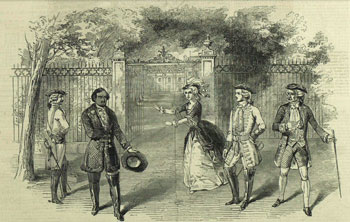
The duel Illustrated London News (Dec. 19, 1846) |
Ardenford's origins. Corinne cannot go through with the marriage preferring Ardenford but the Count denounces him as a slave. Ardenford produces his document of emancipation and demands satisfaction.
Corinne tries to persuade Ardenford not to fight but he refuses as he thinks she is trying to protect Floreville. the Count. She leaves saying that she will not return. The Marquis then arrives and admits to being Ardenford's father but to no avail. The duel is about to begin and the Marquis turns up in the place of Floreville's second. Ardenford at last refuses to fight his brother but is very bitter as it will seem like he was afraid. Corinne having heard the Marquis' confession makes it public and so explains Ardenford's refusal. The opera finishes with her declaring she wants to Ardenford..
Reception
Reviews were generally favourable and made almost no comments on the racial elements of the plot; The Musical World (Dec. 19, 1846) being a small exception with its observation that Harrison's character "though at least a mulatto, according to the drama, comes upon the stage with a face only shadowed by the slightest tint of brown", in marked contrast to the illustration above. The Times (May 21, 1845) reviewing an English stage version of the same play a year earlier noted that the story “is a wild one and not altogether agreeable”, probably because of the theme of illegitimacy in an increasingly straitlaced society rather than any racial connotations.
The Morning Chronicle (Dec. 12, 1846) wrote that "It is one of the best poems the author (Bunn) has yet written, and Balfe has been evidently inspired with the exciting materials". While "many fears were entertained that Mr Harrison would be unequal to the delineation of this most difficult character" but "to the astonishment of the audience" he succeeded and "at times quite electrified the house". While it praised Balfe as a composer, it considered that he
as an orchestral director is out of his depth. There is unquestionably as wide a gap between him and Schira in that capacity, as between himself and Costa. In conducting his own opera, he was in his place, but what an awful scramble he made of the overture.
Others put the poor playing down to the haste with which the opera had been mounted. Like many critics, Chronicle thought that the opera was let down by the third act being too long and feeble. Interestingly, the original French play had been criticised [1] for lacking "the same dramatic skill" as the first two acts, so that weakness had not been rectified by Bunn.
As elsewhere, James Davison (Musical World, Dec.19, 1846) gave the impression that he was sometimes more of a publicity officer than a critic. "Crowds are pouring into Drury Lane nightly to hear Balfe's new opera. The music of The Bondman decidedly improves on repetition. Balfe has raised his reputation immensely among musicians". Such exaggeration and partisanship received a snippy response from the Fine Arts Journal (Dec. 19, 1846), see below. The distinction between "scientific" music and melodic music has been raised in connection with several operas. Davison thought The Bondman bridged that gap and "conciliates the severe judgment of the few, no less than the easy approval of the many". In The Times (Dec.12, 1846) he put this down to Balfe's recent visit to Vienna and exposure to German ideas. However, he was not completely uncritical. Although he thought Bunn had done a reasonable job in his adaptation, the libretto was too long and wordy. Some of the concerted music was also seen as too long and, as with others, he thought that "The third act is greatly inferior to the other two". This last he put down to Balfe having to complete it in haste.
The Patrician (1847), pp. 71-73, thought that "The Bondman is as faultless a production as perhaps any lyrical drama ever produced". "The most striking improvement here visible is the total absence of those loud orchestral effects which were so frequent in his earlier works". Like some other publications it saw the influence of Germany on Balfe in his music having a more coherent and unified finish. "The performers engaged showed without a single exception, by the ability of their singing, that they were determined as far as lay in their power the honours of the composer should not fade".
The Era (Dec. 15, 1846) wrote that the opera "will most assuredly take its stand at the head of Balfe's previous works". It thought that Mr Bunn had adapted the libretto "with great talent". It did not seem to mind the third act judging that "The finale is, as it should be, the crowning effort of the opera". The writer had "never seen an opera more ably rendered. Mr Harrison never sang better nor assuredly acted so well". "Mr Rafter played with much spirit, and materially assisted the success". "Miss Romer acted and sang with great force and effect". "We augur for The Bondman a lengthened popularity".
Henry Chorley in the Athenaeum (Dec. 19, 1846) wrote that it "has shabbily been put on the stage", thus supporting Balfe's complaint. He put it down to Bunn running out of money. He thought The Bondman contained some of Balfe's best music and showed "superior elegance of ideas, more constructive power, and is evener as an entire work, than most, if not all of its predecessors". The inadequacy of the orchestra, particularly the lack of strings, precluded judging the instrumentation. However, he thought the opera "fairly sung and acted" singling out
That Miss Romer likes her part is obvious. She is gentler and more lady-like than we recollect to have seen her and looks her best in her coquettish French costumes; while her superb voice is in good order, and tells abundantly - not extravagantly - in all the passages of energy and pathos".
The Spectator (Dec. 12, 1846) blamed Bunn's hasty mounting of the opera for "the roughness of the orchestra and the confused singing in the choruses". While the original play was lively enough, the adaptation had left it "a very heavy affair". It considered it Balfe's best opera since The Siege of Rochelle. "In this opera...he seems to have taken more than usual pains in the elaboration of several of his concerted pieces; but in aiming at German solidity, he has sacrificed his vivacity, and produced only heaviness". "Though the clacquers were evidently in force, yet the general applause of the audience soon rendered their labours unnecessary".
The Fine Arts Journal (Dec. 19, 1846) was less convinced about the opera than most critics and was scathing about the way some exaggerated the opera's worth (see below). Despite its rather negative opinion that "all in all, [the opera] must be considered in some degree a failure", it found several numbers that it liked, although not in the third act. While "Miss Romer was never in much favour with us, yet she acquitted herself well in some parts". As many other critics, they thought that "Harrison sung and performed better than we ever heard him". On the staging, it also noted that "The opera has not been got up at any great expense". It concluded that it did not think that "it will even run a sufficient number of nights to satisfy the manager's wishes".
[1] Morning Post (Feb. 12, 1845)
Comment
Three of Balfe's operas include black characters: The Maid of Artois (1836), Diadesté (1838) and The Bondman (1846). Each of them showed a quite different picture of attitudes to black characters. Michael William Balfe, an unwitting cultural bellwether examines these differences in more detail.
First night critical exaggeration
The variability of the quality of music criticism and the sometime lack of professional balance is a common thread in looking at the reception of English opera. For some reason, The Bondman reviews particularly incensed The Fine Arts Journal (Dec. 19, 1846) which ridiculed the overblown, inaccurate, language and irrational reasoning of many reviews.
It is therefore clear that the reception of a first night's representation has nothing whatever to do with the real merits of a work. Nor are the reports circulated through the medium of the daily papers at all calculated to assist us in arriving at a true estimate. Lo! another triumph has been achieved, say these trumpeters of fame. The composer has surpassed his former self. All his previous operas... are thrown completely in the shade by this splendid production...
Giving Mr Balfe every credit for his operas, can anything be more absurd than thus to bespatter him with what the public will find out, in a little time, to be anything but fact...Bunn has now been discovered to be a poet.. he has also exceeded his former self.
But, seriously speaking, the whole thing is supremely ridiculous, and, so far from elevating, only tends to degrade every one mixed up in such transactions. Mr Balfe is yet young, and may profit by judicious criticism. Mr Bunn is, perhaps, incorrigible.
The Journal clearly had J.W. Davison at The Times (Dec. 12, 1846) in its sights with his assertions such as:
A visit to Germany was not likely to be unproductive to a mind necessarily so alive to musical expressions as Mr Balfe's; and the reception of his operas at Vienna, seems to have inspired him with notions of art, to which hitherto he had been almost a stranger [1]
The Journal's response was that
If Mr Balfe had gone to hear the works of others... we might, perhaps, have expected improvements; but we certainly do not understand, how, hearing his own operas at Vienna, could have had such an affect (sic), any more than hearing them in London.
It concluded what "is the advantage of claquering on first nights? Nothing is gained by attempting to force a thing down the public appetite" [2]
[1]The Morning Chronicle (Dec. 12, 1846) included many of the same sentiments about Balfe's Vienna visit, "To his natural Irish melodious inspiration, grafted on Italian passion, he has superadded German science", while others noticed a change in his compositional practice even if they did not put it down to his visit to Vienna. The Journal did not quote Davison's following sentence "Paris did little more for the English (sic) composer than confirm him in his dangerous habit of facility". This whole paragraph reinforced the idea of Germany as the true musical leader as opposed to the lightweight France (and Italy).
[2] Coincidentally or otherwise, the Theatrical Times (Dec.15, 1846) carried an article "A few words upon clacquerism".
Scores and librettos
The libretto manuscript is in the British Library - Add MS 42998 ff 121-192b. The printed libretto (London: W.S.Johnson, 1846?) is available online at Goethe Universität, Frankfurt , Hathi Trust and LoC. The printed libretto follows the manuscript fairly closely but with a few additional vocal items, the most ambitious being a Grand Largo towards the end of Act 2 between Corinne, Ardenford and the Marquis.
The autograph full score and the vocal scores both for the opera and for its German version are in the British Library. There are also vocal scores for "Through wood & through forest", "Child of the Sun", "There is nothing so perplexing" and "They say there is some distant land". There is a vocal score in Liverpool City Library. The Carl Rosa archives has two sets of orchestral parts [1].
[1] Tyldesley (p.133)
Recordings
No recordings of any numbers are known
Books, Articles, Online
William Tyldesley, Michael William Balfe: his life and his English operas, (Aldershot, UK: Ashgate Publishing, 2003), pp. 133-138, goes into the history and structure of the opera. There are also some references in the books on Balfe by Biddlecombe, Walsh, Kenney (p. 215) and Barrett (pp. 188-192) (see book list).
Gabriel Banat, "Le Chevalier de Saint-Georges, Man of Music and Gentleman-at-Arms: The Life and Times of an Eighteenth-Century Prodigy", Black Music Research Journal, Vol 10, no. 2 (Autumn 1990) , pp. 177-212, describes Saint-Georges life. Banat also wrote a book on him, Le Chevalier de Saint-Georges: Virtuoso of the Sword and the Bow. (Hilldale, New York: Pendragon Press, 2006).
 |
 |
 |

 |
|
|