  |
 |

|
  The
Sexton of Cologne or
|
|
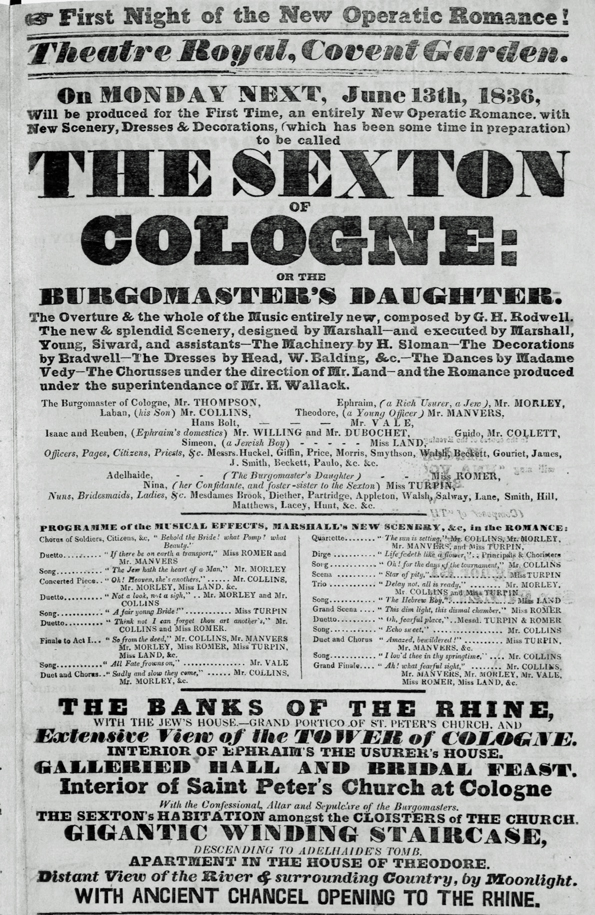
Laban Ephraim Theodore Hans Bolt The Burgomaster
Adelaide Nina Simeon |
- Mr Vale
|
History
This was the second English opera staged by Covent Garden in 1836, presumably hoping to benefit from the recent interest in English opera following Arnold's English Opera House initiative, which had foundered by this time. It may also have been the result of lobbying by Rodwell, the work's composer, who was busy trying to interest people in building a new opera house specifically for English opera, see here. The opera ran for eight evenings until the end of the 1836 season. It was revived for about the same number of performances in the first half of April 1837 but seemingly as a melodrama with much of the music removed [1].
The story that formed the basis of the opera seemed to have had its origins in the 16th century and in various countries according to the Tenbury Wells Advertiser (December 14, 1875, p.5). It first seemed to have surfaced in the 19th century press in the Exeter and Plymouth Gazette (April 12, 1828, p.4), and continued to appear at intervals for many years [2]. It told of the Burgomaster of Cologne's wife being struck down by illness and who, being presumed dead, was interred in the family vaults. The Sexton being at his wits' end for money decides to go and steal the rings that she had been interred with. However, when he starts to do this, the woman grasps his hand. Terrified he breaks free and goes to the Burgomaster to make a clean breast of things. The Burgomaster then gets the Sexton to accompany him to the vault where he finds his wife alive.
The Sexton of Cologne also turned up in an 1834 comic drama called The Dead Guest or the Sexton's Prophecy, but the plot is completely different.
Plot
The librettist Fitzball took the original story and added some touches from Shakespeare's The Merchant of Venice and Romeo and Juliet. In the original, the Jew, Isaac, only briefly appears to refuse to lend the Sexton any more money. Here the Jews, Ephraim and his son, Laban, are portrayed as the main criminals. Previous to the start of the action, Laban has saved the Burgomaster's daughter, Adelaide, from drowning. However, his wish to marry Adelaide is rejected because he is a Jew. The opera opens with Adelaide's marriage to a soldier, Theodore, to Laban's grief and distress. When Laban threatens to kill himself, his father tells him of a ring in his possession that will render the wearer to seem as if dead. Laban gives the ring as a nuptial gift to Adelaide who duly appears to die and is interred in the Burgomaster's family vault. Laban then plans to abduct Adelaide and take her far away and then restore her to life again by removing the ring.
In the meantime, the Sexton, Hans, having been refused any more money by Ephraim and with a sick wife and starving children, decides to steal Adelaide's jewelry that she has been buried with and gets there before Laban. When he removes the ring, Adelaide revives and Hans runs off and hides. Before she can escape, Ephraim and Laban arrive and start to force Adelaide onto a nearby boat. However, Theodore, having been alerted by Adelaide's friend, Nina, then turns up and they try to kill him only to be thwarted by Hans. In the resulting melee, Adelaide goes and stands on a ruined platform and threatens to jump into the river. Laban goes to capture her but the platform gives way and he falls. At the finish, the dying Laban begs for forgiveness from Adelaide, now reunited with Theodore, and Ephraim and Laban then sail away.
Reception
The Morning Post (June 14, 1836) wrote that it "abounds in the absurdities characteristic of [Fitzball's] peculiar style ... yet the plot possesses considerable interest, fixes the attention, and creates an anxiety for the denouement". It noted some pretty melodies but was otherwise lukewarm about Rodwell's music although it implied that it was difficult to make a more precise criticism because of failings in the orchestra. Emma Romer's singing and acting, taking their cue from Malibran's example, were warmly complimented but otherwise Covent Garden was not felt to have the vocal resources to put on "an opera of any pretensions".
The Times (June 15, 1836) was reasonably supportive and recorded that "The audience seemed perfectly happy with the piece". The Observer (June 19, 1836) confined itself mainly to the plot but did comment that Rodwell's music "was very abundant and very ambitious" and "contained, as usual, some agreeable melody" while noting its "many reminiscences of Italian music". The Lady's Magazine (July 1826) also noted the Italian reminiscences but thought that "the scenery and appliances were all very imposing, and it went off with great success".
However Bell's New Weekly Messenger (June 19, 1836) was altogether more scathing. "Rodwell's music, like Mr Balfe's, is, generally speaking, a mere tissue of reminiscences". Fitzball's libretto only shone in comparison with those of Alfred Bunn and "Miss Romer was the sole person whose acting and singing were even tolerable" even though "she has no adequate qualities... to enable her ever to become a first rate artist".
Charles Rice commented on a revival on April 8, 1837 that when
it was, when first produced, a tedious affair, but its representation was tolerated because it contain'd some pretty music; how then can the lessee buoy himself up with the idea that now, stripped as it is of its only attracting powers, the piece will pay for its revival?
Scores and libretto
The manuscript of the libretto is held in the British Library, Add MS 42938, ff. 136-158. The librettist, Edward Fitzball, wrote the covering letter to the Examiner of Plays, George Colman, on June 6, 1836. This was followed up by a further letter signed by a copyist, George Wilson, on June 9 with an additional scene for Nina. It is unusual that permission was asked for the extra song when often changes seemed to have been made post sign off by the Examiner without any further action. Perhaps, as he was a copyist, he felt he needed to make sure he obeyed the guidelines. Neither manuscript has a sign off date.
No printed libretto has been found but the vocal items were published by D’Almaine and Co. and printed by Joseph Mallett in 1836 and can be found at Google books.
A transcription of the libretto from these sources can be found here. There are a few not particularly important differences between the manuscript libretto and the printed songs.
Recordings
No recordings of either the opera or particular numbers are known.
Books, Articles, Online
No books or articles on the opera are known.
[1] Charles Rice, The London Theatre in the Eighteen-Thirties (London: Society for Theatre Research, 1850), p. 38. Rice was an attendant at the British Museum and an avid theatre goer who wrote up a journal about his visits.
[2] It appeared in a "penny" version written by Thomas Peckett Prest - Price One Penny: A Database of Cheap Literature, 1837-1860. Available at http://priceonepenny.info [Accessed January 10, 2018]
 |
 |
 |
  |
|
|