  |
 |

|
  Satanella
|
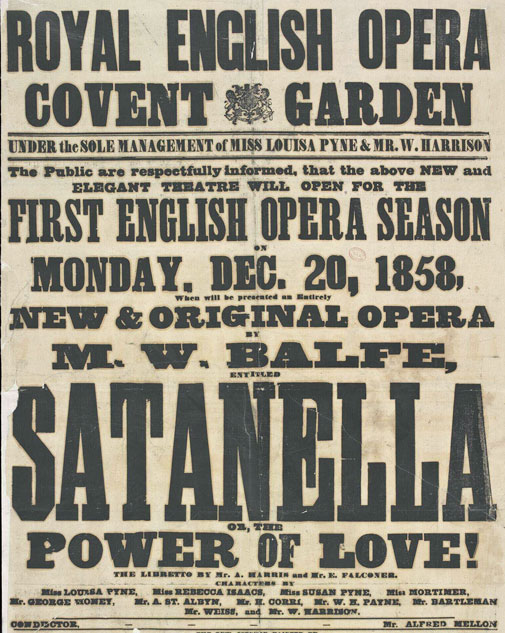
|
Count Rupert Hortensius Karl Bracachio The Vizier First Pirate Nobles Arimanes
Lelia [1] Stella Bertha Lady Satanella |
|
Conductor - Alfred Mellon
[1] Many writers called her Leila rather than Lelia
History
The success of The Rose of Castille no doubt encouraged Balfe, Harris and Falconer to create an opera for the following year. Once again they went back to French sources, to the ballet Le Diable amoureux staged in September 1840. This in turn was based on Jacques Cavotte's 1772 novel, Le Diable amoureux. The ballet's
|
libretto was created by Jules-Henri Vernoy de Saint-Georges and the choreography by Joseph Mazilier using music by Napoléon Henri Reber and François Benoist [1]. Despite the Morning Post's (Sep. 30, 1840) opinion of this "profane production" that "There is no fear of this ballet, in its present form, being done on the British stage", it was produced, without any major changes, as Le Diable amoureux at Her Majesty's Theatre on March 11, 1841 [2]. It was then revived in November, 1843, with its original lead dancer, Pauline Leroux, at Drury Lane, when it was the afterpiece at the premiere of Balfe's The Bohemian Girl (right). Thus Balfe would have been familiar with the plot and so may well have suggested it for the opera. There was also a ballet titled Satanella created by Filippo Taglioni and staged in Milan in June 1842. Some writers have claimed it as the source of Balfe's opera but despite the name, the plot was different [3]. The libretto gives no indication as to where the main |
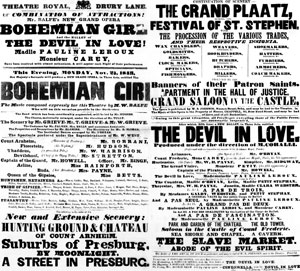 British Library Playbills |
action takes place. The Daily Telegraph (Dec. 20, 1858) claimed it was set in Croatia and that Augustus Harris was the stage manager, rather than Edward Stirling. The opera took around four and a half hours and ended "close to midnight" [4] but by the third performance, it had had an hour removed [5]. Notwithstanding this, it was a success with 57 performances in its first year, 8 in 1869-1860, 4 in 1860-1861 and 10 in 1862-1863 as well as on their provincial tours [6]. As early as March 1861, Eliott Galer's London Grand Opera Company staged it in Leicester "with a special permission" from Payne and Harrison and in July 1861 an offshoot of Galer's company, Edmund Rosenthal's London Royal English Opera Company, staged it in Cambridge and elsewhere. Other companies followed. The Carl Rosa company performed it occasionally including finally on a 1900-1901 tour. The J.W.Turner, Moody Manners and F.S. Gilbert companies continued after that and the Allington Charsley company in June, 1919. Opera Integra staged it in 1977 in London.
In the US, the Richings Company put on an "entirely new, romantic, legendary, operatic spectacle" called Satanella or the Bower of Love that used some of Balfe's music [7]. The Parepa-Rosa company gave the first US premiere proper in October 9, 1871 [8]. Oddly enough, Australia also saw, at least, some of it produced as an "extravaganza" based on Satanella called Satanus and the Power of Beauty in March, 1861. The opera's premiere was by Lyster's company on April 28, 1862, in Melbourne [9]. The Allen/May company gave the New Zealand premiere in Dunedin on March 26, 1874. In 2024, its German premiere was given at the Eduard von Winterstein Theater, Annaberg-Buchholz, Germany (see below).
[1] The scenario, history and other details can be found at https://petipasociety.com/le-diable-amoureux-or-satanella/ and in Simon Morrison, "Still in Search of Satanella", 19th-Century Music, Vol. 46, No. 1 (Summer, 2022), pp. 3-38
[2] Morning Post (Mar. 12, 1841) gave an outline of the plot. It did not refer to its previous opinion of the ballet nor express any opposition.
[3] Selma Jeanne Cohen, "In Search of Satanella: An Adventure Prompted by 'The Children of Theatre Street' ", Dance Research Journal, Vol. 11, No. 1/2 (1978 - 1979), pp. 25-30, discusses the differences. In 1850, their son, Paul Taglioni, created a ballet that was more closely based on the St. Georges/Mazilier ballet.
[4] Morning Chronicle (Dec. 21, 1858). According to the Daily Telegraph (Dec. 21, 1858) the performance was meant to start at 7 pm but "the unusual concourse of equipages" lining up to let off its occupants meant that it was nearly 7.30pm the curtain rose.
[5] The Times (Dec. 23, 1858). William Tyldesley, Michael William Balfe: his life and his English operas, (Aldershot, UK: Ashgate Publishing, 2003), p.190, implies that this was the result of removing a scene (Act 3, Scene 2, see below) but it must have been the result of both that and excisions elsewhere.
[6] Harold Rosenthal, Two Centuries of Opera at Covent Garden. (London: Putnam, 1958), pp. 686-691.
[7] Buffalo Post, (Sep. 25, 1862) advertisement. The New York Post (Mar. 2, 1863) review spoke of it "by no means given as Balfe wrote it, yet it retains enough of the original music to give a high opinion of its merits".
[8] New York Herald (Oct. 7, 1871) advertised it as "first time in America as an opera".
[9] The Age (Apr. 28, 1862)
Plot
Count Rupert, a wealthy but impulsive nobleman, is engaged to the grasping and ambitious Princess Stella,
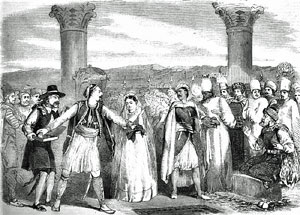 Illustrated Times (Jan. 1, 1859) |
while his foster-sister Lelia secretly loves him. Stella misreads Rupert’s affectionate kindness toward Lelia as betrayal. After a quarrel, Rupert gambles away his fortune, lands, and position and Stella abandons him. In his last remaining property, the haunted Demon’s Tower, Rupert finds some ancient books in which he finds a formula to summon Arimanes, ruler of the demons and duly does so. Arimanes brings his servant, Satanella, disguised as a handsome page, to entrap Rupert and deliver up his soul. Satanella restores Rupert’s wealth. She has fallen deeply in love with him, even though her task is to destroy him. Rupert’s restored fortunes cause Stella to want to return but she learns that Rupert intends to marry Lelia. She arranges for pirates led by Bracaccio to abduct Lelia. Satanella retaliates by having Stella abducted as well. |
A veiled Satanella attempts to take Lelia’s place in the marriage ceremony to Rupert but is struck by a thunderbolt. Rupert discovering Lelia’s abduction pursues the pirates. In a Tunis slave market (illustration above), he is forced to sign away his soul to Satanella in exchange for Lelia’s freedom. Back at the Demon’s Tower, Satanella returns to claim Rupert's soul. She reveals her love, but Rupert rejects her because he loves Lelia. Lelia is willing to sacrifice herself for Rupert, and her selfless devotion changes Satanella. Her possessive love gives way to compassion, and she is overcome by the hope of divine forgiveness. She releases Rupert from the contract and awaits the arrival of Arimanes. The demon-king appears, but Satanella’s repentance is rewarded; she is pardoned and ascends to Heaven, while the curtain falls on the fury of the baffled fiends. |
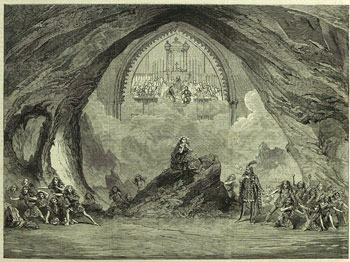 The final scene with Satanella about to be carried to heaven
with Arimanes and his fiends raging below and Lelia and Rupert are
|
Reception
The press was largely supportive of the music, if, as often, less so about the libretto. While a few critics thought that Balfe's earlier easy melodic gift had dimmed somewhat [1], others found a greater sophistication in the music overall [2]. The Examiner (Dec. 25, 1858) saw this as a conscious change of emphasis, "Mr Balfe could afford to put off the old habit of regarding the desires of the Gods (the theatre's upper tiers) and of the music-sellers rather than the independent promptings of his genius".
The Standard (Dec. 22, 1858) ran through the plot of the opera with generally positive comments on its main episodes and their associated singers, although it thought Act 3. scene 2 could "be omitted or considerably
curtailed with advantage". It
made little attempt at a summary except that the opera was
A very queer and unsatisfactory affair as far as the
dramatic interest of the libretto goes, but as concerns the
composer, a work which shows the vigour and fancy of his
muse but little if at all abated by time, and
capable now as ever of producing a profitable crop of
popular melodies.
The Morning Chronicle (Dec. 21,
1858) gave the libretto short shrift
The libretto is indescribable; the
lyrics too awful to cite; the dialogue too dull to provoke the
slightest hilarity when it laboured to be witty, and too vapid to
excite interest even in the most dramatic situation.
It also advised curtailment, "two-thirds of the dialogue, and a more rapid development of the main plot" but,
overall, [Balfe] had
never achieved such artistical perfection before, and his melodies
are as fresh and as heart-touching as ever. The finales of the first
and fourth acts are gems in every point of view.
The Daily Telegraph (Dec. 21, 1858) did little more than lay out the plot and identify the main numbers and singers because "The opera did not conclude until such a late hour that we find it impossible to say more at present, except that it was thoroughly successful". The next day's review remarked that the opera had been trimmed to four hours (from nearly four and a half) but would benefit from still more. Otherwise it mentioned a few numbers, e.g. that the song, "Sultana Zulema", was better appreciated than on the opening night. It concluded that "The piece is magnificently put upon the stage, and deserves fully the great success which it has attained".
The Times (Dec. 21, 1859) reported little except for its success because of the lack of time but The Times (Dec. 23, 1859) review of the third performance was more detailed and mixed. The libretto was "A farrago of absurdities" more suited to ballet than opera. However, "Mr Balfe has attacked the materials provided for him bravely, and if, now and then, he has sunk, or nearly sunk, beneath their weight, he has oftener triumphed over it and turned dross into gold". Some numbers were praised, others criticised but overall "everyone concerned, principal and subordinate, has done his best". Alfred Mellon was singled out for particular praise, the performances going off without any problems. It reckoned that nearly an hour had been cut from the opening night, which would suggest that further cuts were made after the second night, where the Telegraph thought less than half an hour had been cut. The review promised a further examination of the opera but none seems to have been forthcoming.
The Sunday Times (Dec. 26, 1858) thought that while "Mr E Falconer, who has written some very pretty poetry for Mr Balfe's music", the, "unusually long" libretto "does not develop the plot very coherently". It judged that the frequent scene and character changes lent the plot more to spectacle than opera. However, Balfe "has produced a work which will gratify the musical connoisseur". "The music is essentially Balfish - graceful and melodious", "the sweetness of Ireland's wild strains, and the refinement of Italy's soft airs". Its overall verdict was that the opera, "notwithstanding its merit in a musical point of view, and the zealous assistance afforded by all the artists concerned ...cannot, we fear, be considered a permanent success". On the other hand, The Weekly Times (Dec. 26, 1858) considered that it "is certain to have as long and glorious a run as the most favourite of our popular composer's works".
Writing at the end of the season, the
Saturday Review (Mar. 19, 1859) was damning.
A weaker opera,
in every respect, than Satanella, was perhaps never put upon
the stage. We will pass over without comment the absurdity of the
plot, and the bald commonplace of the dialogue.
We cannot,
however, regard is as an unimportant matter that our national opera -
if we can be said, indeed, to possess one at all - should apparently
be represented by music of so inferior a character, or that a company
of artists whose powers are fully adequate to the performance of works
of real merit should waste their energies upon a composition which can
possess no interest for a musician, and which can only attract the
ignorant and uncultivated in musical art.
Its 1871 New York premiere by the Parepa-Rosa company drew contrasting views although, in most cases, the debut of American soprano Jenny Van Zandt (Vanzini) was the main interest. Of the opera, the New York
Times
(Oct. 10, 1871) wrote that
The story of Satanella, if not very
original, has both charm and instructiveness.... The mise en scène
last night was excellent....Yet, of
course, the casket would be of little worth without the jewel; and the
fact that the music, in all its parts, as rendered by principals, by
orchestra and chorus, was so evenly admirable on this occasion, was
required to supply just symmetry to the whole. Satanella is a
success of almost pyramidal dimensions; and besides, at the repetition
to-night, will doubtless draw many a full house hereafter.
On the other hand, the New York Post (Oct 10, 1871)
thought that
In view of its poverty, both harmonic
and melodic, as well as its rather childish and
inconsequent libretto, many will wonder why he [Balfe] should
have written it. ... For chorus and orchestra, as usual,
we have nothing but words of praise, and the dresses and
appointments were as bright and varied as the stage
machinery was inefficient. But have we not had nearly
enough of such light and unsatisfactory side-dishes as
Balfe and Donizetti, and is it not possible, within the
range of English opera, to find some more solid meat of
more classical, or at least more intellectual,
composition?”
[1] "Mr Harrison has had better ballads composed for him (by Mr Balfe)", Daily Telegraph (Dec. 22, 1858). "To judge, however, from Satanella, Mr Balfe must have written himself out. We can find no single melody in the opera which is equal to several we could mention in earlier compositions", Saturday Review (Mar. 19, 1859). Tyldesley (p. 192)
{2] "Several of the finales and other concerted pieces are masterpieces of construction, brilliancy, and dramatic effect", Illustrated London News (Dec. 25, 1858). It complained that the ballads had "as was usual in English operas, of want of connection with the subject" and done "in order that they may sell in the music shops".
Comments
Foster Sister
The plot of Satanella has some
parallels with Meyerbeer's Robert le Diable
(1831),.in that Robert gambles away his wealth,
loses his intended bride, Isabelle, and is in danger of
signing away his soul. He is saved by the goodness of
his foster sister Alice but he ends up marrying Isabelle
rather than Alice. Here Rupert marrying his foster
sister, while legal, feels not altogether acceptable. It
is not clear why they made her such, perhaps to
emphasise their earlier close friendship.
Why did they constantly misjudge an opera's length?
Satanella initially had at least an hour removed after its premiere and some later productions removed even more. An overlong opera and immediate drastic pruning were hardly unusual and one has to wonder why composers and librettists continued to make such a mistake. It put extra work on all concerned, which given the short rehearsal times would have been particularly unwanted. One has to wonder whether sometimes they ever did a full dress rehearsal or whether it was done in sections and it was only on the first performance that the true impact could be measured. The Manchester Guardian (Aug. 15, 1855) explaining the "very thin dress
circle" for the premiere of Loder's Raymond and Agnes
cited
the
general conviction that the first night of a new piece, and especially
an opera, must, necessarily, be little else than a dress rehearsal.
This belief, generally correct, was not warranted by the performance
of last night.
One reason for cramming in too much material was probably that they wanted to see which musical items proved most attractive so that they could shape an opera accordingly, any consequential damage to the overall dramatic flow being of little consideration. The inclusion of so much apparently unnecessary dialogue possibly points to their difficulty in recognising that an opera was not a traditional stage play with songs and that they felt compelled to make it complete as a stage play.
The beginning of the end for English Romantic Opera?
Tyldesley (p. 194) wrote that
It is quite
clear from a retrospective viewpoint that, from about the time of
Satanella, the audience appreciation of Balfe's style, and that of
English opera in general, had begun to decline.
However, the Saturday Review and the New York Post quotes above show that at the time there was a gathering weariness with the lack of sustained achievement of English Romantic Opera, particularly probably for those familiar with Verdi's operas and the dramatic impact of his Rigoletto, Il Trovatore and La Traviata in the mid 1850s. This failure was not just the lack of good librettists but an inherent weakness in the song and dialogue format, as was discussed in the comment section of Balfe's The Rose of Castille.
Henry Chorley in his rather sour obituary in the Athenaeum (Nov. 5, 1870), p. 200, wrote of Balfe's operas, but
it could stand for English opera in general,
As time went on, the
success of the series gradually palled and paled, and the satiety and
the waning were, of course, ascribed to national ignorance. Where was
the good of "casting pearls" before homely animals? (not to speak too
disparagingly).
Scores and Librettos
The manuscript libretto is in the British Library, Add MS 52978 R. The Examiner received it on December 8 and the licence was sent on December 9. The manuscript submitted to the Examiner called Rupert, Ulric.
The contemporary printed libretto can be found at the Goethe Universität, Frankfurt and Archive.org. It has a few changes from the manuscript. The most interesting is in the final scene where references to "soul" are crossed out in the manuscript, presumably by Donne, and phrases such as "My bond I claim" inserted instead of "thy soul I claim". The printed libretto continued to use "soul".
The second edition of the libretto at Warwick Digital Collection [1] shows cuts to the dialogue in the first three acts with the whole of Act 3, Scene 2 omitted. In all nine pages were cut from the original printed libretto's 44. There is an 1871 Parepa-Rosa company edition at Google books that shows further dialogue excisions over the second edition but restored the missing scene. There is a modern one that was distributed with the Naxos vocal items recording but does include the unrecorded dialogue. It has even more cuts [2]. There are no changes to vocal items in any edition, where they are included. The full score is available in manuscript in the British Library, Add MS 29354-29355 and modern editions from Retrospect Opera and Victorian Opera Northwest. Copies of Boosey's vocal score can be found at IMSLP and Opera-scores.com [3]. It shows further cuts over the libretto second edition including the second half of Act 2, Scene 1. The Carl Rosa Trust has original band parts. There was the usual myriad of arrangements, such as Henri Laurent's Satanella Waltz |
Satanella Waltz - V&A [4] |

[1] The Warwick edition has two title pages. The outer one says "Third Edition" and the inner one, which seems to match the rest of the document, is titled "Second Edition".
[2] The booklet to the Naxos Satanella recording describes briefly the sources of the score used.
[3] The Illustrated London News (Jan. 15, 1859) advertised scores of some numbers but did not advertise the vocal score until December 14, 1861
[4] The image shows "The ascent of Satanella , with a Bude light reflection on her visage", (The Morning Chronicle, Dec. 21, 1858) . The Bude light was an alternative name for limelight being named after its inventor Sir Goldsworthy Gurney, who lived in Bude, Cornwall.
Recordings
|
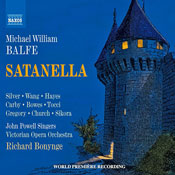
There are two
recordings of the opera:
There are recordings
of individual numbers: |
Books, Articles, Online
|
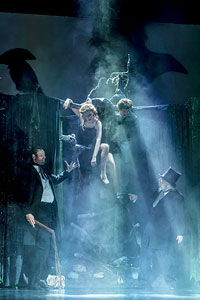
William Tyldesley, Michael William Balfe: his life and his English operas, (Aldershot, UK: Ashgate Publishing, 2003), pp. 187-196, goes into the history, influences and structure of the opera. George Biddlecombe, English opera from 1834 to 1864 with particular reference to the works of Michael Balfe. (Oxford: Routledge, 2019), pp. 119-122, has an assessment and analysis of the opera as a representative of Balfe's later style. Michael Hurd, "Opera:1834-1865" in Nicholas Temperley, ed. The Romantic Age, 1800-1914.. (Oxford: Basil Blackwell, 1988), pp. 318-322, offers an analysis of the first act an examplar of an English Romantic opera. There are a few remarks in the books on Balfe by Walsh, Kenney and Barrett (see book list). There was a performance of the opera at the Eduard von Winterstein Theater, Annaberg-Bucholz, Germany, in 2024 (right). Reviews can be found here and on the Concerti website |
 |
Victorian Opera Northwest has pages on the opera and its recording
 |
 |
 |
  |
|
|