  |
 |

|
  Robin Goodfellow,
|
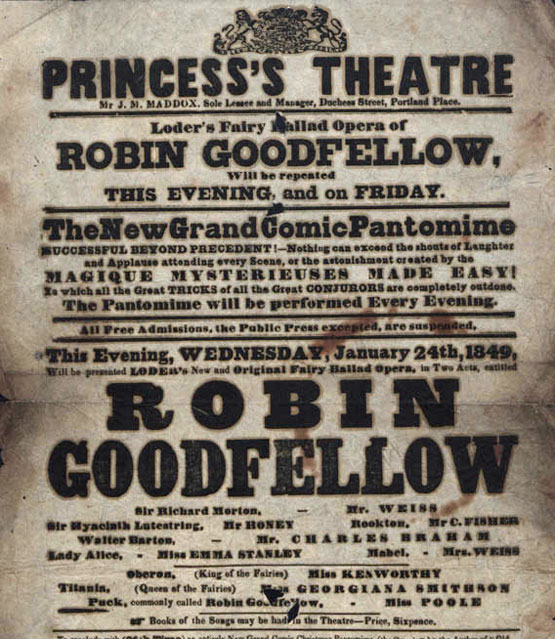

|
Sir Richard Morton(?) Sir Hyacinth Lutestring Walter Barton Goodboy Rockton
Puck (Robin Goodfellow) Titania (Queen of the Fairies) Lady Alice Mabel Oberon (King of the Fairies) Mustard Seed Gnatfly Maydew Rosebud |
- Mr. Henry (James Henry Horncastle)
- Georgina Barrett (Mrs Weiss) |
History
This was yet another work provided by Loder in his capacity of music director of the Princess's Theatre. It was essentially a number of ballads together with incidental music but without ensembles and it is a marginal case as to whether to classify it as an English opera. Although the vocal score implied that Loder had written the libretto, it appears[1] to have been by John Frederick Smith, a well known novelist of the day and who had already been identified as a possible librettist of Loder's Francis the First .
John Maddox, the Princess's manager, in his covering letter to the examiner said that it was sent to be licenced on November 25, 1848, with a plan to perform it on December 2, 1848. It is not clear whether the latter date was deliberately listed earlier in order to ensure that it was licenced in time or whether the premiere date slipped.
Plot
The Daily News (December 7, 1848) summarised the plot as:
Puck, or Robin Goodfellow, having incurred Queen Titania’s displeasure, is expelled the realms of Fairy Land, and his banishment is to be perpetual, unless within a given time he find out what is dearest to a woman’s heart. He is allowed three guesses: the failure of the last is to seal his doom. He repairs to earth where – it being the period of the Commonwealth - he finds in the family of the Royalist, Sir Richard Morton, a disguised Cromwellian [Rookton], seeking to gain Sir Richard’s estates and his daughter, by fastening a plot upon this worthy knight. The young lady, however, has fixed her affections upon Walter Barton, her only objection to him being that he is a puritan. This objection he seeks to remove by assuming a cavalier costume and manner. An interview of the lovers induces Robin Goodfellow to suppose that love is the master-passion of the fair sex: his statement to that effect, however, is rejected by Titania. On a subsequent visit to the earth he finds Sir Richard betrayed by the nefarious Rookton, but saved by the heroism of Walter Barton; his observations of Lady Alice’s conduct on this occasion makes him conclude that faith is the master passion with woman: the solution not being adopted by Titania, he makes a third experiment, and ascertains from the future proceedings of the Lady Alice with her lover, that to have her will is what is dearest to woman’s heart, and Titania owning the soft impeachment, Robin Goodfellow is received into the bosom of his family, and so the piece ends.
Reception
The Standard (December 8, 1848)
thought it
both a pretty story and
pretty music" adding that "The overture,
of Weberish hue, exhibits Mr. Loder's
masterly skill in writing for the
orchestra; and the accompaniments to the
ballads and concerted pieces are equally
indicative of taste, judgment, and
propriety of effect. Pity there is
not a better band to do them justice.
The
Morning Post (December 9, 1848) was less
complimentary.
The author [of the text]
has been anything but fortunate in the
amalgamation [of fairy and domestic]".
While on the music, it thought that:
"There is considerable merit in the
orchestration, which is in the best
school, and is both fanciful and
effective; but there is a want of
freshness in the melodies, which are, in
the majority of instances, either too laboured or too trite.
The
Examiner (December 9, 1848) disagreed.
The story is better than usual, the
actual and the fanciful being rather
prettily blended in it; and pieces of
higher musical pretension have been much
less entertaining than Robin Goodfellow.
The Musical World
(December 9, 1848) also liked the work
and in a follow up two weeks later
remarked:
Mr
Loder’s delightful opera, Robin Goodfellow, still continues its
successful career. The music becomes
more acceptable at every hearing, and
the various ballads and concerted pieces
are nightly received with increased
applause.
Scores and Librettos
The libretto is only available in manuscript at the British Library, Add MS 43015, ff. 286-307b. A transcript can be found here. The printed Songs, Choruses etc of the opera (London: S.G. Fairbrother, 1846) were made available in a scan from the British Library. Given their ongoing problems, that scan is made available here. There are some differences in the printed Songs from the manuscript, which are noted in the transcript. There are not many and they are not very significant.
The vocal score is also in the British Library.
Recordings
None are known
Books, Articles, Online
David Chandler's "Edward Loder and his Librettos" (pp. 229 - 231) in Nicholas Temperley (ed.), Musicians of Bath and Beyond: Edward Loder (1809-1865) and his Family, (Woodbridge: The Boydell Press, 2016) discuss the libretto.
[1]Andrew, King (ed.), The London Journal, 1845-83, (Aldershot, UK: Ashgate Publishing, 2004), p.103
 |
 |
 |
  |
|
|