
 |
 |

|

 MaritanaMusic by William Vincent Wallace
Libretto by
Edward Fitzball
|

|
Charles the Second Don Cesar de Bazan Don Jose de Santarem Marquis de Montefiori Alcade Captain of the guard Noble Boatman Soldier Old Man
Marchioness de Montefiori Maritana Lazarillo |
- Mr Burt (John Birt) - Mr New
|
Conductor - William Vincent Wallace / Francesco Schira [1]
[1] Wallace conducted the first few performances and then Schira, the Drury Lane Music Director, took over.
History [1]
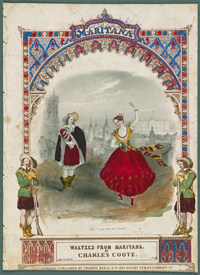 |
Wallace's life was very varied and unusual. He was a pianist and violinist who arrived in London in 1845 after considerable travel and adventures throughout the world. At this point, he had not composed an opera but had written other musical works. In London, he met with an old friend, Heyward John St. Leger, who was later to introduce him to Edward Fitzball. The result was the opera, Maritana, based on Adolphe d'Ennery and Philippe François Pinel's play staged in Paris in 1844, Don César de Bazan. Adaptations of it were enjoying considerable popularity in London [2], so much so that Alfred Bunn initially was not interested because he thought the subject had become hackneyed [3]. Bunn eventually became enthusiastic and contributed two ballads: "In happy moments" and "Scenes that are brightest". The opera was postponed from Thursday, November 13 because of "the difficulties of the music, and the elaborate nature of the stage appointments, which absolutely necessitate further rehearsals" [4]. On February 5, 1846, it notched up its 50th performance [5] and went on to join Balfe's The Bohemian Girl (1843) and Benedict's The Lily of Killarney (1862) as the three most popular and enduring of English |
Romantic operas. Its success seems to have come just in time for the theatre "otherwise, it would have been the finishing stroke in the chapter of accidents" [6].
It was staged in many other English speaking countries including Dublin (1846), Philadelphia (1846), New York (1848) and Sydney (1849). There was also a German version: Vienna (1848) [7], Hamburg (1849) and Prague (1851) and an Italian edition with recitatives instead of dialogue [8].
The opera was still being performed in the 20th century. Even in 2020, Richard Bratby could assert that "If Maritana were translated into Italian and passed off at Glyndebourne as a rediscovered bel canto rarity, it would be hailed as a minor masterpiece" [9]. The opera was the inspiration for Gilbert and Sullivan's The Yeoman of the Guard [10].
[1] Andrew Lamb, William Vincent Wallace. (Croydon, UK: Fullers Wood Press, 2012) , pp. 69-73, describes the opera's history in some detail. Edward Fitzball, Thirty Five Years of a Dramatic Author's Life. Vol. 2 (London: T.C. Newby, 1859), pp. 231-234, gives his account.
[2] For example, for the 1844-1845 and 1845-1846 seasons at the Princess's theatre
[3] Fitzball's view was completely contrary. He wrote in the libretto's preface, "Few subjects become so popular, musically adapted to the stage, as those with which the Public are already familiar".
[4] Illustrated London News (Nov.8, 1845), Musical World (Nov. 13, 1845)
[5] The Times (Feb. 3, 1846). It was a benefit for Wallace.
[6] The Weekly Dispatch (Nov.23, 1845). It is not clear exactly what "accidents" it had in mind but the failure of The Fairy Oak the previous month would have been one of them.
[7] The Musical World (Jan.22, 1848) carried a report of its tremendous reception in Vienna despite a lacklustre primadonna.
[8] The Illustrated Sporting and Dramatic News (Feb. 28, 1874) stated that the opera had been translated by Signor Zaffira and the music for the recitatives was by Tito Mattei. Mattei was a pianist and composer who lived for many years in London. The booklet to the Naxos recording claims that the adapter was a musicologist, Severio Mattei, but Tito Mattei looks much more likely given the title on the Italian vocal score (see below) and his responsibility for the recitatives being quoted widely in the press. It was used in Dublin in 1877, by Colonel Mapleson's company in its 1885-1886 US tour and in Dublin in 1887, at Her Majesty's Theatre, London, in 1880 and New York, 1885 - Alfred Loewenberg, Annals of Opera (London: John Calder, 1978).p. 1845, Harold Rosenthal, ed., The Mapleson Memoirs, (London: Putnam, 1966), p.247
[9] The Spectator (Mar. 21, 2020) . As was seen above there is an Italian version
[10] Michael Walters, "From Maritana to Yeoman. An examination of Wallace, his bizarre life, and his opera which was the inspiration for The Yeomen of the Guard", Gilbert and Sullivan Pamphlets, No. 1 (May 1998). Available at https://www.gsarchive.net/yeomen/wall.pdf .
Plot
Maritana is a gypsy street singer in Madrid. Charles II, the young king of Spain, is in disguise and sees her and is taken with her beauty. His devious minister, Don José, sees this and encourages his affections, hoping that the King will compromise himself. José intends to reveal the King's infidelity to further his own favour with the Queen with whom he is in love. Don Cæsar de Bazan, a noble man but poor, is arrested and sentenced to death by public hanging for duelling during Holy Week when defending a poor apprentice boy named Lazarillo from mistreatment by his master.
|
Don José offers Don Cæsar a soldier's death (shooting instead of public hanging) if he agrees to marry a veiled lady before his execution; Don Cæsar agrees. (In fact Don José has concealed the fact that the King has pardoned Don Cæsar in the interim). Don José brings the heavily veiled Maritana to marry Don Cæsar before the execution, with the intention of making her a nobleman's widow so she can be formally introduced to the King. While Don Cæsar and his executioners participate in the wedding feast, Lazarillo removes the lead shot from all the weapons. The execution is carried out, Don Cæsar feigns death, and he later escapes and goes to a ball at the Montefiori villa, seeking his new wife. Don José brings Maritana to see the Marquis and Marchioness de Montefiori at the ball, asking them to pretend that she is the Marquis's niece. Don José then brings her to meet the King. Don Cæsar arrives at the villa and demands to see his bride. Don José brings the old Marchioness to present to him. Since |
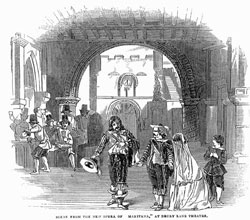
Don Cæsar and Maritana's wedding |
Don Cæsar did not see his bride, he believes José's story that this is she. He is so disappointed that he agrees to sign a paper relinquishing her. Just as he is about to do this, he hears Maritana's voice in the background. He recognizes her as his bride and refuses to sign but is arrested.
Now imprisoned in the royal palace, Maritana wonders what will become of her. The King enters but she repulses him telling him that they are the victim of Don José's plotting. Don Cæsar arrives and, not believing that the King is who he says he is, demands his bride. Before explanations can be made, the King is summoned by the Queen to the Palace. Don Cæsar and Maritana meet and find out that their love is mutual; they decide to appeal to the Queen. While waiting in the palace gardens, Don Cæsar overhears José telling the Queen that the King has a rendezvous with Maritana that evening and kills him for betraying the King. When the King hears of Don Cæsar's loyalty, in his gratitude he repents of his designs on Maritana and appoints Don Cæsar as Governor of Valencia.
Reception
The Morning Chronicle (Nov. 17, 1845) was rather downbeat at the start of its review because although "Mr Fitzball has followed the original play scene by scene [1]...its soul and spirit seem to have evaporated in the process". Further "a good deal of the music being so clumsily introduced that it is a mere dead weight on the drama". The similarity to the play with its noted actors showed up the lack of "histrionic talent on behalf of our dramatic singers". Harrison "walked through the part in true opera-singer style". Romer "was by no means fitted either by appearance or manner, to personate the fascinating gipsy girl". Only Elizabeth Poole as Lazarillo met their approval. The musical performance was deemed "as satisfactory as could be expected" and the staging as "worthy of the theatre". Its final verdict was more encouraging:
Upon the whole this opera has impressed us with a high opinion of Mr Wallace's genius and attainments as a musician, and with the conviction that under, more favourable circumstances, he is capable of producing a much better work.
The Weekly Dispatch (Nov 23, 1845) after commenting on it being "one of the worst libretti ever written" also elaborated on the shortcomings in the acting giving an example of Harrison addressing the audience rather than the intended hearer. It looked with more favour on Emma Romer's acting and particularly Elizabeth Poole's. In common with some other papers there was comparatively little comment on the singing perhaps because it was recognised that the soloists were not at their best after the extended rehearsals. Although it acknowledged the popularity of the opera, the brilliant and bold style, notwithstanding the "overpowering application of the drum and trombone" and the "soft, flowing, and expressive" melody, it doubted whether any of the numbers would become popular with the general public. Yet, a little over a year later, James Davison (Musical World, Feb. 27, 1847) wrote that "In a short space the melodies became so popular that you could not go... into a drawing-room without hearing them fall from the lips of some silken syren".
As with other papers, The Observer (Nov. 16, 1845) had a somewhat contradictory attitude. It was unenthusiastic in its appraisal of some numbers and noted the opera's lack of originality and that the music was often inappropriate to the dramatic situation. It concluded that "It is a composition solemn almost to heaviness, and deficient to a great extent in that graceful gaiety, which is the 'breath of life' to works of that class and character". However, despite this and taking shortcomings in the performance into consideration, nothing remained "but to award it perfectly unqualified praise", which seemed mainly due to its melody, "rich to repletion; and is sweet almost to the point of cloying".
The Times (Nov.17, 1845), with the libretto in mind, acknowledged that "Mr Wallace has had disadvantages to wrestle with that would have disheartened a composer of less energy and resources ... Without being thoroughly original, he possesses an extraordinary flow of ideas, which he treats with the knowledge and intelligence of a practised artist... it is long since an English opera has been produced the reception of which was so enthusiastic, and in which so much promise of ultimate eminence was indicated" [2]. It thought that all the performers "are entitled to praise for their exertions. They did their best; though from a lack of a sufficient number of rehearsals, they were unable to do full justice to the opera".
Henry Chorley (The Athenaeum, Nov. 22, 1845) was "decidedly favourable to its composer, Mr Wallace - considering the work as his first essay". Nevertheless he noted "some of his music being scored with a careless uncouthness, which is neither originality nor genius". "Miss Romer...is effective and animated in her new character, though not as sure of her roulades as could be wished...Mr Harrison...has found a part entirely to his mind". Only Phillips was found at fault for his self-conscious acting [3].
James Davison devoted considerable space in four issues of the Musical World to the opera, whose success he welcomed (Musical World, Nov. 20, 1845) with the sentence "The star of our national opera is in the ascendant". He noted that the opera was attended by "one of the most densely crowded audiences ever assembled within the walls of [the Drury Lane theatre]". He commented favourably, as had others, on the overture, which was rarely the case with English operas and then went on to describe the first act in detail and to praise its music, except for occasional "superobstroperous" orchestration. The following week Davison carried on in the same vein with Act 2 and, although making fun of Fitzball's plotting and text, declared it was "by no means a bad [libretto]"[4]. On December 4, he went through Act 3 and in concluding offered congratulations all round as well as to the singers and noted that "The opera has been produced in costly style - the band and choruses have been enlarged, and the mise en scene is all that could be wished". However, a little over a year later, on February 27, 1847, he talked of it having been brought out "somewhat shabbily". On December 18, 1845, Davison returned again to Wallace's success and, after cataloguing the recent history of English opera and what he saw as its fading relevance under the impact of Balfe's success, greeted Maritana as a harbinger "that a British school of dramatic music is now within our reach".
The Sun (Nov 17, 1845) was of a similar opinion to the Musical World. After praising many of the numbers it wrote that "This opera is evidently the work of a thoroughly accomplished - nay, more, of a very learned musician", who "takes the whole orchestra within his grasp, and plays upon it as though it were one instrument". It concluded that it looked forward to his future career "for he may, if he gives his genius fair play, become the founder of an English - a national - school of operatic music"
[1] The blatant plagiarism is an interesting reflection of the lack of copyright protection at this time for foreign authors. At least familiarity with the play meant that audiences would have no difficulty following the plot.
[2] The writer was probably James Davison, who was their main critic at this time. Its sentiments echo his writing in the Musical World. He was being a bit disingenuous in his final sentence as Balfe's The Bohemian Girl was only two years previously and was, no doubt, glossing over that success because of his unhappiness with Balfe.
[3] Phillips gave his own account of the opera and his antipathy to it in Henry Phillips, Musical and Personal Recollections. Volume 2 (London, Charles J. Skeet, 1864), pp. 211-214. It was the last new English opera that he sang in.
[4] Later, Davison in the Musical World (Feb 27, 1847) referred to the libretto as "a book filled with the most monstrous absurdities". He also talked of the opera being brought out shabbily whereas he'd previously praised Bunn for producing the opera in "costly style". He clearly got rather muddled for some reason.
Comment
Encores
The demand for encores was an interesting phenomenon at this time entailing a much more democratic, not to say chaotic, process as the audience gave its approval or otherwise. The Observer (Nov. 16, 1845) noted the rather extreme example that happened in Maritana. When Harrison sang "There is a flower that bloometh",
The friends of the composer demanded an encore, and an antagonist party attempted to put the cry down, but without success. The war of discord lasted for full five minutes; and when the encore was given it was sung with a running accompaniment of hisses.
The Sun (Nov. 17, 1845) reckoned that the fracas lasted ten minutes during which time Harrison "stood bowing to the audience, doubtful as to what he was to do" and that eventually he just repeated the last verse. Such episodes undermined dramatic continuity and, as with Harrison, left the performers in limbo while it happened. Encores also had the effect of making long evenings even longer and of tiring the performers and so potentially impacting the performance.
Critics often accused publishers of using claques to demand encores for certain numbers so that their repetition would help stoke demand for the vocal score. The Era (Nov. 23, 1845) suspected that this was the case in this instance, which had nearly excited a riot:
Some ill-advised friends determined upon its repetition excited the violent indignation of that section of the auditory who had purchased their right of judgment. The encore was for a time heroically resisted - the row was tremendous - but the leather-lunged claquers, by dint of bellowing, shouting, and similar physical demonstrations, succeeded partially to conquer their opponents; the result was a repetition, amidst a sotto voce accompaniment of sibillation.
The decision on whether a play or opera should be given further performances was a similar process. In this case, The Observer wrote that "It was given out for repetition amidst the unanimous cheers of the house" - presumably the earlier naysayers had been won over.
Counterbalance to Balfe's influence
To us there seems little to distinguish Balfe from Wallace with their reliance on individual numbers rather than any overall musical and dramatic effect, a tendency that was exaggerated further by the inane librettos and publishers' predilection for saleable single numbers. However, contemporaries clearly did see a difference. One of the soloists, Henry Phillips, wrote that "The music was certainly most charming and original, abounding in a style of melody we had not been accustomed to hear" [1] . The extended rehearsals argue that others found difficulty in finding a satisfactory line. Some critics showed uncertainty or a degree of contradiction in their appraisals as well as having doubts about the opera's likely popularity with the wider public, all of which proved unfounded. A report in the Musical World (Jan 22, 1848) referred to "critics insist so strongly on Mr Wallace's deviation from the English school", although did not spell out the reasons.
Although both Balfe and Wallace had Irish backgrounds and began their professional lives as violinists, their development took quite different routes. Balfe was primarily a singer while Wallace matured into a violin and piano virtuoso. Wallace included a broader palette of musical effects rather than just focusing on individual numbers, as can be seen in his use (or assumed use) of Spanish dances and the violin obbligato to "Hear me, gentle Maritana" that brightened up an otherwise rather dull number. The Spectator (Nov 22, 1845) in comparing him to Balfe, spoke of "a more popular talent, (being full of the turns of melody which please a miscellaneous audience, with less monotony in the form of his pieces) and with decidedly higher capacity to interest the musician". It complained, though, that the opera was "not entirely free from the influence of the house-model, which has obtained in the establishment from the palmy days of The Maid of Artois. Tedium has ever been greatly enhanced here by exhibiting the same singer in the same style of ballad" [2].
Michael Hurd wrote
If Wallace lacked Balfe's easy spontaneity, he could, when necessary, rival him in melodic charm - as the fluent melodies of Maritana prove. Harmonically he was rather more adventurous and self critical, and his capacity for realizing large-scale musico-dramatic structures (such as in The Amber Witch) was greater. But, as might be expected from someone who followed such an erratic career, the cumulative effect of his operatic achievement is rather less than its individual high points might lead one to anticipate [3].
For his contemporaries, given his melodic gifts allied to his "elaborately instrumented scientifically constructed work" [4], he bridged the divide between the "scientific", less popular, composers, such as Barnett, Macfarren and Benedict, and the popular, Italianate melodist, Balfe. Thus Wallace was seen to offer a more productive way forward for English opera. Unfortunately, he never quite lived up to these hopes and Maritana remained his most popular offering.
[1] Henry Phillips, Musical and Personal Recollections. Volume 2 (London, Charles J. Skeet, 1864), pp. 211-212
[2] They particularly took exception to Bunn's contribution of two ballads that brought the action to a complete stop with no real relevance either to the character or situation. One of those was "Scenes that are brightest", possibly its most popular number.
[3] Michael Hurd, "Opera: 1834-1865", in Nicholas Temperley, ed.. The Blackwell History of Music in Britain, Vol. 5, (Oxford: Basil Blackwell, 1988), p.312.
[4] The Sun (Nov 17, 1845)
Scores and librettos
| The libretto submitted to the Lord Chamberlain can be found at Add MS 42989, ff. 74-184. It was received by the Examiner on October 31, 1845 and signed off on November 8. There are many examples of the libretto on the internet, although almost all are post 1845 and were published outside of the UK. The edition at Google Books looks to be the original 1845 edition. Comparison with the manuscript show a few differences. The most significant are two songs contributed by Bunn: Don Jose's "In happy moments, day by day" that replaced "Come seek with me my native towers" and Maritana's "Scenes that are brightest" that was just left as a blank in the manuscript. The King's "Hear me, Gentle Maritana" replaced "Love’s Peri waved her purple wing" in the manuscript but this was not claimed to be by Bunn. There was no obvious signoff from the Examiner for these changes. The printed libretto at HathiTrust is also claimed to be from 1845 although it includes a page showing the cast for the Pyne-Harrison performance at the Lyceum in 1857, which must have been inserted later. However, it is later than the Google one as there are some changes in the dialogue, presumably to clarify and compress the action, Don Cesar's song "There is a flower that bloometh" |
 |
was moved from Act 3 to Act 2, a chorus with Don Cesar, "Banish gloom and sorrow" was omitted and some of the other songs, for example, "'Tis the harp in the air", were shortened. The effect of these changes was to reduce its running time from four hours to three.[1] The Hathi Trust also has several US editions. Internet Archive has an 1870 US one. The Univ. of Wellington has an 1885 edition used in New Zealand. The Library of Congress has a version used by Lyster's Opera Company in Australia in the early 1860s and a German version. Naxos has one to fit with its recording.
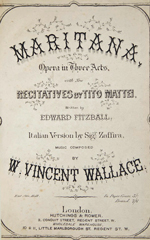
The British Library lists well over 100 related published items including an 1846 vocal score, some later editions, an Italian edition with recitatives by Tito Mattei instead of dialogue (see picture right) and a German edition. It also has orchestral parts for the opera. IMSLP has several 19th century editions of the vocal score and some of the numbers as well as two US editions of the libretto.David Grant produced a critical edition of the score as part of a PhD dissertation (Open University, 2010) - https://doi.org/10.21954/ou.ro.0000ffa8. Glasgow Libraries online houses the Moody-Manners Opera Company archives including orchestral parts for their edition of Maritana. The Carl Rosa Archive have hand copied orchestral parts.
[1] Andrew Lamb, William Vincent Wallace. (Croydon, UK: Fullers Wood Press, 2012), p.79
Recordings
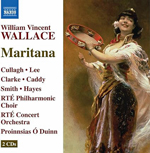
| The only commercial recording of the opera is by the RTE Concert Orchestra conducted by Proinnsías O'Duinn on Naxos 8.660308-09. There is a
private recording on LP of the Beaufort Opera
conducted by
Joseph Vandernoot on Rare Recorded
Editions,148/149. This recording is
available at
https://www.youtube.com/watch?v=AXst_hcux30&t=13s There is also a rather hazy video of a 1987 Kinsale Opera performance on https://www.youtube.com/watch?v=_OaBfi7YB2Y and of a St John's Musical Society, Waterford, 1981, performance at https://www.youtube.com/watch?v=NyQ17jmUva4 |
 |
A private recording of the Italian version
(with recitatives), but here sung in
English by the Glasnevin Musical Society at the Gaiety
Theatre, Dublin, in October 1976, can be found at
https://w.youtube.com/watch?v=rMERxr4rBRg ,
https://www.youtube.com/watch?app=desktop&v=ZLC3JlJaQNk,
https://www.youtube.com/
watch?v=j2lFWkA_xM0. This is probably the most enjoyable
performance despite some recording glitches.
Excerpts from an historic recording (1931) of Maritana featuring Heddle Nash, Denis Noble, Miriam Licette and Clara Serena available on Cavalcade of English Singers, Volume 2, Dutton CDBP 9802, 2010.
Excerpts from Wallace's Maritana, Balfe's The Bohemian Girl, and Benedict's The Lily of Killarney, Orchestra conducted by Havelock Ellis reissued on EMI Classics 0094633594821 in 2005.
A selection of arias from Wallace operas (including two from Maritana) sung by Deborah Riedel with Richard Bonynge conducting on The Power of Love, (Melba MR301107 , previously 301082), 2000.
Joan Sutherland sings "Scenes that are brightest" from Maritana on Decca 425 048-2.
Some fascinating early 20th century cylinder recordings of Maritana from the University of California Cylinder Preservation and Digitization project can be found here.
Books, Articles, Online
John W. Klein, "Vincent Wallace (1812-65): A Reassessment", Opera. (October 1965), pp. 711-712 has some remarks as part of its wider subject.
Andrew Lamb, William Vincent Wallace. (Croydon, UK: Fullers Wood Press, 2012), pp. 73-83, has a chapter on the opera giving its history and reception in some detail.
Robert Phelan, William Vincent Wallace: A vagabond composer. (Waterford: Celtic Publications, 1994), pp. 39-41 and pp. 98-107, discusses the work and gives some reviews of the first performance and of revivals.
Michael Walters, "From Maritana to Yeoman. An examination of Wallace, his bizarre life, and his opera which was the inspiration for The Yeomen of the Guard", Gilbert and Sullivan Pamphlets, No. 1, May 1998. Available at https://www.gsarchive.net/yeomen/wall.pdf includes material on Wallace's life, on Maritana and with short descriptions of Wallace's other operas.
George Biddlecombe's book, English opera from 1834 to 1864 (see book list), pp.132-133, has a section on Maritana.
 |
 |
 |

 |
|
|