  |
 |

|
  Henrique or The Love PilgrimMusic by William Michael RookeLibretto by John T. HainesTheatre Royal, Covent Garden, London
|

|
Henrique Don Carlos del Alcala (Senor of La Guardia) Alvaro de Luna (Senor of La Guardia, Late Minister & General of Juan, King of Castile, exiled among the Zingari of Serrania) Leolf de Zuniga (a young knight) Diego Goto (The Esquire of Alvaro) Roderigo (Esquires of
Don Carlo) El Ximen (Leader of the Zingari) Zingari, Hunters, Knights
Alzine (Daughter of Alvaro) Amabel de Valentia (an Orphan) Afra (Daughter of El Ximen) Zingarelli, Castillian peasants |
- Mrs East
|
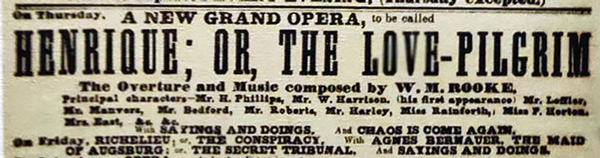
Playbill (part)
History
The success of Amilie (1837) encouraged Haines and Rooke to create a new opera and Macready to stage it. The opera did not meet with great success and urgently needed to be reduced in length. There seemed to be some disagreement between Macready and Rooke about those reductions and about relegating it to second on the bill. The upshot was that it was withdrawn after five performances. This was announced by Rooke in a letter to the press [1], dated May 11, the last performance. He also said that it would be revived the following season [2], but it never was, either in London or elsewhere. Perhaps with a more sympathetic manager it might have had a longer run [3].
[1] For example, the Morning Post (May 14, 1839). It had been performed on May 2, 4, 7, 9 and 11.
[2] The Observer (Nov. 3, 1839) wrote that it was "to be again brought forward at Covent Garden" but it was not
[3] The Age (May 12, 1839) reckoned that the Covent Garden audience, since Macready became manager, was primarily interested in spoken drama and were not of a musical bent.
Plot
The Era (May 5, 1839) summarised the plot as:
Don Alvaro de Luna, a banished nobleman, lives amidst the Zingari gypsies of Servania, in the midst of whom he has educated his young and lovely daughter Alzine. A wandering pilgrim, who turns out to be Henrique, King of Aragon, in disguise, meets her in this position and falls violently in love with her; Alzine's affections are likewise devoted to Henrique, his rank being unknown to her - yet he determined upon flying from her for ever [their differences in rank being deemed insurmountable]. In the mean time, she has attracted the attention of a most ruffianly nobleman, Don Carlos, who determines, at all events, to possess her and lays a plot to carry her off on the very evening that Henrique quits her and, by some means, gets both lovers into his power. The gypsies, however, appear and turn the tables, but during the contest the rank of Henrique is discovered and throws poor Alzine into despair, as she imagines a union impossible and her father attempts to slay the king.
Every body, however, escapes and the scene changes to the palace of Henrique, which Don Alvaro follows the king, for the purpose of assassinating him. Alzine, however, arrives at the palace just in time to save the king. Don Carlos is punished in consequence of his treacherous communication with the Moors; and the king ends by marrying his rustic love, who has opportunely discovered, by means of some letters delivered in the very nick of time, that her birth is quite equal to that of her royal consort. [In fact, the letters refer to her father being reinstated into the nobility and hence her rise to an acceptable status.]
Reception
Charles Macready, the Covent Garden manager, privately dismissed the libretto as "the greatest mass of unintelligible trash that ever perplexed a moderate intellect - perfectly detestable" [1].
The Era (May 5, 1839) complained that "This meagre and not very novel plot, together with an underplot ..., is attenuated into a piece lasting ... four full hours. Will managers and composers never learn wisdom from the repeated failures occasioned entirely by the length of their pieces". It thought the opera, although not very original and with some obvious plagiarisms "is very pleasing in its style; although there is little novelty, every thing is graceful and the instrumentation is remarkably correct". It along with most commentators was enthusiastic about the debut of William Harrison, "who made a very favourable impression, both as an actor and singer" and who was to become a mainstay of English opera along with Louisa Pyne in the Pyne-Harrison company.
The Charter (May 5, 1839) after dismissing the libretto, "we seem destined never to have an interesting English opera" turned to the music [2]. On this it wrote that: "we are happy to be able honestly to bestow unqualified praise. It is not certainly of that high original character which at once elevates a composer to the ranks of genius; but it is, for the most part, eminently pleasing, varied, and effective". Their biggest complaint was its wearying length and suggestions were made as to how it could be reduced including removing all recitative, which was being used in tandem with spoken dialogue. All the main singers, including Harrison, were complemented.
The Atlas (May 4, 1839) noted that no opera since the production of Rooke's Amelie "has excited more general curiosity and none more forcibly illustrated the fable of the 'mountain in labour' ". It raised the question seen in Barnett's Farinelli on the tension between the demands of the public and those of professional musicians and critics: "For the unlearned public it possesses but few attractions, while to the critical musician it must prove a succession of disappointments". It was not as whole hearted about Harrison as most. While finding much to praise in his voice "He does not, however, possess feeling, or even any great amount of its artificial substitute, style.
The Weekly Dispatch (May 5, 1839) took the same line. It thought that there were "no striking points" or any grand effect or any "song which will long be a favourite with the public". "An even tenour [sic] of mediocrity runs through all the music. We are far from depreciating the opera, for the composition, though not striking , is scientific and not deficient in taste". It was though "by no means equal to Mr Rook's [sic] Amilie". Notwithstanding this, it predicted "that it will be one of the most successful productions of the season" although "the want of the pruning-knife was severely felt".
[1] William Toynbee (ed.), The Diaries of William Charles Macready, Vol. 1 (New York: G.P. Putnam's Sons, 1912). p.478
[2] In a letter to the Morning Advertiser (Nov. 5, 1839) the librettist, Haines, complained that between "the kind alterations and mildly-imperative suggestions of the management, and the improvements of the composer, I, its originator, feel comfortably innocent of very many of its faults".
Comment
The Observer (May 5, 1839) had an interesting observation on the opera:
Mr Rooke has introduced a great many solo pieces. We are inclined to think that in adopting this course, the composer has done wisely, inasmuch as by solo writing he is carrying out the old English style of opera composition.
There are often complaints about English opera following Italian or German styles but very little on what was considered actually to constitute English opera other than the language. This emphasis on the solo links to the liking for the ballad.
The printed vocal items differs in some ways to the manuscript that was passed by the Examiner, particularly in the finales. If anything they made the opera even longer. Given that the printed text would closely follow what was actually performed, otherwise there would be little point in printing it, it is not clear if such changes would have been agreed with the Examiner. The changes in the printed vocal items seem to be aimed at making the muddled plot a little clearer. There is a tension between the usual plot of Carlos as scheming usurper and Henrique earning everyone's reproaches and Alvaro's enmity for misleading Alzine. The manuscript leans to the latter early on but the printed vocal items favours the former. There may well have been dialogue changes as well as changes in vocal numbers. Moors as potential aggressors are named regularly throughout but actually make no appearance, while the role of Amabel is rather vague and could have been dispensed with.
Scores and librettos
The manuscript is available in the British Library (Add MS 42951 , ff. 192-224). A transcript is available here. The printed text for the vocal items (London: W.Wright, 1839) is available at Google Books and Archive.org . There are quite a few differences between the manuscript and the printed sources.
The vocal score is available in the British Library (System number: 004620023), as are scores for some individual numbers.
Recordings
None are known
Books, Articles, Online
None are known.
 |
 |
 |
  |
|
|