
 |
 |

|

 Hamet and Zelena
|
|
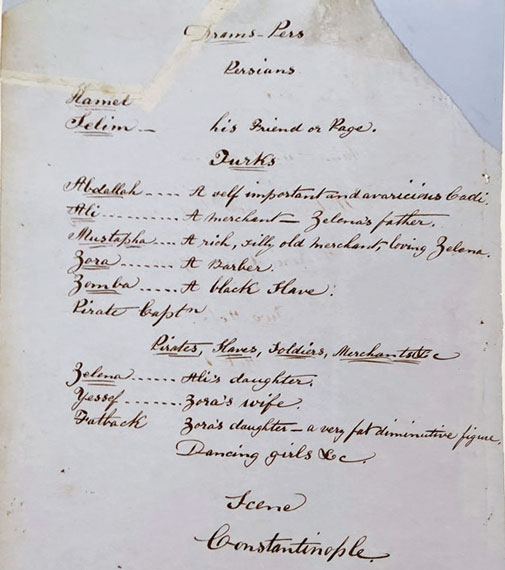
Hamet Selim - his friend or page Abdullah - A self indulgent and Ali - a merchant, Zelena's farther Mustapha - A rich, silly old Zora - A barber Zimba - a black slave Pirates, slaves, soldiers,
Zelena - Ali's daughter Yessef - Zora's wife Fatback - Zora's daughter, a very Dancing girls etc |
-
- Mrs Bromley (Kate Dibdin)
|
Conductor - Mr Levey [1]
[1] Lanza was probably not in Dublin as, otherwise, one would have expected him to conduct but the Dublin Daily Express ( Feb. 2, 1855) makes clear that Levey was the conductor. The Illustrated London News (Jul. 30, 1853) in its announcement of Dublin taking the opera had said Levey was entrusted with its production.
History
Hamet and Zelena was one of only four English operas of this era that received its premiere outside of London, but, unlike, for example, Loder's Raymond and Agnes (1855), it never received a London performance.
Unusually for English opera this one had quite a long gestation. Its first appearance was as a concert piece [1] at the Princess's Concert Room on March 8, 1848, using the orchestra of the Princess's Theatre. Opinion seems to have been favourable despite some poor performances and The Era (Mar. 12, 1848) hoped "ere long to hear [it] in a more complete form". Nothing more was seen or heard of it until January 8, 1851, when at least some of it surfaced at the newly formed London Operatic Concert Company at the Music Hall in Bedford Square, London. It again received a poor performance, "the music was uncourteously mauled", and it did not impress[2]. Again there was silence until the Illustrated London News (July 30, 1853) announced that it would be produced at the Theatre Royal in Dublin.
The manuscript was signed off by the Examiner on January 26, 1854, but it was not until January 12, 1855, that the theatre advertised its upcoming performance and not until February 1, 1855, that it was performed. In the event, it received only two performances. One of the songs was given at concerts organised by Lanza in Liverpool in March 1856 but otherwise there were no further performances of either the opera or songs from it.
[1] Windsor and Eton Express (Mar. 18, 1848) referred to it as a rehearsal.
[2] The Era (Jan. 12, 1851)
Plot
The Dublin Daily Express (Feb. 2, 1855)
sketched the plot:
Hamet, a Persian prince (Mr. Haigh), has been,
with some attendants, taken by pirates, who, not knowing his rank,
bring him to the slave market of Constantinople for sale. There he
chances to see Zelena (Miss Lanza), in a window of her father's house,
and they, being struck with each other's appearance, sing a duet with
great propriety, and she throws him a scroll, by which he is informed
that Ali, her father (Mr. Corri), has determined to marry her to
Mustapha (Mr. Ellerton), whom she detests. The Cadi (Mr. Durand),
overseeing somewhat of this, purchases the slaves from the pirate and,
having some cause to be revenged on Ali, resolves to pass Hamet on him
as a prince anxious to wed the fair Zelena [although] believing him to be a
barber. Ali consents, and, so of course, do the lovers; but Hamet, who
gets his liberty on the occasion, has promised to deliver over the
lady's dower to the Cadi, and keeps his word in a novel way, by not
accepting any. Thereupon a guard is privately sent for, and Hamet
arrested, which closes Act I.
In the second act the Persian is acquitted
of the charge trumped up against him, and returns to his bride, but
the Cadi then informs Ali of the state of the case and a second
separation is the result. Meantime Yessef and Zelena resolve upon a
counter-stratagem, viz., that the latter shall repair to the Cadi in
disguise, and tell him she is possessed of a large fortune and
indescribable attractions, but is the daughter of a barber, Zorab (Mr.
Swift), who gives out she is poor and ugly. The Cadi having an itching
palm, catches the bait, and signs an agreement with the barber to
forfeit a large sum if he fails to many his daughter Fatback. The
wedding procession soon after enters; the Cadi is laughed at when the
real lady is seen, and has to pay forfeit, while Hamet discovers his
real character, and claims his bride.
Reception
The Dublin Daily Express (Feb. 2, 1855) congratulated Mr Harris for devoting the resources to bring out a new opera. It thought that although Lanza "has not displayed any very exalted genius, he has at least proved himself possessed of that which is sometimes more valuable - the power of pleasing an audience". It "regretted that such good music should be linked to so paltry a libretto" and wondered why no good librettos
were to be found. Overall it was impressed
by the production:
The opera was excellently put upon the stage, the
dresses and decorations being gorgeous, the scenery appropriate, and
the general effect more than pleasing. Mr. Haigh's voice is improving
perceptibly ... Mr Durand [was improving as an actor and ] sang
throughout throughout steadily and well. Miss Lanza we have rarely
heard more effective ... although she seemed once or twice to take
liberties with the score"[1].
The Dublin Daily Express could hardly have been more wrong in "We predict for Hamet and Zelena a long run, and a permanent place in the repertoire of the theatre".
Freeman's Journal (Feb. 2, 1855) was similarly impressed by the Theatre Royal's initiative. Its critique was rather limited. It noted some debt to Balfe, Rossini and Donizetti but also a "rich vein of original melody in the solo pieces" but mainly just encouraged people to go and see it as "doubtless...[it] will, and must, be again and again presented". "To judge from last night's opera, [it] will enjoy the sympathy of crowded houses through a long succession of evenings". A few days later, Freeman's Journal (Feb. 13, 1855) wrote about its "numerous and well pleased audiences" even though it had folded after two performances.
Saunder's Newsletter (Feb. 5,
1855) fulminated at some length about the awful libretto
a more
purposeless and confused plot, verses more silly and less lyrical, and
incidents more enigmatical and less interesting, could not have been
strung together and pitched upon the stage.
It noted Lanza's strength in the solo items and arrangements for two or three voices but sparing use of chorus or larger ensembles. His "graceful, glowing and easy style" and the Rossini influence. It praised the singers other than Corri who was virtually voiceless from a cold. The excellence of the staging and the orchestra under Levey "showed a desire to secure for Hamet and Zelena in every department, a successful career". It noted that the second performance drew "an average house" and did not add whether it foresaw a long run.
The Weekly Gazette (Feb. 10, 1855) denounced a libretto "far below even a respectable mediocrity". A long and rather negative critique of Rosalia Lanza's singing followed, which can be found under her biography, Haigh and Durand were treated more leniently. The chorusses had "evidently been rehearsed with care, and the singers well disciplined by Mr. Levey". Lanza's accompaniment was praised in certain numbers although the reviewer had "seldom heard so undisguised a plagiarism as in the buffo duet between the Cadi and Zelena". Overall, there was limited comment on the music and there was little impression that the opera, other than one or two numbers, had been an success although the soloist were brought before the curtain. It ended
with a more general complaint.
It is greatly to be regretted that our English vocalists,
generally speaking, neglect a very important duty, that of practising
a clear and distinct pronunciation of the words which they have to
sing.
There was little interest in the opera from the London papers. The Musical World (Feb. 10, 1855) and The Era (Feb. 4, 1855) each had short, positive, reviews of a few lines contributed by someone in Dublin.
[1] Perhaps the paper had seen a vocal score although none has been found. It was not typical to refer a performance back to a score.
Comment
Censorship
Although some or all of the opera received performances before the official premiere, nothing was sent to the Examiner for clearance, perhaps because they were concerts rather than stage performances.
Reviews and reviewers
The
reviews were very positive predicting a long run, particularly the
Freeman's Journal and the Dublin Daily Express,
but the opera seems to have failed very quickly. It's possible that
some event might have derailed it, e.g. a soloist falling ill, but the
fact that Lanza resurrected only one number at his Liverpool concerts
the following year rather implies that audiences did not like it. Any
apparent first night success might have been down to friends, free tickets or claquers. As has been seen with other English opera, reviewers
sometimes seem to have seen themselves as publicists and cheerleaders
as well as critics. In this case, the reviewers may have been keen to
drum up audiences so as to encourage Harris at the Theatre Royal to
continue to experiment occasionally rather than just sticking to the
tried and trusted.
Scores and librettos
The libretto manuscript is available in the British Library, Add MS 52945 I. It was received on January 25, 1854 and the licence sent on January 26, 1854. No printed version is known.
Recordings
None known
Books, Articles, Online
None known.
 |
 |
 |

 |
|
|