
 |
 |

|

 Henry Haigh and
|
|
Haigh was born in Yorkshire on August 1, 1830. He was the son of a shoemaker but both he and his older brother, Edwin, became musicians, suggesting musical interest and ability in the family. The first mention of him seems to be at a concert in Hull on January 29, 1850 with Edwin as pianist [1]. A few months later, at another concert he was billed as a pupil of Signor Furtado [2]. At a concert on January 16, 1851 he was described as "from the London Concerts", so had apparently appeared in the capital by then. In April 1851 he was one of the "immense phalanx of operatic talent" at the Surrey Theatre in London. Louisa Pyne, William Harrison and Charles Manvers, artists with whom he would later work, were also on the bill [3]. By March 1852, again at a concert organised by Edwin, he was listed as from the Theatre Royal, Edinburgh. In the November, he made his debut in Glasgow, where he was praised for "combining a fine quality of voice, with great good taste" and suggesting that he "may take his place among the best English operatic singers" [4]. |
|
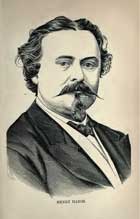
In late 1852, he moved to Dublin where he sang in opera, oratorio and concerts until March 1855 when he returned for engagements in Bath and Bristol. While in Dublin at the Theatre Royal, he sang in the premiere of Lanza's Hamet and Zelena on February 1, 1855. He then seems to have disappeared from view after April until the end of the year and it is probable that this was when he went to Italy for more training [5]. In February 1856, he made his first appearance at Covent Garden along with Lucy Escott in Balfe's The Bohemian Girl. The Standard (Feb. 19, 1856) wrote that his "style of singing betrays cultivation, though there is apparently very little stage experience". The following month he joined James Tully and Frederick Kingsbury's company at Drury Lane. Elizabeth Dyer was one of the company and on April 25, 1857 they married while in Hull on tour with the company, of which Haigh had become a part manager [6]. The tour included a season at the Surrey Theatre in London. Near the end of 1857, the company broke up following Lucy Escott's defection. The Haighs made an appearance in Edinburgh at the end of the year and in several other cities early in 1858. They seem to have sung scenes from operas, presumably with piano, and, at least sometimes, supported by members of the local stock company [7]. During Lent both appeared in "monster concerts" at the Alhambra in London. In April they joined Tully's new company at Sadler's Wells and stayed with him on his company's tour in the latter half of the year, although fitting in some concerts along the way. Some of 1859 was spent touring with Frederick Kingsbury as conductor and, in the autumn, he joined the Pyne-Harrison company at Covent Garden, but not his wife. Unfortunately, William Harrison took almost all the leading tenor roles in new English operas, of which there were 13 during the company's existence, while Haigh only sung in the premieres of Alfred Mellon's Victorine (1860) and Julius Benedict's The Lily of Killarney (1862). After the season, over Easter 1860, he and his wife were part of a short run of Wallace's Maritana at Drury Lane organised by Dr James Pech. The Observer (Apr. 15, 1860) wrote that "He has a small sweet tenor voice, sings with taste and delicacy, and, in a very limited range of parts, is a useful performer". Both then sang with his National English Opera Company [8] as well as in a few concerts before he returned to the Pyne-Harrison company for the 1860-1861 season. A provincial concert tour with his wife followed until Pyne and Harrison's 1861-1862 season, his last with them at Covent Garden. After its conclusion he set up his own company for a provincial tour.
In September 1862, Haigh petitioned for bankruptcy owing just under £900. He blamed his position on "insufficient receipts as manager of the New English Opera Company and being unable to procure an engagement" [9]. He was not hired for the 1862-1863 season by the Pyne-Harrison company, to whom, in any case, he owed money. He did sing in opera at Sadlers Wells, in his own company and in Corri's company, had a spot singing in a Scottish confection entitled Bonnie Dundee at Drury Lane and sang in concerts and oratorio. However, his oratorio singing was not admired. Commenting on his performance in Mendelssohn's Elijah for the Sacred Harmonic Society, the Englishwoman's Domestic Magazine (Vol. VI, Mar.,1863, p. 234) was not alone in its opinion that "He is gifted with a charming voice, but his inertness or incapacity render him utterly incapable of any dramatic intensity - of musician-like reading of the intention of the author"[10]. His operatic singing also drew criticism from the Bradford Observer (Oct. 15, 1863): "Mr Henry Haigh's voice was once a fine tenor and would be still if he were not so fond of using the falsetto". Towards the end of 1863 the Haighs advertised their annual visit to Scotland.
Haigh again joined the Pyne-Harrison company when it went on tour in Spring 1864 as well as a spell with Henry Corri's company. He was hired by the Royal English Opera (Limited), who took over from Pyne-Harrison at Covent Garden for the 1864-1865 season and went on tour with them afterwards. He appeared in the premiere of George Alexander Macfarren's Helvellyn for them. When the company folded in February 1866, he joined E.T. Smith's production of Weber's Der Freischutz at Astley's and then toured with Thirlwall and Corri's Grand English Opera Company. In early 1867, he went on a concert tour of Scotland. The Aberdeen Press and Journal (Feb. 20, 1867) commented that he "disappointed not a little those who on former occasions have heard him sing. His soft tones seemed to have lost in sweetness; and his best efforts were more or less marred by carelessness or unevenness of voice". Later that year he toured with Edmund Rosenthal's Grand English Opera Company with the Alessandri sisters as the leading ladies. The tour included Hull at the end of August when they were followed the next week by Loveday and Summers' Grand English Opera Company with Haigh's wife, Elizabeth Haigh-Dyer, as its prima donna. By the end of the year, he had also joined Loveday and Summers with whom he toured until April 1869.
In
August 1869 he sailed,
without his wife, for
America having been recruited
on a seven month contract
with the Caroline Richings Opera
Company. His reception
in the US was mixed.
Preston [11] claimed that he
was an "utter failure" but
The Era (Oct. 24,
1869) wrote that he was
"well received" and
"rapturously encored" at
least on one occasion.
However, given he was back
with Loveday's Company in
Britain by January 1870 well
ahead of his contract's
termination, it would seem
that he was sacked [12].
However short it may have
been, he and Loveday made
the most of it advertising
Haigh as "the greatest
English Tenor on the British
Operatic Stage" and that it
was "his first appearance
since his Successful Tour
through the United
States"[13]. Later that year he again started
up his own opera company
with his wife as prima donna
and including her sister
Teresa Greenaway. At that
point he had "an industrious
and efficient
orchestra"[14], conductor
George Cooke. The tour
ran through until the start
of 1872.
In 1872,
Haigh joined
a company run by Cooke and
Addison but by the July was
advertising his services. In
the autumn he stood in for
an indisposed Sims Reeves
for several concerts in
Glasgow and appeared in
opera bouffe at the
Alhambra. More concerts and
an engagement with the Grand
Duchess Opera Bouffe company
followed until August 1873.
In Liverpool his performance
in Offenbach's The Grand
Duchess of Gerolstein
was compared to that of
William Harrison and found
wanting, "while his acting
reminded one of the true
Harrison style, there were
wanting the the
necessary vigour and power
in his vocalisation"[15]. He and his wife
then did a number of
costumed concert performances
of operas with
piano but without a chorus, entitled English
Opera Recitals. They then
joined Miss Carry Nelson's
Comic Opera Company in the
autumn of 1873 but by early
1874 he was again
advertising his services. He
cannot have had much luck
for they
went back to touring with
their English Opera Recitals
company and possibly with a
more complete company (see
here).
The Haighs also seem to have been
hired for particular
theatre's productions, such
as Rob Roy at the
Theatre Royal, Liverpool, in
March 1874.
He continued to tour until the spring of 1876; his wife had advertised in The Era (Jan. 23, 1876) that she would be disengaged at Easter so they must have planned to wrap up the company around then. However, things did not go smoothly and Elizabeth was ill for much of the first three months so that other prima donnas, mainly Jessie Mills, had to be hired. Elizabeth was back by April but in early May both were advertising that they were disengaged [16]. Their final date had been at Grantham where they were "comparatively unsupported" [17]. Perhaps this or just lack of funds convinced them that there was no future in touring as The Era (Nov. 5, 1876) carried a notice that the things left by Mr Henry Haigh in Grantham would, if not claimed, be sold to defray expenses and, as presumably he did not do so, The Era (Dec 6, 1876) advertised the sale of his theatrical wardrobe. Concerts again followed as well as a short engagement with Telma and Walsham's opera company but by December 1877, he was again "at liberty". He and his wife then advertised for students before he again tried touring in the autumn of 1878 with The London Drawing Room Opera Company, no doubt a similar pared down effort to the Recitals company, but it lasted only until early 1879. There do not appear to be any further appearances by him [18] but he was fortunate enough to be one of the few remaining recipients of the Covent Garden Fund, receiving £55 a quarter [19].
The Morning Post (Apr. 10, 1860) in its review of Maritana at Drury Lane, perceptively wrote that
Mr Haigh has a beautiful voice, and much natural taste, and, with careful study, might become an ornament to our lyric stage; but he has still much, very much, to learn. His tone wants development. his style lacks breadth, his phrasing symmetry and distinctness. Thought and earnestness of purpose, too, are wanting, and thus his performances, despite the charms which very uncommon physical gifts impart to them, generally leave an unsatisfactory impression. We feel in listening to him that a man is before us who might accomplish a great deal... but who disappoints us by a seeming indifference and apparently unconscious displays of histrionic, no less than musical, ignorance. If in the midst of these shortcomings we did not catch some occasional glimpses of a better nature ... we should not expend so many words on Mr Haigh, or consider his powers so attentively; but although he has shown us little as yet beyond which nature has done for him, she has been so bountiful, and he is so youthful, that bright hopes may reasonably be entertained with respect to his future career. But he must think, and feel, and study, and reflect a great deal before he can accomplish all that we believe him to be capable of achieving.
Haigh never seemed to find that dedication and sense of purpose to achieve all that his peers thought him capable of. On the other hand, the same article contrasted him with his his wife who " has not such physical means, but [who], nevertheless, is a better singer and actress".
[1] The Hull Packet (Jan. 18, 1850)
[2] The Hull Packet (Dec. 20, 1850). This was when he sang at another concert organised by Edwin in early 1851. His teacher was named as Furtadi but this must be a misspelling of Furtado, who was an active teacher at that time.
[3] The Era (Apr.13, 1851)
[4] The Hull Packet (Oct. 29, 1852) quoting a Glasgow newspaper. They obviously took an interest in his progress as a local boy.
[5] T. Allston Brown, History of the American Stage. (New York: Dick & Fitzgerald, 1870), p.154, wrote that after 1852 Haigh spent the next three years in Dublin followed by a further two in Italy, including at La Scala. This is not correct as he was back in London by 1856, but it may be a garbled version of what happened except that both stays were rather shorter than Brown claimed. The Morning Post (Aug. 5, 1863) listed an Italian address amongst others in his bankruptcy discharge.
[6] Sunday Times ( Sep. 28, 1862). His bankruptcy proceedings, Escott, Haigh and Durand also appear to have been joint managers.
[7] Belfast Mercury (Mar. 2, 1858)
[8] The Cheltenham Looker-on (May 5, 1860) described it as Mr Haigh's Opera Company.
[9] Sunday Times ( Sep. 28, 1862).
[10] At a Sacred Harmonic Society Concert of Handel's Messiah the previous year, Haigh had been paid £8-8s (London Daily News, Dec. 18, 1886)
[11] Katherine Preston, Opera for the People ( New York : Oxford University Press, 2017), p.127.
[12] Katherine Preston, Op.Cit., p.137.
[13] Norwich Mercury (Apr. 16, 1870)
[14] Western Mail (Nov. 29, 1870)
[15] Liverpool Mercury (Jun. 24, 1873)
[16] The Era (May 3, 1876)
[17] The Era (Apr. 30, 1876). However, the Lincolnshire Chronicle (Apr. 28, 1876) reckoned that attendance had been "pretty good".
[18] There was a Mr H Haigh who sang mainly around Yorkshire in the 1880s and was based in Huddersfield .
[19] Glasgow Herald (Nov. 13, 1899) . The income from the fund might well have been their main income as the 1881 census did not show the Haigh's having any servants. The 1901 census showed Haigh living in a boarding house in Rhyl, where or close to where he died.
Haigh-Dyer, Madame -
Elizabeth Mary Dyer
(1834-1899)
At a case
before the Insolvent
Debtor's court in 1857 [1]
Dyer was said to have been
articled to Frederick
Kingsbury for singing
tuition for 3 years from
August 1853 and including
her board and lodging. He
had also promoted her
appearance at Drury Lane and
for all this, he was
entitled to half her income.
However, she had broken the
agreement and sung elsewhere
without sharing the
proceeds. He was out
of pocket as a result and
demanding recompense. She
claimed that he had not
taught her piano and harmony
and that she was owed money
as a result of his
insolvency. The case was
adjourned to give them
time to settle, which
eventually they did by
February 1859 [2].
Her first public appearance seems to have been at a New Philharmonic Society concert on February 14, 1855. Her first appearance at Drury Lane was on July 28, 1855 in Weber's Der Freischutz. She was said to have made "a very successful and promising debut [3] and that her "agreeable voice and neatness of style proclaim her an acquisition to the company" [4]. From then until autumn 1859 she usually performed in companies along with Henry Haigh, whom she married in 1857. He joined the Pyne-Harrison company's 1859-1860 season at Covent Garden while she went to sing at the Royal Pavilion Theatre along with William Parkinson and Edmund Rosenthal. She joined her husband for a brief engagement singing in Wallace's Maritana at Drury Lane over Easter 1860 at the end of the 1859-1860 season. The Daily News (Apr. 10, 1860) wrote that:
Her action was easy and intelligent, with considerable sprightliness. Her voice was flexible, but her intonation, especially in high notes, was uncertain, and the florid passages with which the music abounds were beyond her powers of articulate execution.
Several months with her
husband's National
English Opera Company
followed before he returned
to the Pyne-Harrison company
for their 1860-1861
season. For Elizabeth, the final months of
1860 and much of 1861 proved
largely empty except for a few
concerts. In October 1861
she advertised in the
Era (Oct. 13, 1861)
that she could "accept
engagements for Opera,
Concerts and Oratorios". In
the spring and autumn of 1862, she sang with
Hamilton Braham's Grand
English Opera company and in
between with her husband's
opera company and in
concerts with her husband.
In June 1863 she, but not
her husband, joined
Brookhouse Bowler's English
Opera Company as primadonna
for a short tour until mid
August. At the end of August
she became primadonna of
Rosenthal's company but with
a break over the Christmas
period when she and Henry
were engaged for a show at
the New Theatre Royal,
Glasgow. By now she
was usually titled Madame Haigh-Dyer
[5].
She stayed with
Rosenthal until the summer
of 1864 but then after a
brief engagement in a
company put together by
Oliver Summers, she joined
George Loveday's company
where she stayed until 1870.
She did have a brief break
in March 1866, when she went
to Italy for about a month
for more training.
Her
forthcoming appearance with her husband
at Astley's for E.T.Smith's
production of Der Freischutz
was noted by The Times
(Mar. 20, 1866) as her first
London appearance since her
return from Milan and the
Sunday Times (Apr. 8,
1866) review wrote that:
Since her absence from England her voice has much improved, and her intonation is far more perfect; she, however, does not succeed in rapid transitions - not so much owing to want of power or insufficient compass, as to inexpertness in hitting the required note with that mastery and self-command which results from the combined excellence and high state of cultivation both of the ear and method of producing sound. Every other attribute she possesses: a fine person, with countenance prepossessing, and attitudes graceful and commanding".
In October 1870, her
husband again set up his own
company which ran through
until spring 1872 [6], when
they appeared as the stars
of a production at the
Theatre Royal, Leeds. Spring
and summer of 1872, she
was with Rose Hersee's
Company, in the autumn at the
National Standard theatre as
part of Aynsley Cooke's
English Opera Company and
ended up in the November in some concerts in
Glasgow. For
much of 1873 she and her
husband
toured their English Opera
Recital Company, essentially
concert performances in
costume with piano but
without a chorus. She
sang in pantomime in Leeds
and York in early 1874 and
she and her husband played
in musical dramas, such as
Rob Roy in York until May.
In June 1874 they
resurrected their recitals
company and toured through
1875. Although
ill for the first three
months of 1876, she returned
to the company in the April
but by the end of the month
the company had folded. She and her
husband sang in concerts
for the rest of 1876 but by
early 1877 she was appearing
with the Telma and Walsham's
Company. The Preston
Chronicle (Mar. 3,
1877) confessed that "we
have heard her to greater
advantage but whatever
casual deficiency we may
complain of in voice she
fully atones for by her ever
natural, and, when required,
majestic histrionic
abilities".
The
Hampshire Telegraph
(Sep. 19, 1877) noted
"Since her last appearance
here she has adopted
contralto in place of
soprano parts, and it will
be understood by this that
her voice will not now bear
the strain to which it has
long been exposed". She was probably
by nature a contralto
or mezzo and sang as that
in several companies but
probably forced
up so that she could take
more lucrative soprano roles
and save the cost of a
soprano for their own opera
company.
In view of the wide range of
roles that she took, often with more than
one in a week, it was
hardly surprising that her
voice suffered. They
included opera bouffe, lead
English opera roles, Amina
in Bellini's La
sonnambula, Bellini's
Norma, Donizetti's Lucia,
Leonora in Verdi's Il
Trovatore and Leonora
in Beethoven's Fidelio.
She
sang with Telma and Walsham
until, at least, April 1878.
Perhaps no engagements were
forthcoming for by the
summer she and her husband
were advertising singing
lessons and preparing people
for the "lyric stage". She
and her husband then did a
tour until spring 1879 with
what they titled The London
Drawing Room Opera Company
but which was also titled
Madame Haigh-Dyer's English
Opera company when it
appeared in Walsall [7].
It was probably a pared down
operation
similar to the earlier
Opera Recitals company. Although Haigh-Dyer advertised that
she was free she never
seemed to have had anything
more than an occasional
concert from then on.
In 1880 and 1883, she sang
in charity concerts for the
local Roman Catholic church
at Liscard in Cheshire where
they had gone to live and
where she was also the church
organist. In 1890 she was
still teaching, "three
guineas a term payable in
advance" [8].
[1] The Times (Nov. 12, 1857), Teesdale Mercury (Dec. 16, 1857). The case was complicated by the fact that she had married Haigh since the start of the action and, as a married woman, was deemed to be without separate property.
[2] Daily News (Feb 2, 1859)
[3] Sun (July 30, 1855)
[4] Field (Aug. 4, 1855)
[5] Married women calling themselves "Madame" had become the usual way to title themselves by the 1860s rather than "Mrs". Some retained "Miss". A short article, "What's in a title" gives a brief history of the changes in women's titles in the 19th century. Haigh-Dyer is interesting in that she swapped the normal order of the husband's name coming second. Prior to that she was often listed as "Miss Dyer" so she was clearly keen to ensure the prominence of the name.
[6] Towards the end of that time, The Era (Jan.14, 1872) described the company that included Haigh and his wife as being under the management of Mr Grantham. Grantham had been a member of Haigh's company. Either the correspondent made a mistake or, for some reason, there was a switch in management around the end of 1871. Certainly there were a few changes of personnel, Haigh-Dyer's sister Teresa Greenway no longer being a member.
[7] The Era (Dec. 8, 1878). An article in the Dudley and District News (Oct 29, 1881) referred to a visit by Madame Haigh-Dyer's Opera Company but does not say when that was. As mentioned on the Companies page, there were other mentions of a Haigh-Dyer company but to what extent these were references to Henry Haigh's companies and to what extent they were independent of them is unclear.
[8] Liverpool Mercury (Jan 15, 1890)
*********
There was a
Miss Dyer who was active
from the late 1820s to the
late 1840s but she was
primarily an actress.
 |
 |
 |

 |
|
|