
 |
 |

|

 Berta
|
|
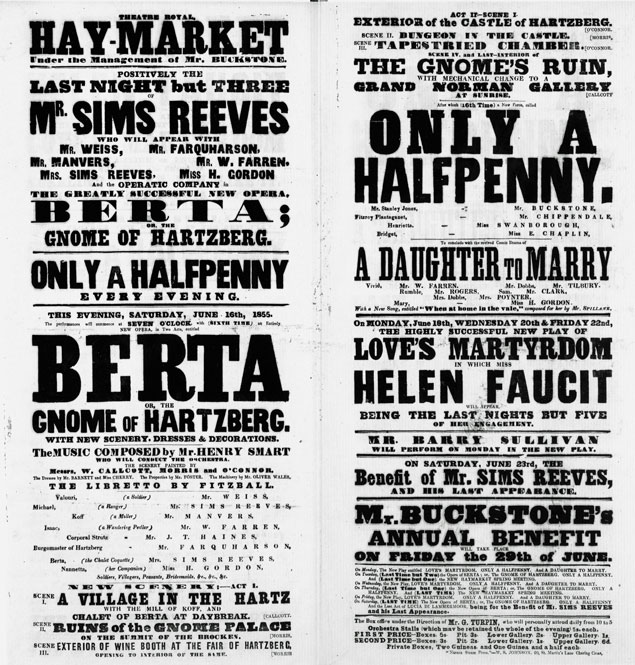
Valouri (a Soldier) Michael (a young Ranger) Koff (a Miller) Isaac (a wandering Pedlar) Corporal Strutz |
- John Haines [2] |
|
Burgomaster of Hartzburg
Berta (the Chalet Coquette) Nanneta (her Companion) |
- Emma Lucombe (Mrs Sims Reeves) |
Conductor - Meyer Lutz
[2] Hains in the libretto list. The libretto submitted to the Examiner had Mr Bass as Corporal Stutz
History
The Era (May 27, 1855) noted that the premiere had already had "two or three postponements" before again being postponed on May 27 due to Emma Lucombe's (Mrs Sims Reeves's) indisposition. According to The Times (June 21, 1855) the opera's final performance was on June 23. This was claimed to have been because "other arrangements"[1] had been made but then Sims Reeves was suddenly re engaged to appear at the Haymarket the following week in Guy Mannering so possibly falling attendances were the cause.
Sims Reeves included it in his visit to Dublin in November 1855 but with Jenny Bauer as Berta instead of Lucombe. Its final performance was probably for the benefit for Lucombe when the troupe went to Birmingham in December 1855. As usual numbers from the piece were included in concerts for a further couple of years. This was Smart's first opera and the experience seems to have discouraged him from pursuing an operatic career.
[1] William Spark, Henry Smart: His Life and Works. (London: William Reeves, 1881) , p. 22. Pages 18-22 have a short section on the opera but it has little new information.
Plot
The main thread of the plot as given in the Daily News (Jun. 4, 1855) may be summarised as [1]:-
The opera centres on Berta, a charming and kind-hearted village girl whose vanity and ambition often lead her to mistreat her devoted lover, Michael. The story begins with a quarrel as the couple prepares to attend a nearby fair. Irritated by Berta’s pride and demanding behaviour, Michael leaves without her. Although Berta pretends to be pleased by his departure, she soon regrets her actions and decides to follow him to the fair with a friend facing similar romantic difficulties. The narrative then introduces Valouri, a young soldier who has secretly returned to his native village after many years away. Local tradition tells of a ruined castle haunted by a gnome-king who lured young women to their ruin. In reality, this mysterious figure had been the immoral Baron of Hartzberg, who used the legend to conceal his misconduct. Before his death, however, the Baron acknowledged his lawful marriage to Valouri’s mother, making Valouri his legitimate heir. Returning in disguise, Valouri discovers the strained relationship between Michael and Berta and devises an elaborate plan to cure Berta’s vanity and restore harmony between the lovers. Disguised as a mysterious stranger, Valouri gains Michael’s confidence by claiming supernatural knowledge of his affairs and promising a magical charm that will win Berta’s affection. He then orchestrates a series of dramatic events, first implicating Michael in a theft and later persuading the Burgomaster that Michael is the Baron’s heir. Michael is celebrated as the new Baron, while Berta, believing she has lost him, is filled with remorse and sorrow.
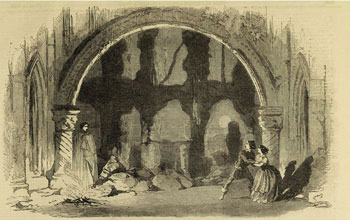
In the second act, the deception is reversed when Valouri reveals himself as the true heir, leading to Michael’s arrest for impersonation. Berta is prevented from speaking to Michael and is publicly chosen by the Baron as his intended bride, intensifying her despair. Valouri privately explains to the Burgomaster that Michael is innocent and that the entire scheme is meant to test Berta’s love. He secretly rescues Michael, reunites the lovers, and directs them to the legendary Gnome’s Ruin. There, disguised once more as the mythical gnome, Valouri subjects Berta to a final trial of devotion. Convinced of her sincere love and transformed character, he reveals the truth. The haunted ruins are magically transformed into a splendid hall, |
 Illustrated London News (June 16, 1855) |
where Michael and Berta are joyfully united in marriage amid festive celebrations
[1] The original synopsis was summarised using Chatgpt and then checked against the libretto.
Reception
The Sun (June 4, 1855) was very fulsome about all aspects of the opera but elsewhere, while most reviews were very positive about the music, the libretto was sometimes criticised and the fact that the Haymarket did not have the resources for a top class performance was often cited.
Fitzball, the librettist, rationalised the opera's lack of
success in his memoirs [1]:
The opera, or rather operetta of Mr. Henry Smart, "Berta," was
produced at the Haymarket. Mr. and Mrs. Sims Reeves, Wiess (sic),
Manvers, William Farren, &c., playing the various parts. Music is by
no means in its ascendent (sic) at this theatre; the book,
too, was not ponderous enough for the weight of the composer's work,
consequently this opera, excellent and appreciated as it really was,
aided also by the finest scenery, by Mr. Calcott, as well as the
finest singing, by Reeves, failed of attraction, simply because the
public do not seek music at this house. In his next attempt to do
himself anything like justice, Mr. Smart must adopt a more important
subject in a much larger theatre.
The Daily News (Jun. 4, 1855) was full of praise for the piece. "Berta is of a very high order" with "expressive melody, skilful construction, and rich and varied instrumentation". "But it is by far too long, and very considerable curtailment is requisite for its permanent success", although it noted the applause on the first
night. Like Fitzball, it also saw its
performance at the Haymarket as a handicap
In regard to the performance, we cannot say that it did justice to the
work, but it was as good as could well be expected at a theatre where
opera is only a secondary object. Mrs. Sims Reeves, in the part of the
heroine, acted with intelligence and spirit, and sang like a good
musician; but her person and voice did not "realise" (to use an
American word) the character.
Reeves, Weiss and, to an extent
Gordon were also praised but
As to the orchestra and chorus, we can
say nothing in their praise. An orchestra and chorus cannot be good
unless they are part of the regular establishment of a musical
theatre.
The Illustrated London News (June 9, 1855) thought that Fitzball's libretto had "good points, and affords room for musical effects; but its plot is excessively complicated, and so confused as to be sometimes unintelligible". "The music is charming" . "So far there is nothing to find fault with; but the effect of the music was almost destroyed by the discords of an orchestra that could not play, and a chorus that could not sing". It reckoned that "The intrinsic beauties of the piece, nevertheless, triumphed over the defects of its performance" and that several numbers could not "fail to become popular, both in the concert-room and in the private musical circle".
The Standard (June 4, 1855) spoke very highly of Smart's musical abilities and his past works, "But why, with such high pretensions, has he allied his music to such a worthless libretto". Even "in the most foolish days of English opera books we never had anything thinner, poorer, and sillier than this". It excused the Haymarket's manager, John Buckstone, that the execution "was in many places ragged and undecided" because "The Haymarket is not a professedly operatic theatre". The singers were praised and the opera "placed prettily on the stage". The opera, "notwithstanding its great length, was extremely well received".
The Morning Chronicle (June 4, 1855) did not agree with much of the above the criticism particularly of the
opera's execution
Berta may be
esteemed a deservedly successful, as well as highly meritorious
composition; and there can be no doubt that it will prove a "trump
card," if not to the management at least to the music sellers. The
execution of the opera was in almost every respect admirable for its
beauty and completeness, Mrs. Sims Reeves, notwithstanding her recent
illness, sang with a feeling, a grace, and a truth, which has rarely
been surpassed. Mr. S. Reeves was equally excellent; while Mr. Weiss
and Miss H. Gordon acquitted themselves of their respective parts in a
manner which left nothing to be desired. The orchestra was in
sufficient force adequately to interpret the score, and the chorus was
careful and steady in every passage.
[1] Fitzball, Edward. Thirty Five Years of a Dramatic Author's Life. Vol. 2. (London: T.C. Newby, 1859), p. 377.
Comment
As with many other English operas, the actual performance included material not signed off by the Examiner.
The casual anti-Semitism typical of the era makes an appearance here. Michael's apparent theft is from a Jew called Isaac, who is given distorted dialogue clearly meant to imitate what Jews were supposed to sound like. Fitzball, the librettist, had shown similar prejudices in his libretto for Rodwell's The Sexton of Cologne (1836), although not the dialogue style. One suspects that he was a past master in knowing what would gain a laugh.
Scores and librettos
The libretto sent to the Examiner was actually a printed one bu Chappell of London (British Library, Add MS 52954 H). It was titled Berta, Legend of the Hartzberg and described as a Comic Opera. It was received on May 3, 1855 and the licence sent back on May 4.
A printed copy of the libretto (London: Chappell, 1855) is available at the Library of Congress and is titled Berta, The Gnome of the Hartzburg, a Romantic Opera. There are some differences from the printed one submitted to the Examiner, in particular Act 2 has quite a few additions and omissions compared with the Examiner's copy.
The scores of six numbers were published as
separate songs:- "Scenes of yesterday depart", "Sad was the hour",
"Oh! what a happy life",
Recordings
None known
Books, Articles, Online
None known.
 |
 |
 |

 |
|
|