  |
 |

|
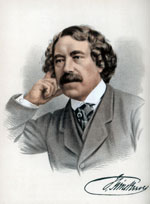
  John Sims Reeves1818-1900 [1]
being recruited it is difficult to see how he could have fitted in with Harrison, who looked to take the tenor leads. Only later as part of E.T. Smith's short lived rival English Opera company did he sing in some further premieres: Macfarren's Robin Hood (1860) and Wallace's The Amber Witch (1861). More generally Reeves moved away from opera into concerts and oratorio. Financial problems caused him to continue to sing into his 70s when well past his best. A few months before his death on October 25, 1900, he was granted a Civil List pension of £100 a year "in consideration of his eminence as a singer, and of his straitened circumstances" [5]. Sims Reeves wrote two books about his career: Sims Reeves: His Life and Recollections, (London: Simpkin Marshall & Co., 1888) and My Jubilee (London: London Musical Publishing Company Ltd., 1889) and one on his singing methods, On the Art of Singing (London: Boosey & Co., 1900). Books by other authors include: H. Sutherland Edwards, The Life and Artistic Career of Sims Reeves, (London: Tinsley Bros., 1881) and Charles E. Pearce, Sims Reeves: Fifty Years of Music in England, (London: Stanley Paul & Co., 1924). Augustus Gurney in his unfinished biography of his brother, Archer Gurney, included the following description of Sims Reeves [6]: It was through [Howard] Glover that my brother and I had the happiness to make the acquaintance, and later to acquire the friendship, of our great English tenor Mr Sims Reeves. We first met Reeves at Glover's, a night or two before he made his debut on the 6th Decr. 1847 at Drury Lane, and took the town by storm as Edgardo in Lucia di Lammermoor with Madame Dorus Gras as the Lucia. He sang to us "Fra Poco", and I need not say that we sat entranced. That was the first of many golden hours spent in listening to his glorious voice, animated by the soul within, and we soon learnt to value the man as such as we admired the artist. May I here express a very little of the wild delight with which we have listened to Reeves? Never have our souls been so musically stirred to their depths as by his enchantments. And as we felt, so felt the general public. Again and again we have seen the audience rise at him enthusiastically in order the better to give the better vent to their rapturous feelings. We loved his style all round, and thought him equally unsurpassable in a simple ballad, an oratorio, on the Italian stage, or say by way of contrast in The Beggar's Opera. Our lives have been enriched by him. Ineffaceable is the happiness which we owe to his genius. A great artist, every great artist, deserves men's gratitude. Could anything be wanting to his complete success? Nothing at this day; but for a time it was the fashion in 'society' to contrast his grand effects unfavorably with the level and pleasing efforts of certain Italian singers. And [Archer] Gurney's indignation was aroused, and he burst into song. The following lines from his Transcendentalists will speak for themselves. In Reeves the rarest qualities combine; Art’s highest Magic, and the glow divine Which kindles generous souls with nameless force, Which vulgar fashion reprobates as coarse. That mean and small refinement which would throw Convention's pall o'er all, above, below: - A voice, which ranging wide, possesses still A sympathetic quality to thrill; Now charms you like the zephyr's softest tone, The nightingale's bewildering forest-moan, Now like the storm-wind wakes to glorious strife, And kindles passion's billows into life: All by that task controlled, that instinct high, No study can achieve, no art can buy, Heav'ns gift at birth, which, falling from above, Attuned the artist's soul to light and love. Hear him as Edgar Ravenswood complain: This is no forced, no artificial strain; Your soul lies whelm'd 'neath those deep seas of grief Until a sigh, or tears, must yield relief. Hear him of Nelson's death the burden sing, Where is the heart would not responsive ring? Even Fashion's slaves are rapt beyond control And start to find they still possess a soul. But oh! in Handel's strain, that awes and charms, List him as Samson taunt the giant's alarms, Or else as gentle Acis trill his lay, Or as brave Maccaboeus fire the fray; Or hear him in those strains most rapt of all, As Jepthah mourn his one loved daughter's fall, And then, with heart-restoring melodies Follow her angel-wafted to the skies. - Can critics list, and coldly say "’Twas well?" And can the Public wake not to the spell? It wakes, to momentary glow it wakes: Beneath the charm Convention all forsakes; The vast crowd thrill with joys unknown till then, And Music stirs the hearts of Englishmen. But soon that most unwonted ardour dies, Ardour that must its owners much surprise. The crowd goes home, and mutters, "I declare, Reeves does sing finely though." "Yes, very fair," "Not in good taste, though, quite, but he'll improve", And so the dull world slides along its groove.
Those burning lines may at least serve to show how one sympathetic poet-soul appreciated another.
[1] According to Reeves's My Life and Recollections, p. 14, he was born on October 21, 1821. He also put his age as 20 on the 1841 census. However, the 1901 supplement to the Dictionary of National Biography, Vol. 3, has September 26, 1818. This date is also given in an October 25, 1818, baptism record for John Reeves with mother, Rosina, and father, John, musician in the Royal Artillery. Quite why Reeves should claim a different date is not clear. [2] The 1838 date is from Grove Music. Reeves in My Jubilee (p. 13) says that he made his debut in December 1839. In His Life and Recollections (p.16) he says that it was in Guy Mannering for a George Barker Benefit. However, that was on December 14, 1838, (Newcastle Courant, Dec. 14, 1838) so Reeves looks to have got the date wrong. [3] Sims Reeves: His Life and Recollections, (London: Simpkin Marshall & Co., 1888), pp.21-22. In the 1841 census Reeves described himself as Professor of Music at the Theatre Royal, Drury Lane. [4] Reeves's marital history is a little strange. His marriage to Charlotte Emma Lucombe took place on November 2, 1850 and the certificate is accessible on ancestry.com. He described himself as Gent, even though he was a well known singer by this time. The baptism record of his son Ernest, February 1, 1855, also listed his profession as Gentleman, so he obviously wanted people to see him more than just a singer. The Era (Sep. 28, 1895) claimed that he had been married before but no supporting evidence has been found and he described himself as a Bachelor on the 1850 certificate. Following Lucombe's death on June 11, 1895, he married Lucy Maud Richard in September 1895, reported by The Era (Sep. 21, 1895) and listed on Ancestry.com. The Irish Times (Oct. 3, 1895) and other papers claimed he had married Maud Rene, a pupil, whose first public appearance, advertised as a pupil of Reeves, had been listed in the Daily Telegraph (Feb. 21, 1894). Presumably Rene was Richard's stage name. She later attempted a career singing songs particularly associated with Sims Reeves but her tour of Australia ended with aspersions of insanity and her bringing a court case for libel (Truth, Perth, Australia, Oct. 28, 1905). [5] The Era (Aug. 4, 1900) [6] Augustus Gurney, A Remarkable Clerical Career. ed. David Gurney (Market Harborough: Troubadour, 2025), ebook - https://troubador.co.uk/bookshop/biography/a-remarkable-clerical-career , pp. 423-426. Archer Gurney officiated at the baptism of Reeves's son Ernest Archer Reeves and possibly other of his children. |
 |
 |
 |
  |
|
|