  |
 |

|
  Amilie* or The Love TestMusic by William Michael Rooke,Libretto by John T. Haines
Theatre Royal, Covent Garden, London
|

|
General Count der Tiemar
Gervaise Grenadot (his valet) Jose Speckbacher } ( Chamois Hans Meyer Pierre /Aderl
} Courier Amilie Vernet (a Young Orphan) Lelia (Hostess of the Golden Grapes) Barbet (Servant to the Inn) |
-
John Wilson |
Conductor - William Rooke [1]
[1] The Morning Post (Dec. 4, 1837) reported that Rooke "directed upon this occasion", thus following the convention at that time and implying that someone else took later performances. This was presumably George Rodwell, whom Macready had retained on taking over the management (Morning Post, Oct. 2, 1837) only for them to fall out a few months later (The Observer, Apr. 1, 1838).
History
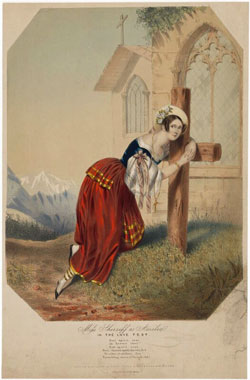
Macready followed up John Hullah's unimpressive Barbers of Bassora with William Rooke's Amilie or The Love Test. It has been claimed that Rooke composed Amilie, or The love test back in 1818 while in Ireland [1]. However, its librettist, John Haines, lived in London and only started writing for the theatre in 1823. It is
|
Jane Shirreff in Rooke's Amilie |
unclear whether there was an 1818 version, which Haines then revised and reworded, or whether Rooke might have written the music for other purposes back in 1818 and then used it with Haines's libretto or whether, which seems most likely, he composed afresh for Haines's libretto[2]. Macready complained on October 21 that Rooke "came into my room and insisted that his opera could not be done for three weeks. We had a long altercation... but it appeared at last that Mr Rooke had not the music ready to give to the band !!!" [3]. This has all the hallmarks of contemporary English opera composition with a last minute rush to complete it. Whatever its origins, Amilie was premiered at Covent Garden on December 2, 1837, and achieved considerable success being performed over 50 times during the season [4]. Macready's Journals for August 5, 1837 [5] recorded that he agreed to pay Haines and Rooke £10 a night for the first ten nights, £15 for a further ten and £10 for fifteen more nights, after which, presumably, he paid nothing. £100 was paid upfront. The Standard (Dec. 7, 1837) wrote that Macready had presented Rooke with a £100 note "as a small token of his esteem and respect", but it is not clear whether this was in addition to their agreement. It added that Macready had been paid £1000 by Cramer, Addison and Beale for the music rights. On the other hand the Morning Post (Dec. 8, 1837) reported that it had been told that Rooke received £500 for the copyright. The latter would have been the more usual arrangement. Macready revived the opera at Covent Garden the following season. |
The True Sun (Dec. 4, 1837) shone an interesting light on the sorts of pre-performance manoeuvres that went on. It noted that, in this case: We have had no puffs preliminary; no prefatory paragraphs of private dress rehearsals and public insinuations that such and such movements would doubtless become popular, and command an extensive sale. Moreover, we noticed several music publishers, and many professors in the pit; the same men on other occasions we have seen in the boxes on a first night; we, therefore, take it for granted that all these people paid for their places. On October 15, 1838, the opera premiered at the National Theatre, New York, performed by a touring company under the leadership of two of its London stars, Jane Shirreff and John Wilson, and Edward Seguin[6]. Michael William Balfe sang the role of Tiemar during a six week visit to Dublin with John and Mary Wood (Mary Paton) at the end of 1838. It was given in many cities in Britain, Ireland and the US over the next few years and was still being revived well over a decade later. The Era (Nov. 10, 1850) wrote that its staging at the Royal Grecian Saloon in London in 1850 "proved most attractive". The Seguin troupe gave it in their 1841, 1844, 1845 and 1851 seasons [7] and it was performed at the Olympic theatre, New York in 1849 [8]. In 1859, George Balmore [9] chose it for his benefit at the Marylebone Theatre, London. William Lyster's Company gave it in Melbourne in 1863 with Lucy Escott as Amilie but does not seem to have been a success [10]. As late as 1866 it was advertised for the Royal Cambridge Music Hall in London (possibly just excerpts) [11]. A scene and a chorus from the opera were included in the "Modern Irish Music " section of the Feis Ceoil's inaugural concert in 1897 [12]. |
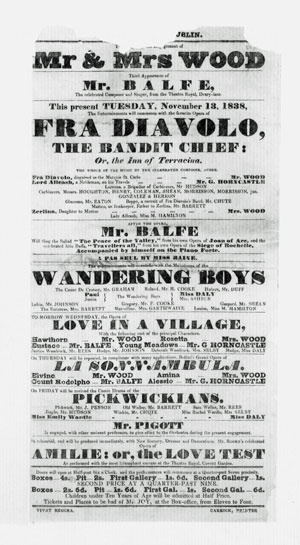 Dublin Playbill, 1838 British Library Playbills |
[1] Paul Collins, "Rooke, Michael William", Dictionary of Irish Biography. Available at https://www.dib.ie/biography/rooke-william-michael-a7794 [accessed Dec 4, 2021]. No contemporary reports have been found that support this date. The earliest reference to the 1818 date that has been found is in Eric Walter White, The Rise of English Opera (London: John Lehmann, 1951), p.93, which he repeated in his, A History of English Opera. (London: Faber and Faber, 1983), p.263. In both books he referred to the opera as both Amilie and Amalie.
[2] Louisa M. Middleton, "Rooke, William Michael",
Dictionary of National Biography, 1885-1900, available at
https://en.wikisource.org/
wiki/Dictionary_of_National_Biography,_1885-1900/Rooke,_William_Michael
[accessed Dec. 4, 2021] implied the last with talk of Rooke devoting
"his leisure to the composition of an opera" after he had become
established in London.
[3] William Toynbee (ed.), The Diaries of William Charles Macready, Vol. 1 (New York: G.P. Putnam's Sons, 1912). p.419
[4] Harold Rosenthal, Two Centuries of Covent Garden.(London: Putnam, 1958) , pp.82-83. Abraham Bassett, The Actor-Manager career of William Charles Macready, (Ohio State University: PhD thesis, 1962), Appendix B, p. 475 gives a total of 54 performances in 183701838 and 9 in 1838-1839.
[5] Sir Frederick Pollock (ed.), Macready's Reminiscences and Selections from his Diaries and Letters, (London: Macmillan and Co. 1876). p. 426.
[6] Katherine Preston, Opera on the Road. (Urbana: University of Illinois,1993), p. 52.
[7] Preston, Op.Cit. p.229.
[8] Vera Brodsky Lawrence, Strong on Music, Volume 1 (New York: Oxford University Press, 1988), p. 590.
[9] Sunday Times (Sept. 25, 1859)
[10] The Age (Jan 20, 1863), Harold Love, The Golden Age of Australian Opera (Sydney: Currency Press), p.74.
[11] Sunday Times (Apr. 15, 1866).
[12] Freeman's Journal ( May 18, 1897)
Plot
The Times (Dec. 4, 1837) outlined the plot:
Amilie is an orphan girl, betrothed to Anderl, a young man who has gone to the wars. He has, however, promised to return in a year and she relies steadfastly on his fidelity. Meanwhile she is persecuted by the addresses of Jose, a lawless hunter, who tries every stratagem to compel her to become faithless to Anderl. His comrades fire her cottage in the hope of forcing her to seek shelter with Jose. She however finds a friend in the Count der Tierner, who has just returned to his estate. The Count has discovered a long lost son in Anderl, and learning that he is in love with the humble Amilie, has promised to consent to their union if the damsel prove faithful for a year. The absence of Anderl is purposely contrived to put her love to the test (hence the second title). Jose perseveres in his attempts, although he is a little daunted by the prophecies of a gypsy, Pierre, who tells him all attempts will be fruitless. He extorts from her a promise, that if she loses Anderl, she will accept none but himself, and then forges a letter from Anderl, whereby she is made to understand that the latter is married. She almost loses her senses, and, to the horror of Jose, resolves on taking the veil; however, the story is brought to a happy conclusion by the appearance of Anderl, who has throughout watched the fortunes of his beloved in the disguise of the Gipsy, Pierre. |
.
Reception
Macready had few expectations of the opera: "The new opera was rehearsed, with which I was most dissatisfied. The composer is a man of genius, obstinate on his own theories, and the writer is a conceited fool"[1]. However, rather begrudgingly on its premiere, he acknowledged: "Saw the new opera, which, silly as the words are, and overweighted as it is with music, was quite successful" [2] .
Unusually for English opera, The Times (Dec. 4, 1837) praised the librettist who had "discovered that the words of an opera need not necessarily be revolting trash. Not only are his verses inoffensive to common sense, but in many instances even poetical". Further,
To call this a composition of promise would be but small praise; it is a most meritorious performance, and few English operas produced in the course of years would bear any comparison with it.
The Observer (Dec. 4, 1837) also judged the text to be "of a very superior description to those which of late have been offered to a composer" and was fulsome in its praise of the composer, "numerous sprinklings of beauty of composition", except for thinking some choruses too long.
The Examiner (Dec. 10, 1837) was ecstatic: "We hardly know which to admire this pleasing production for, as a work of art, or as a work of inspiration". It did qualify the praise:
Let us here observe that in speaking of the character and sentiments of the persons in this noble opera, we do not speak of the absurd trash of the libretto. The genius of the musician alone has given body and shape to the creations worked upon, and familiarized them to us for ever.
...
But the beauties of the opera are crowding so fast upon our memory, that we are quite at a loss to know which to give preference to.
John Bull (Dec. 3, 1837) thought that the "literary portion of the opera is bald, disjointed and uninteresting" but "the music will go far to redeem these wants". The Athenaeum (Dec. 9, 1837) wrote that the music was "of the lighter German school and partakes both of its beauties and its faults. There is much pleasing melody, and the orchestral accompaniments are full and appropriate". On the other hand the "first impression of the drama itself was that it was tedious and uninteresting". The critic, presumably Henry Chorley, saw it a second time "and we think still better of the music, and still worse of the drama". While the story was not a bad one, "it has been most lamely and inefficiently treated".
The most negative report was from The Satarist (Dec. 10, 1837). It also was critical of the libretto, "anything inferior hardly can be imagined". It was a bit more positive about the music which "is generally pleasing, sometimes pretty, seldom more" but believing Rooke to be "more indebted to his memory for imagination" and pointing out what it saw as some of the plagiarisms. However, it did find the music not undramatic and highlighted one scene that it thought "exceedingly effective".
The Examiner (Dec. 10, 1837) was full of praise for Jane Shirreff's first two solos but her execution of the last song "was cruelly ineffective", which it put down to insufficient flexibility of voice. The other soloists were also congratulated. "The fall of the curtain was followed by the most heartfelt and genuine applause we ever heard". The Athenaeum (Dec. 9, 1837) picked out several numbers and singers for praise but was also critical of Shirreff and that "she would do better, if she did not try to do quite so much. She attempts to out Malibran Malibran, and this interferes with the fair display of a talent of her own".
Some commentators mentioned the fog, which seemed to have been so thick in the theatre that "it did not allow [the scenery] to be seen to the greatest advantage" [3].
[1] William Toynbee (ed.), The Diaries of William Charles Macready, Vol. 1 (New York: G.P. Putnam's Sons, 1912). p.428
[2] Sir Frederick Pollock (ed.), Macready's Reminiscences and Selections from his Diaries and Letters, (London: Macmillan and Co. 1876). p.436
[3] Morning Herald (Dec. 4, 1837)
Comment
Macready's lack of sympathy with opera can be seen in his dealings with Hullah on The Barbers of Bassora and with Rooke on Amilié and later on Henrique. He gives the impression of not really understanding opera with his comments on Amilié being "overweighed" with music. Perhaps he expected it to work as spoken drama with musical additions, as tended to be the model in his younger days. Similarly, he probably judged singers and their vocal capabilities by the standards of actors, not taking into account the great difference in voice production between the two and the greater risk with voice problems for singers.
Scores and librettos
The manuscript submitted to the Examiner is available at the British Library Add MS 42943 ff.148-221. The covering letter was dated November 23, 1837 but there is no signoff date either on the manuscript or in the Lord Chamberlain's Day Book. An 1862 edition of the printed libretto (Melbourne: E.M. Abbott, 1862) can be found at Google books and at the National Library of Australia. The vocal score (London: Cramer, Addison & Beale, 1837?) is at http://en.opera-scores.com and archive.org. The printed vocal numbers (London: W. Wright, 1837?) can be found at the HathiTrust and Google.
As might be expected there are quite large differences between the manuscript and the 1862 printed libretto, no doubt reflecting changes over the years. The plot remains much the same. The manuscript and printed vocal items are mainly identical, the main difference being that some of vocal items shown in the manuscript were omitted, probably to reduce the running time.
Recordings
No excerpts are known
Books, Articles, Online
Gabriella Dideriksen, Repertory and Rivalry: Opera at the Second Covent Garden Theatre, 1830 to 1856. (King's College, London: PhD thesis, June 1997), pp. 270-277 discusses the opera.
Katherine Preston, Opera on the Road. (Urbana: University of Illinois,1993), pp. 50-56, has a section on the opera [1].
[1] On p.56, Preston also asserted that it had been composed 20 years before its 1838 appearance.
 |
 |
 |
  |
|
|