
 |
 |

|

 Royal English Opera Company
|
|
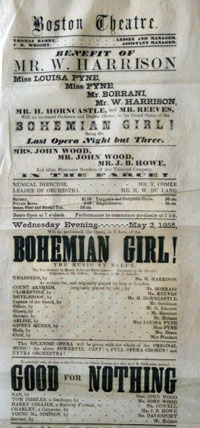
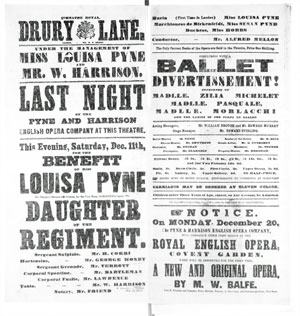
Louisa Pyne and William Harrison first sang together in concerts in 1841. From 1849 their careers became increasingly intertwined singing together at several London theatres and on tour. At the end of the 1851-1852
Bravo's Bride (1860), The Puritan's Daughter (1861), The Armourer of Nantes (1863) and Blanche de Nevers (1863), Wallace's Lurline (1860), The Amber Witch, Love's Triumph (1862) and The Desert Flower (1863), Benedict's Lily of Killarney (1862), Macfarren's She Stoops to Conquer (1864), Mellon's Victorine (1859), Glover's Ruy Blas (1861) and Clay's operetta, Court and Cottage (1862) Out of season the company toured that season's operas for two or three months as well taking on individual concert engagements. Their touring was quite ambitious and comprehensive. For example, their stay in Sheffield, in April 1858, promised a chorus of 16 and a band whose core was 14 musicians, presumably the section leaders which were then augmented by local players. Balfe's The Rose of Castille was promised "with new Scenery, Dresses and Appointments"[11]. Generally they were very well received although their visit to Dublin in May 1859 was not altogether a success. The Dublin Evening Mail (May 30, 1859) ventured a thoughtful answer, which has something of a modern ring: |
In the ensemble the Pyne and Harrison company were superior to many of the Italian parties that visit Dublin. But our general public are, alas! not educated up to the appreciation of a band, well provided by performers on every special instrument, so as to give due effect to the instrumental portion of the operas, and a chorus numerous and efficient both in choral utterance and stage grouping... The band was little short of perfection and we think the best we have had in our Dublin theatre... under the direction of a consummate musician and experienced conductor, Mr Alfred Mellon, one now second to none in these kingdoms. Hence it was quite impossible that the operas could be given with anything but completeness.
... [However, the public had grown used to Italian companies formed around a nucleus of star singers.] ...
For these reasons we wish our public would learn to know, that for the performance of an opera there is more required than three or four singers of great name, and that a work well rendered in all its vocal and instrumental requirements - though not having those three or four great singers, is as a whole, superior in general effect and instruction. Two or three great vocalists, with all subsidiary parts, either neglected or unfitly represented, is not opera.
After the end of their management, Harrison took over Her Majesty's Theatre for the 1864-65 season in order to stage a season of English opera. Louisa sang in some of the operas and, rather inadvisedly, seems to have helped fund it losing what remained of her money [12]. It seems inconceivable that having lost so much at Covent Garden the pair should risk the rest of their money on a similar venture.
Michael Burden has written on the rules that Pyne and Harrison laid down for their company. See here.
[1] Daily News (Aug.24, 1854) reported their departure the previous "forenoon". Katherine K. Preston, Opera on the Road: Traveling Opera Troupes in the United States, 1825-60. (Urbana and Chicago: University of Illinois Press,1993), p. 304. Preston (pp. 214-304) has a chapter on the Pyne-Harrison Company's history in the US. Ruth Lamb, "The Artistic Life of Louisa Pyne", The Girl's Own Paper. Vol 14 (1893), pp 247-248 and p. 340 has a more anecdotal account. Also Anton Reiff, Touring the Antebellum South with an English Opera Company. ed. Michael Burden. (Baton Rouge: Louisiana State University Press, 2020). Reiff was their musical director but although he described their itinerary and incidents along the way, he has almost nothing to say about the other persons on the tour and nothing to say about their performances. Despite their success, there were some less than fulsome reviews. The New York Times (Nov. 12, 1855) wrote that "Miss Louisa Pyne was the only artist that could be listened to with satisfaction - the tenor and second soprano being barely tolerable, and the basso only a few degrees above mediocrity".
[2] Their 1862-1863 season went from August to March.
[3] Charles L.Kenney, A Memoir of Michael William Balfe. (New York: Da Capo Press, 1978), p. 246. Kenney states that Augustus Harris was stage manager but he was only that for the Italian Opera season. Edward Stirling was stage manager for the Pyne-Harrison company.
[4] The Morning Post (Mar. 19, 1860) printed Harrison's closing address to the 1860 season in which he stated that £79,788 had been spent on "artists, authors, rent etc." over the previous 3 seasons. Over the 8 years of the company, they claimed to have paid out £200,000 (Morning Post, Mar. 21, 1864). The figure for Lurline comes from Gratton Flood, W.H. William Vincent Wallace. (Waterford: The Waterford News, 1912), p.28.
[5] Luigi Arditi, My Reminiscences. 2nd edition (London: Skeffington and Son, 1896), p. 96.
[6] Lamb, p. 341
[7] Mrs Whiffen (Blanche Galton), Keeping off the Shelf. (New York: E.P.Dutton & Co, 1928). p.27
[8] Kenney (p.252) states that Balfe was to write an English opera for them to be delivered
at the respective dates of October, 1861, 1862, and 1863. The composer was to receive three hundred pounds for the exclusive right of acting, singing, and representing at any place or places wheresoever for three years, and another hundred pounds for the optional right if claimed for a further term of two years immediately after the first. One hundred and fifty was payable on the 20th of October of each year specified, and the remainder on the day after the first night of performance . There was a further stipulation that the managers were to supply the opera-book and to charge one hundred pounds for the right of printing the words with the music, and in no other shape.
In addition, Balfe would have continued to hold the publications rights for which he now regularly received £1000.
[9] Lamb, Loc.Cit.
[10] The Morning Post (Mar. 21, 1864) gave its appraisal of the company's problems as well as printing Harrison's closing address.
[11] Sheffield Independent (Apr. 17, 1858).
[12] Edward Stirling, Old Drury Lane. Vol. 1 (London: Chatto and Windus, 1881), p. 194 stated that Harrison lost £20000 and Pyne £12000 on the Her Majesty's Theatre venture, the remains of the fortunes that they had built up. Publicly, Louisa never seems to have been linked to Harrison's undertaking other than to sing there but, if Stirling is to be believed, she did put money in. Stirling was their stage manager at both Covent Garden and Her Majesty's.
 |
 |
 |

 |
|
|