
 |
 |

|

 The Maid of Honor*Music by Michael William BalfeLibretto by Edward Fitzball
Theatre Royal, Drury Lane, London
|
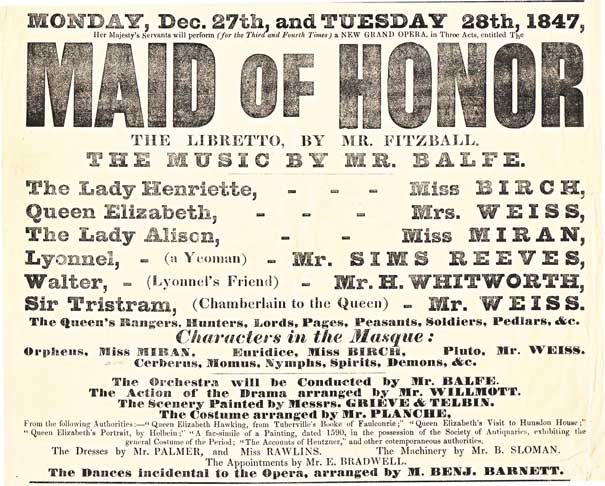
Sir Tristram (Chamberlain to the Queen) / Pluto Lyonnel (a wealthy young Yeoman) Walter (his Friend) Queen Elizabeth Lady Henriette / Euridice ( Maids of Honor) Alison / Orpheus |
- Willoughby Weiss - John Sims Reeves - Henry Whitworth - Georgina Weiss - Charlotte Ann Birch - Mira Moran |
Conductor - Michael William Balfe [1]
[1] Balfe conducted the first three performances according to the Musical World (Jan. 8, 1848) and Hector Berlioz many of the remainder
History
In the summer of 1847, Louis-Antoine Jullien took over the Drury Lane lease, which Alfred Bunn had given up in May 1847. Jullien was best known as a concert conductor and organiser but decided that he also wanted to stage opera and hired Hector Berlioz as his musical director. He also lined up Balfe to write an opera.
Balfe's opera is sometimes claimed to be based on the libretto used by Friedrich von Flotow's in Martha that premiered in Vienna on November 25, 1847, a month before Balfe's. According to Max Maretzek, at that time employed at Her Majesty's Theatre and, for a short while, by Jullien, Balfe told him that he knew about Flotow's opera and had
heard Flotow's Martha in Vienna last year. I like his music, but I prefer the libretto to the music and wish to try my hand at it. I shall introduce an additional character in the plot, Queen Betsey, and have some military display; and anyhow, if Flotow's Martha ever passes the limits of its fatherland, and should reach London, I shall have advantage of the first impression in my favor. [1]
Maretzek's recollection cannot be correct given that Flotow's opera premiered less than a month before Balfe's. In fact, Balfe's starting point was an entirely different source. Jules-Henri Vernoy de Saint-George had produced a scenario for a ballet, Lady Henriette, ou la Servante de Greenwich, which was successfully given in Paris in 1844 and for which Flotow had provided some of the music. It was subsequently given at Drury Lane, premiering there on April 15, 1844. According to an article in The Era (Mar. 10, 1844) the ballet was itself based on a comedy, Comtesse d'Egmont, of some ten years previous. Flotow was using a libretto by Wilhelm Friedrich Riese (writing under the pseudonym W. Friedrich) based on the ballet. Balfe was in Vienna in the autumn of 1846 and might have become aware of Riese's libretto and Flotow's intention to set it. However, The Observer (Dec 26, 1847) stated that Fitzball used the St. Georges scenario and this can clearly be seen from the events and people that he included but which did not occur in Riese's libretto [2].
Jullien had to cut short a successful run of Donizetti's Lucia in order to stage Balfe's opera. According to the Sunday Times (Dec. 23, 1847), Jullien stood to forfeit £200 if he failed "to produce his opera three nights at least before Christmas, in order that his songs might be in the shops to meet the Christmas sale"[3]. In practice it was only given twice before Christmas but presumably that was sufficient. Any sense of urgency can only have been exacerbated by Balfe's usual tardiness over the score, not finishing it until December 4, 1847 [4], and by Jullien's chaotic management [5], including failing to apply for a licence until the day of performance thus risking having to cancel it [6]. In fact the printed libretto was sent for permission rather than a hand written manuscript as was usually the case. Jullien had to use several debutants as many of the regular Drury Lane English opera performers had gone with Bunn to the Surrey Theatre, although this proved to be little handicap in the event.
Tyldesley (p.151) claimed that Balfe's score showed that he wrote recitativo secco throughout the opera rather than dialogue. Given Balfe's lack of success with it in Catherine Grey (1837), as well as it being unpopular and increasingly old fashioned, it would have been an odd choice. No commentary mentioned such recitative as would be expected because of its novelty so that it must have been abandoned for the usual spoken dialogue.
In all 22 performances were given ending on February 16, 1848 [7], although the final act was given separately on a few dates after that. Thus it was not Balfe's least successful commercial venture, as Tyldesley suggested, compared to the twelve of Catherine Grey (1837). Given Balfe received £600 from his publisher, Chappell, and a further £200 from Jullien for the performance rights, it was quite lucrative for him [8].
The opera was never given anywhere else nor revived in London but various parts of the music, particularly the ballad "In this old chair", were given throughout the rest of the century and beyond.
[1] Max Maretzek, Revelations of an Opera Manager in 19th Century America (New York: Dover Publications, 1968. This comprises two volumes by Maretzek : Crotchets and Quavers (1855) and Sharps and Flats (1890). The quote comes from the latter volume, p. 73. Maretzek also reckoned that Balfe conducted Flotow's opera at Her Majesty's Theatre but in fact the scheduled 1852 performances did not take place and the Italian version was not given until July 1, 1858 at Covent Garden conducted by Michael Costa. An English version was first given at Drury Lane by the Pyne and Harrison company on October 11, 1858 under Alfred Mellon.
[2] For example, the inclusion of Lyonnel enlisting as a soldier in his despair at losing Henriette, the stage presence of the Queen, the incident of the bolting horse, the insertion of a court masque and Lyonnel going mad that were all part of St Georges' scenario but did not occur in Riese's libretto.
[3] James Planché tried to persuade Jullien to pay the forfeit and postpone the premiere because the current opera, Donizetti's Lucia, was doing so well taking £400 a night (James Planché, The Recollections and Reflections of J.R.Planché, Vol. 2 (London: Tinsley Brothers, 1872), pp. 133-134). Planché provided help with the historical details (Illustrated London News, Dec. 18, 1847), which claimed, according to the playbill, to be based on Elizabethan portraits.
[4] William Tyldesley, Michael William Balfe: his life and his English operas, (Aldershot, UK: Ashgate Publishing, 2003), p.152.
[5] Edward Fitzball, Thirty Five Years of a Dramatic Author's Life. Vol. 2 (London: T.C. Newby, 1859). p.180-184
[6] The Observer (Dec. 26, 1847).
[7] According to the theatre listings in The Morning Post.
[8] The Era (Jan 7, 1848)
Plot
The plot was set in Greenwich as in St-Georges original ballet, rather than Richmond, as in Riese. The time was in Queen Elizabeth I's reign, whereas St-Georges and Riese had set it in Queen Anne's.
Lady Henriette confides in Alison about her boredom at court. Sir Tristram enters with a bouquet for Henriette but she quickly disabuses him of any interest on her part. The women mock him until hearing a crowd singing as they go to the forthcoming statute fair, where servants are hired for the following year. Henriette and Alison decide to dress as peasants and go to the fair. They inveigle Tristram into going with them. At the fair, Lyonnel and Walter enter looking to hire servants. They see Henriette and Alison and hire them, despite the women confessing they don't know how to do any household chores. After the fair ends, Henriette and Alison try to leave but are told that they are bound by their contract having taken the men's money. Back at the men's house, the women prove themselves incompetent but the men are charmed by Henriette's singing. The women try to escape but are prevented by Lyonnel who confesses his love for Henriette. Once Lyonnel has gone to sleep, Tristram turns up and helps them escape.
Act 2 is set in the Royal Park. Hunters and soldiers enter, including Lyonnel and Walter. Their celebrations are interrupted by the arrival of the Queen. Walter recognises Alison when her mask falls. All go off to the hunt except for Henriette who is resting. She is found by Lyonnel who renews his pleas but she rejects him. The Queen's horse bolts but is stopped by Lyonnel. She ennobles Lyonnel and gives him a sword and a ring which he can use to ensure that any demand is fulfilled. Lyonnel asks that all the women unmask but Henriette has already disappeared so he is frustrated in his efforts.
|
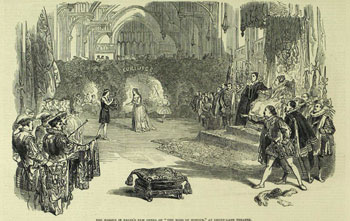
Act 3 is set in the Throne Room as courtiers prepare for a masque [1]. The Queen enters, acknowledges Lyonnel and signals the masque to begin. The masque is based on the Orpheus legend with Henriette playing Euridice, Alison as Orpheus and Tristram as Pluto. As Euridice is saved, Lyonnel throws himself at Henriette's feet. He then threatens to kill himself with a sword given him by the Queen. There is general turmoil as Henriette confesses all to the Queen and they work out how to cure Lyonnel's madness. They decide to take him back to his house and that Henriette and Alison will once again enter dressed as peasants. Henriette sings the song that Lyonnel loved so much and he recovers. All ends happily. |
Lyonnel recognises Henriette as Euridice in the masque Illustrated London News (Jan. 8, 1848) |
[1] Berlioz had an early and continuing interest in Gluck's music and was later to make a version of Orphée. It is tempting to think that Berlioz's enthusiasm might have influenced Balfe to switch from St Georges' scenario that used Juno and Venus to Orpheus and Eurydice. The contralto Orpheus looked forward to Berlioz's edition of the opera over 10 years later which made the same substitution for Orpheus.
Reception
Fitzball (p.185) reckoned that Balfe thought the opera, "his most polished performance", but this is difficult to credit in the circumstances. Fitzball remarked that "very few of us best judges of ourselves" seeming to imply that he also had doubts. In the opposite to the usual verdicts on Balfe, the critics were generally positive, several praising a more coherent structure in the music rather than a string of ballads, while audiences were not, mainly because there was only one memorable ballad.
The opera had hardly the best of preparation possibly because of Balfe's tardiness and the pressure to stage it before Christmas. The Observer (Dec. 19, 1847) wrote that at the final rehearsal, Reeves was missing, the orchestra recalcitrant and that people were working to mar its prospects. The following week it was happy to report that these problems had been corrected and the opera as success:
the melodic matter, in which it is superabundant, being well chosen; the score being most fascinating in its vocal development; and the whole being instrumented with richness, with wisdom, with taste, and with discretion. Unlike his earlier operas, which were mostly aggregations of ballad airs, the composer here emulates higher models.
It was "one of the best as well as one of the most signally successful operas ever penned by an Englishman (sic), and as such ever produced in this country". Despite such fulsome praise it wrote that "the execution of the opera was not satisfactory; in fact the performance on this occasion was the only full rehearsal it had ever undergone, which will account for many grave errors". It thought that all the debutants, save Whitworth, made a good impression. It also went to the next performance which showed a "manifest improvement and with a still more distinct and more decided success" than the opening night.
The Daily News (Dec. 21, 1847) was of much the same opinion:
brilliant and well deserved success - a success, which will stand the test of time, for this is unquestionably the best work, on the whole, that this prolific composer has yet produced...
No operatic performance, at all comparable to this, was ever witnessed in an English theatre
The Era (Dec. 26, 1847) wrote that "without hesitation, we pronounce it, musically speaking, his best opera", although "we do not think it is likely to become so popular as The Bohemian Girl, because it does not abound in catching and detached melodies". "At the same time, the concerted pieces are of a higher class". While Charlotte Birch was a first class concert artist it had had doubts about her acting abilities but it was able to "chronicle her complete success as a dramatic vocalist". "Miss Miran almost rivalled Miss Birch in the success which attended her debut". "Mr Reeves sang with great taste, and fully sustained his reputation". Some, however, thought that "his languishing deportment smacks much too obviously of personal conceit not to kindle occasional sensations of objection and disdain"[1].
The Literary Gazette (Dec 25, 1847) was particularly generous in its praise of Mira Miran, "We never remember to have heard so young a performer sing with such accuracy, and seizing every point so well throughout her part". "Mr Reeves sang exceedingly well, and acted with great feeling". However, on Miss Birch it thought that after a career focused on the concert platform, "Her manner is now so excessively stiff and wanting in expression, that her excellent singing is deprived of much effect". On the other hand, The Sun (Dec. 21, 1846) thought that "she is as great an actress as a singer". For whatever reason, Birch made no further appearances on the operatic stage.
The Illustrated London News (Dec. 25. 1847) was less sure about the opera. Even though, "the voice of journalism has generally been strongly in favour...we must take leave to doubt whether the opera can be permanently attractive, and whether it will add to Mr. Balfe's fame". One reason was that it thought the plot too thin for a "grand opera" and the scenes included to fill it out "impede the progress of the action". Further, "The composer's inspiration seems to have been infected by the monotonous plot...It is the worst instrumental piece we have heard from Balfe - without plan, design, or coherency". One particular complaint was the beginning of Act 2, "Are we never to be relieved from the eternal Chorus of Hunters, introduced in opera".
Henry Chorley in the Athenaeum (Dec. 25, 1847) was complimentary about all the main soloists but was scathing of Fitzball's libretto:
The text ...is an absurdity - the old mixture of bombast and namby pamby. From first to last, it perilled the singers - made a difficult story doubly hazardous - and must have operated, though possibly unconsciously, as a clog on the composer. No good opera can be written to such words which will keep the stage with a refined public.
The Atlas (Dec. 25, 1847) dismissed it as "showy and superficial" and while allowing Balfe "some prettiness and elegance" judged that "there is nothing new in it, nothing which corresponds to the musician's idea of composition".
[1] The Standard (Dec. 21, 1847)
Comment
The differences in Balfe's and Flotow's approaches
Fitzball, for Balfe, and Riese, for Flotow, show some interesting differences in their approach despite being drawn from the same source. Fitzball's is very much a traditional approach with an external figure to the five main protagonists, the Queen, putting everything right. Riese keeps the action very much within the five who eventually sort matters out for themselves. This keeps the action much tighter, particularly as it does not include the extraneous masque. Riese's Lyonnel has fallen out of love with Henriette, his depression having shades of Goethe's Werther and has to be coaxed back into it by reproducing their original meeting. Balfe and Fitzball went for the more dramatic, but less convincing, madness cured as often in opera by a song. In general, they ignore much of the comic potential of the misunderstandings and the changing differences in status between the protagonists in favour of a more run of the mill melodrama.
Interestingly, neither librettist could break out of the 19th century constraint of needing to raise Lyonnel's status so that he can marry Lady Henriette. Riese resorted to the device of him being the unknown son of an exiled aristocrat while Fitzball has him rewarded for saving the Queen, both rather awkward contrivances.
Why was Jullien seen as a new dawn of English opera?
From the perspective of today, there seems little to choose between the management of Alfred Bunn and that of Jullien, nor was there in the eyes of The Atlas (Dec. 25, 1847). However, Jullien's efforts were clearly seen by some as a step change in quality and ambition. The Sunday Times (Dec. 26, 1847) wrote:
That which we have long hoped and contended for has at length been accomplished, and we have now, in the fullest meaning of the term, a national opera in a national theatre.
Jullien was a consummate showman and had several years of successful, popular and, presumably, lucrative concerts behind him. His promises, as outlined in the Era (Aug. 29, 1847), included a large and varied repertoire and an orchestra of the best instrumentalists and a chorus of a hundred, all drawn from Her Majesty's and Covent Garden. Such promises must have sounded very sweet to those used to Bunn's erratic, shoestring operation. Unfortunately, Jullien had neither the funds nor expertise to see it through, vast amounts were lavished on productions, singers did not get paid and opera production ground to a halt within three months. While his efforts were almost certainly doomed, the unsympathetic attitude of Balfe's publisher in enforcing a premature deadline cannot have helped and shows the power such people wielded in the operatic world.
Scores and librettos
The libretto submitted to the Lord Chamberlain is in the British Library, Add MS 43008, ff. 877-895[1]. It is just a copy of the printed libretto published in London by Chappell in 1847. This is available at the Staatsbibliothek zu Berlin and Hathi Trust .
The British Library has a vocal score but it consists only of the main numbers as listed in the opening pages of the libretto. The score of the balled "In this old chair", its best known number, can be found at the Library of Congress, Hathi Trust and IMSLP . The score of the opening madrigal, "Lo! the bee on fairy wing", is available at the University of Wisconsin-Maddison.
[1] ff 895 is just an advertisement
Recordings
"In this old chair" is on a CD of songs, Balfe: Songs and Arias., Kay Jordan, Peter Dempsey, Guy Rowland. Victorian Opera Northwest WRW 204-2, 2008
Books, Articles, Online
William Tyldesley, Michael William Balfe: his life and his English operas, (Aldershot, UK: Ashgate Publishing, 2003), pp. 150 - 154 goes into the history and a few points of the structure of the opera, most notably the use of recitativo secco.
There is a little information in Walsh (pp. 198-199), Kenney (pp. 218-219) [1] and Barrett (pp. 192-194) but almost nothing in Biddlecombe's book. (see book list). Sims Reeves wrote about it in his Life and Recollections, (London: Simpkin Marshall & Co., 1888), pp. 65-68 and in My Jubilee (London: London Musical Publishing Company Ltd., 1889), pp. 76 - 77, but there is little new information on the opera.
[1] Kenney wrongly claims that "Oh, smile as thou wert wont to smile" is a balled from The Maid of Honor but it is actually from The Daughter of St Mark.
 |
 |
 |

 |
|
|