
 |
 |

|

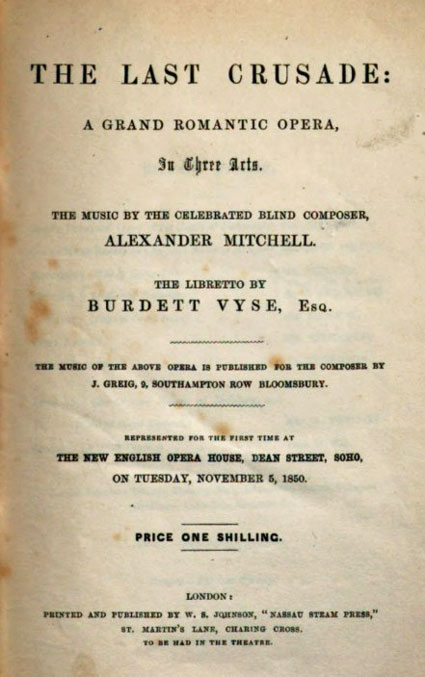
 The Last CrusadeMusic by Alexander MitchellLibretto by Burdett Vyse
New English Opera House (Royalty
Theatre),
London
|
|
Count Dietrich (Lord of the Castle of Liebenstein) Count Hugo Elbegast (Rejected Suitor of Armgard)
Heinrich (Heir of Liebenstein) Hermann First Knight Second Knight
Armgard (An Orphan Heiress of Steinberg,
Zulieka (A Greek Captive) |
-
Charles Durand
|
Conductor - Mr Anschuez [1]
[1] Bell's New Weekly Messenger (Nov. 10, 1850). Mitchell conducted the earlier private performances
History
The first mention of the opera seemed to have been in early 1846.[1] It then had a trial performance at the Hanover Square Rooms on October 12, 1846, although it sounds as if the libretto was read out and then the music included as required. It was characterised as "a clumsy and imperfect exposition " but "not deficient in cleverness and dramatic effect".[2] The opera had not been submitted to the Examiner at that point as it was a private performance. A similar effort, possibly performed as intended with the spoken dialogue, was made at the Music Hall, Bedford Square, on August 16, 1848.[3] The reception was claimed to be enthusiastic. The overture was given by Queen Victoria's private band in Buckingham Palace on February 27, 1849.
The first public performance of the opera was as Die treuen Bruder in Brunswick, Germany, in 1850, where again it was said to have been successful. It finally achieved a public performance in London at the New English Opera House on November 2, 1850, but the enterprise closed within a few days. In 1860, Mitchell instigated a number of concerts in which some or all of the vocal and instrumental music was given in support of the Milton Society for Improving the Social Standing of the Blind, for example, at the Horns Tavern, Kennington, on April 20,1860.[4]
[1] The Observer (Feb. 8, 1846) quoting The Globe
[2] Morning Herald (Oct. 13, 1846)
[3] The Era (Aug. 20, 1848)
[4] The South London Chronicle (April 28, 1860).
Plot
Supposedly based on legends associated
with the castle of Liebenstein, the plot concerned two brothers, Count Heinrich and
Rudolph, both of whom are secretly in love with Armgard, an heiress and the ward of their
father, Count Dietrich. Count Hugo, the evil genius of the opera, had also sets
his heart on her, but has been refused. He learns from her that
Rudolph is the favoured one and determines that Rudolph shall
not have her. He causes confusion all round by having Armgard think a
present from Heinrich is actually from Rudolph so having her show her
gratitude for it and give Heinrich the idea that he is the favoured
one. In his disappointment Rudolph signs up to go off on a crusade
under Hugo's command. Heinrich learns of the mistake too late to stop
Rudolph so goes off after him on the crusade.
The scene then changes to Palestine, and the assault and
burning of Nazareth. Heinrich is captured but is helped to escape by a beautiful Greek slave,
Zulieka, who brings him to Rudolph's camp. Heinrich tells Rudolph of
Hugo's duplicity but Hugo turns up and arrests Heinrich. He says that
he will spare his life on condition that Rudolph will
become a Knight Templar. Rudolph agrees to this on condition of
a last meeting with Armgard before taking the oath of the
order. Armgard, in the
meantime, has been surprised at not hearing from Rudolph since his
departure. Her ladies tell
her that a body of crusaders is approaching, with Rudolph at their
head, who details the events which occurred in Palestine and
that they must part forever. Heinrich also arrives with Zulieka.
The
final scene is set in the Hall of Knight Templars as Rudolph is
preparing for his inauguration. Count Hugo
exults in the success of his revengeful scheme but, before the ceremony
is completed, Heinrich enters, and, in the name of the Emperor, arrests
Hugo and abolishes the Knight Templars. The two couples can now
finally wed.
Reception
There were few reports on the performances, partly because of the unfamiliar venue and its very short life. It is clear that the performance was very poor, none of the singers being experienced opera singers and probably stage direction being minimal; Mitchell, being blind, only able to rehearse the music.
The Illustrated London News (Nov. 9, 1850) did not mince its words reflecting that such a large city as London
with
all its musical and vocal
resource
could have
produced such an exhibition of
incompetency and puerility. The
only relief to the annoyance
caused by the melancholy
display, being that it
presented itself nearly
throughout a three-act opera -
"The Last Crusade" by Mr.
Mitchell, the blind composer -
as a burlesque; and as such was
laughed at by those amateurs
who could not feel how much
injury was done to "native
talent" by the disastrous
performance; whilst, on the
other hand, the "friends" of
the establishment, by a series
of parodies on great lyric
triumphs, in the shape of
encores, re-calls. and
ovations, were adding fuel to
the flame of disgust and
discontent. Criticism on Mr.
Mitchell's pretensions is
utterly disarmed by the glaring
deficiency of the execution.
For the future foundation, on a
permanent basis, of a really
National Opera-House, nothing
could be more fatal to art and
artists than Tuesday's " Last
Crusade."
The
Era (Nov. 10, 1850)
withheld its judgment:
When the
Last Crusade was
originally represented at the
Grand Ducal Theatre, Brunswick,
the German critics were loud
and almost unanimous in their
approval of it as a musical
composition; they spoke of the
boldness of its conception,
melodious phrases, and high
dramatic colouring. For the
life of us we could not see it
on Tuesday. But this probably
might have arisen from the
defective manner in which
self-evident propositions were
misrepresented. The merits of
some of the songs burst through
the barriers which bad singing
impaled them in, while two or
three of the concerted pieces
indicated musical capabilities
of no common order. The acting
was out of all character, and
frequently author and composer
were travestied beyond
endurance. Some of the choruses
were passable, and exhibited
traits of careful rehearsing ;
but the performance, as a
whole, was a dead failure. It
would be, therefore, ridiculous
to attempt a critical analysis
of the real merits of the blind
composer until his work is
performed so as to give us some
definite idea of his meaning.
At present we have it not.
The Observer (Nov. 10,
1850) was a little more
positive:
The opera being
produced on a very limited
scale and being sustained by
principals who were totally
unaccustomed to the stage,
anything like a detailed
opinion of its effectiveness is
impossible. Still the attempt
to procure a hearing for the
work at a time when no operatic
theatre is open, was creditably
made, and the scenery and
costumes displayed superior
taste on the part of the
manager. Several of the pieces
were encored, and at the end
the composer, Mr. Mitchell, was
twice called forward with the
greatest enthusiasm.
The Weekly Dispatch
(Nov. 10, 1850) also tried to
be sympathetic to the effort:
We do not feel bound to speak
without reserve upon the merits
of the vocalists, all of whom
were new to the stage, and of
course laboured under
disadvantages common to
debutants. There was much
talent displayed; but while we
say this we are quite sure that
many additions and some
omissions of performers must be
made before the undertaking can
be turned into a profitable
speculation to the managers,
and become a useful one to the
public.
Comment
The Weekly Dispatch (Oct. 13, 1850) in welcoming the new company touched on one of the problems
bedevilling English opera:
This theatre has been taken by an operatic commonwealth, for the purpose of bringing out the works of English composers, and of fostering
generally native musical talent. In an age in which there is so much
exclusiveness practiced, and when an author's or performer's success
depends so much upon his being known, this scheme will be found a
great boon to many who have not been able to appease managerial
dignity, or conquer its prejudices.
On November 10, 1850, the same paper
elaborated a further danger that
Singers belong, like poets, to the
genus irritabile, and we trust no professional jealousies
will mar the success or prejudice the advancement of "the
commonwealth".
Scores and Librettos
The manuscript of the libretto passed by the Examiner is in the British Library, Add MS 43030 ff.229-289. It was licenced on October 29, 1850. The printed libretto (London: W.S. Johnson, 1850) is available at the Library of Congress and the HathiTrust. There are few differences between the manuscript and printed librettos.
There do not appear to be any full or vocal scores of either the opera or individual numbers. Unusually the music was published by John Gregg, one of the singers.
Recordings
None are known
Books, Articles, Online
None are known
 |
 |
 |

 |
|
|