  |
 |

|
  The Devil's OperaMusic by George Alexander MacfarrenLibretto by George Macfarren
English Opera House (The
Lyceum), London
|

|
The Marquis Posillipo (a Venetian Noble) Pepino (his page) Count Giulio Villardi (a Florentine soldier) Sig. Herman (Scholar of the University) Giacomo Perendelli (a Gondolier) Chief of "the Ten" Diavoletto
Medora (Daughter of the Marquis) Signora Giovannina (her Gouvernante) |
|
History
By 1838, the English Opera house was clearly failing in its initial ambition to stage new English opera. Samuel Arnold had given up the management in 1836 and a brief takeover by Alfred Bunn was followed by a cooperative. In 1837, Macfarren offered El Malhechor using a libretto from his father but the EOH had no baritone suitable so it was dropped. The following year, they offered to put on an opera if he could provide one that fitted their current company, which included the pantomimist, George Wieland. The result was The Devil's Opera which was brought out in about 10 weeks [1]. Money was short and much must have been spent on the staging leading Macfarren to augment the orchestra with several friends who played for free [2].
Despite such an unpromising beginning, the opera ran for over 50 performances and was revived the following year for 12 performances during Michael William Balfe's short lived management of the EOH. It was rumoured to be going to be given at Covent Garden in 1842 but that did not happen. It was performed for a few nights in Sydney, Australia, in October 1851. Finally a performance (probably a concert performance) was given in Taunton in 1888 on its 50th anniversary.
Macfarren [3] gives a humorous account of the opera's rehearsals and some of the pitfalls that transpired during performance. This was probably typical of most English opera around that time:
The English Opera House did not succeed. The company was compounded of singers and actors, each of whom regarded the unattractiveness of the other party as the cause of failure. Money was not fluent, small dividends were paid, and general anarchy was consequent...
Mapleson, the copyist (father of the Italian Opera adventurer), refused to continue the transcription of the music, until paid for writing the first two scenes - an impracticable event, under the state of the treasury. Practice was thus delayed till arrangements could be made with Goodwin that he should copy the parts on risk, and be paid a nightly guinea for their use throughout the run of the opera. When the study was nearly completed, the choristers, discontented with their quota, demanded payment in full, which being impossible, they deserted. New delay was until a new chorus could be enticed into the scheme, with whom the task of teaching had to begin afresh.
At length, Monday, August 13th, was fixed for a first performance. On the 12th the overture was finished, and given over to the mercies of the copyist as we went down to a night rehearsal, which was the last, in order that the singers might not be fatigued on the morning before the evening of performance. I depended greatly on Cooke, (my father's friend of twelve years, and my own, on all occasions when he could serve me,) for support as leader of the band. On the morning I learned of his serious illness, by which he was confined to bed for many weeks. When I entered the orchestra to conduct the opera, the subaltern violinist who was emergently promoted to leadership, and who had primed himself with stimulants for his new and nervous position, begged me to let the overture be slow, or he would not be able to see, much less to play the notes...
On the next morning when all met to exchange congratulations, the Seguins announced that they had signed to start for America in a fortnight; so others had to be found to take their places. George Lejeune ... and Priscilla Horton were the philosopher's stones of the occasion, on whose account rehearsals had to be renewed. Scarcely were they launched in their parts, than Rainforth took a country engagement for certain pay; so Horton was promoted to her part, and Mrs. Serle was her successor in that of Mrs. Seguin [4].
[1] Henry C. Banister, George Alexander Macfarren: his life, works and influence. (London: George Bell and Sons, 1891), p.51 stated that the opera was "begun, rehearsed, and finally brought out within a month" but there is a sketch dated 29 May 1838 and the overture score says sketched June 1838, begun June 1838 and completed 12 August 1838, one day before the performance, George A. Macfarren,The Devil’s Opera. Manuscript score & sketches (1838), Cambridge: Fitzwilliam Museum, MU MS 1062.
[2] Banister (1891), p. 52
[3] Banister (1891), pp. 49-50
[4] Priscilla Horton and George Lejeune took over from the Seguins on August 27 (The Observer, Sep. 2, 1838). Horton had taken over the part of Pepino from Elizabeth Rainforth by September 11, 1838 (Morning Chronicle, Sep. 11, 1838).
Plot
|
In a square in Venice, Count Villardi unexpectedly meets an old friend from university, Herman. Herman, having had a proposal of marriage rejected by the girl's father, is in Venice to help the eccentric Marquis Posillipo with his obsession of bringing a corpse back to life. His reward for a successful attempt will be the hand of Posillipo's daughter, Medora. However, Medora, whom her father has locked in the house, is in love with Villardi. She has seen him from her window and sends him a letter by her page, Pepino, begging for help, The other main characters are Medora's rather nervous governess and Villardi's black slave, Diavoletto, who saved him from imprisonment by the Arabs. Hermann has procured someone to act as a live "corpse", so that he will be able to raise it from the dead. The coffin is sent to Posillipo who proceeds with the experiment before Herman arrives. Amidst fireworks and general mayhem, a body rises from the coffin; it is, in fact, Diavoletto. Herman arrives to be congratulated on the success of the experiment and is bewildered about what has happened. Diavoletto reappears and does some tricks before disappearing. Medora is summoned by her father to marry Herman only to be whisked away by Diavoletto when she gets to the altar. In Act 2, the Council of Ten have got wind of Posillipo's experiment and have had him arrested for communicating with |
Benjamin Webster, The Acting National Drama |
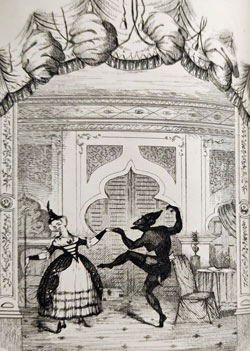
evil spirits. His sentence is to forfeit his estate but, as he is signing the deed, Diavoletto arrives and rescues him leaving the Council in shock. Having been thwarted yet again in trying to get married, Herman is wandering disconsolate when he meets Pepino, who reveals herself to be Stella, his first love. Posillipo has been taken to Villardi's villa where, after more fireworks and incantations, Medora is restored to him. All is explained. Posillipo is cured of his obsession with magic, the two couples are united and Diavoletto is freed from slavery and offered to the governess, who had been promised a husband for her pains.
Reception
The opera received a few glowing reviews The Crown (Aug.19, 1838) thought that "in very few instances have performances of greater promise emanated from native talent". Further it praised the EOH's management committee "for hazarding their joint resources upon the success of this undertaking. The piece is perfectly presented, the cast but immaterially defective; and the scenery, most exquisitely painted". The Age (Aug. 19, 1838) was of much the same opinion concluding that they "recommend everyone who has the interest of English music at heart to go and support an English composer and English performers in a most admirable English opera". The music was pronounced "to be of a very high order".
Generally, reviews were much more mixed. The Satirist ( Aug. 19, 1835) made the broad criticism that
The performance had all the failings which are, it seems, necessarily attendant on a first representation, at least on the English stage; among which the most discreditably apparent was the frequent need of the aid of the prompter.
The length of the piece was a further complaint but, by the 4th performance, the Morning Chronicle (Aug. 17, 1838) reported that it had been "judiciously curtailed" and that "This is all that was wanted on the first night, for the music is of a character to please all hearers, and reflects the highest credit on the composer".
Most were critical of the libretto while finding much to praise in the music, even with reservations. The Morning Advertiser (Aug. 14, 1838) probably summed up the general feeling that the music was "deserving rather for the future promise than for the present excellence which it displays". The Athenaeum (Aug. 18, 1838, p. 589) spoke of "such an unmeaning harlequinade, as is here crammed into a libretto, we do not remember to have encountered before" but "the music... offering us something better to descant on". This verdict was rather tempered by references to "complicated finales - wearisome incantation scenes - overscored airs etc." due to Macfarren's overambitious orchestration. Actors by Daylight (Aug. 18, 1838, p. 197) came to a similar conclusion. On the libretto, "more more execrable trash was never honoured by the notice of a composer" and noted that the author had the modesty to conceal his identity. The music, " generally bespeaks a practical musician and exhibits germs of talent ...but, as a dramatic composer, Mr. Macfarren has much to learn" .
Comments on the performers were mixed. All agreed that Wieland's antics were the foundation of the opera's success and Elizabeth Poole was widely praised. Macfarren added his own tribute to Wieland in the Advertisement at the front of the printed libretto:
This trifle owes a large share of its attraction to the indefatigable exertions and ability of Mr. Wieland, the skilful director of the stage arrangements. and agile personater of the Imp-ersonal spirit of the piece. His merits have received a far more gratifying testimonial in the general eulogiums of the public press, and the nightly applause of crowded audiences, than this poor tribute can hope to afford ; yet, in justice and gratitude, it cannot be omitted or forgotten.
The author's sincere acknowledgments are due to every one concerned in the production and performance of the Devil's Opera, not only for the success of his humble work, but for their kind co-operation in his desire to introduce an aspiring young musician to the public as a British dramatic composer - his feelings of national pride at the result are scarcely outbalanced by the more touching interest which a father naturally takes in the triumph of a worthy and affectionate son.
Of the 1888 revival, the Musical Times (Sep. 1, 1888) noted that, although the work was "more or less out of date", the performance was very successful and thought that the original staged version "must have been exceedingly funny".
[1] During the run, Wieland was injured by a partially open trap, an injury which led to the setting up of a Theatrical Benevolent Fund to help performers when such accidents occurred.
Comment
This is another example of the influence of the immensely popular Thomas Dartmouth Rice and his blackface act, which had been seen earlier in the year in Michael William Balfe's Diadesté (1838). Notwithstanding the claim that "the main notion of the plot is a happy satire upon the taste for the wild and supernatural, so prevalent of late years", it was probably Rice's The Virginian Mummy, first performed in Britain at the Surrey Theatre in July 1836, that provided the model. In it, Captain Rifle persuades a black waiter, Ginger Blue, to disguise himself as an Egyptian mummy to be brought back to life by an elixir devised by an antiquarian doctor, whose daughter Rifle wants to meet [1]. George Macfarren sought to make the whole thing more farcical by employing George Wieland, the best known pantomimist of the day and incorporating pantomime routines. The Macfarrens did not include a patter song along the lines of Rice's "Jim Crow", either because they had never sought to or because they saw it did not go down well in Balfe's Diadesté.
The casual and unthinking attitude to racism and slavery of the times comes through in the opera. The Wieland character is named Diavoletto, little devil, and and is assumed to be black, although there is no necessary reason in the plot why that should be. The Virginian Mummy parentage might also have influenced this choice. There is also an assumption that, having rescued Villardi for no obvious reason, Diavoletto is then willing to become his slave, to be freed at the end as part of the general rejoicing.
[1] Hazel Waters, Racism on the Victorian Stage (Cambridge, UK: Cambridge University Press, 2007), p.104
Scores and librettos
The manuscript submitted to the Lord Chamberlain can be found in the British Library at Add MS 42948, ff 373-398b. The covering letter is dated August 7, 1838. The Lord Chamberlain's Day Book just records the licence grant as in August. The printed libretto was published in Benjamin Webster, The Acting National Drama. vol. 5, 1838, Google books [1]. There are several differences between that and the manuscript, notably the printed version has an extra scene in Act 2 and, for example, at the end of Act 1 there are wavy lines where songs were either meant to be or to have further verses, which are present in the printed libretto. Thus the manuscript was signed off apparently without those items being examined. The Songs, Duets, Choruses in The Devil's Opera (London: E.H. Turnour, 1838) can be found at Google books. It mainly agrees with the printed libretto except that it wrongly places the Act 2, scene 2 in Act 1 and vice versa and omits Act 2, scene 3.
The manuscript score is in the Fitzwilliam Museum, Cambridge, https://idiscover.lib.cam.ac.uk/. A copy of the vocal score (actually a collection of numbers rather than a complete vocal score) is in the British Library.
[1] The printed version specifically says "printed from the prompter's copy".
Recordings
No excerpts are known
Books, Articles, Online
Henry C. Banister, George Alexander Macfarren: his life, works and influence. (London: George Bell and Sons, 1891, pp. 48-55 includes Macfarren's account of the opera's history. It is available online at http://www.archive.org/.
George Biddlecombe, English opera from 1834 to 1864 with particular reference to the works of Michael Balfe. (New York: Garland Publishing, 1994), pp. 153-154, has a short section on this opera and Macfarren's An adventure of Don Quixote.
Some comments on the opera are included in Russell Burdekin, "Sir George Alexander Macfarren, his life and his operas", The Journal of the British Music Society, Volume 32, 2010, pp. 87-88 or pp. 7-8 in the online version here and in Maxwell W. Pettit, "Sir George Macfarren; the Compleat Victorian", The Journal of the British Music Society, Volume 8, 1986, p.28.
 |
 |
 |
  |
|
|