
 |
 |

|

 LéonieMusic by Joseph Francis DugganLibretto by Henri Drayton
Theatre Royal, Drury Lane
|
|
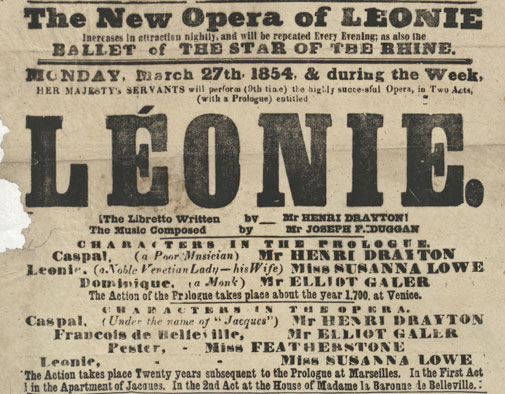
Caspal (a poor musician) Léonie (a noble Venetian, his Wife) Dominique (a Monk) |
Opera
|
Caspal (under the name of Jacques) François de Belleville Pester Thomas (a domestic)
Leonie (a noble Venetian, his Wife) |
- ?
|
Conductor - Joseph Duggan
History
| Joseph Duggan had accumulated a considerable experience in composing songs and incidental music before his first work, a one act "lyrical sketch", Pierre, with libretto by Henri Drayton that premiered at the St James's Theatre on November 5, 1853. It starred just the two Draytons. According to the Observer (Oct. 6, 1853) it achieved "complete success". Others, such as the Era (Nov. 13, 1853), were less enthusiastic with the Daily News (Nov. 7, 1853) writing about the orchestra going on strike for lack of pay after Pierre finished but before the rest of the evening's programme and launching a diatribe against the corrupting influence of the music publishers. Pierre lasted less than a week although the Draytons revived it at Brighton in early 1854. However, Drayton and Duggan were sufficiently encouraged to try a more ambitious effort, Leonie, at Drury Lane. The Morning Post (Mar. 15, 1854) saw this as a deliberate experiment to show that small scale economical operas with a few principals, a small orchestra and no chorus could provide an entertaining show. Drayton's libretto drew heavily on Morris Barnett's very popular Monsieur Jacques first staged at the St. James's Theatre on January 12, 1836 [1]. That, according to the Morning Post, drew on a French adaptation, Le Pauvre Jacques, of Kotzebue's Der Arme Dichter. Drayton added a prologue giving the back history to the story. Joseph Duggan had accumulated a considerable experience in composing songs and incidental music before his first work, a one act "lyrical sketch", Pierre, with libretto by Henri Drayton |
 |
that premiered at the St James's Theatre on November 5, 1853. It starred just the two Draytons. According to the Observer (Oct. 6, 1853) it achieved "complete success". Others, such as the Era (Nov. 13, 1853), were less enthusiastic with the Daily News (Nov. 7, 1853) writing about the orchestra going on strike for lack of pay after Pierre finished but before the rest of the evening's programme and launching a diatribe against the corrupting influence of the music publishers. Pierre lasted less than a week although the Draytons revived it at Brighton in early 1854. However, Drayton and Duggan were sufficiently encouraged to try a more ambitious effort, Leonie, at Drury Lane. The Morning Post (Mar. 15, 1854) saw this as a deliberate experiment to show that small scale economical operas with a few principals, a small orchestra and no chorus could provide an entertaining show.
Drayton's libretto drew heavily on Morris Barnett's very popular Monsieur Jacques first staged at the St. James's Theatre on January 12, 1836 [1]. That, according to the Morning Post, drew on a French adaptation, Le Pauvre Jacques, of Kotzebue's Der Arme Dichter. Drayton added a prologue giving the back history to the story.
Being given so close to the end of the season on April 8, it showed little confidence by the management in its chances of success. The opera managed eleven full performances at Drury Lane, but almost all as a filler to the main attraction and two where just the final two acts were offered. It then transferred to the Marylebone Theatre on April 24, 1854, but did not last the week. Drayton's company gave it in Manchester in July 1855, where, according to the Era (July 29, 1855), it was "very successful". There do not seem to have been any further performances.
[1] Barry Duncan, St James's Theatre, (London: Barrie and Rockliff, 1964), p.20. Also Sunday Dispatch (Jan. 10, 1836). Some sources have 1837.
Plot
The Standard (Mar. 15, 1854)
described the plot:
The opera is in three acts, the first of which
is designated "a prologue". In this we find that the poor musician,
Caspal, has won the heart, and what is more, the hand, of a young
Venetian lady of high birth. The young pair have been secretly married
by a monk, whose sympathies have got the better of his discretion. The
prospect of paternal tyranny as regards a match in another quarter
faces Leonie as a matter of course, and the couple meditate an
elopement, and so avoid the mischief that is brewing. The unfortunate
Caspal is, however, laid hold of by the inexorable "paterfamilias",
and the state of affairs is comprehensively intimated in the libretto,
which tells us, " Leonie falls on the couch beside the window - the
monk in an attitude of profound grief".
Twenty long years
intervene. Leonie, overcome with tribulation, has departed this life,
but revives again in her daughter, who has become a prima donna and
the admiration of all Italy. She lives with the Baroness de
Belleville, whose son Francois has yielded incontinently to the
fascinations which actresses in general, and prima donnas in
particular, are born to exercise. Leonie, with due amiability,
promises the young gentleman her hand - but not until she has
discovered her father, whom she has reason to believe still lives. Of
course he does, for we have already been introduced to a mysterious
old composer, with a gray bead, immersed in poverty, and the prey to
some dreadful memories which have muddied his brain, and we at once
whisper to ourselves - hic est, here is Caspal. Francois is
not behind hand in the general perception, and he takes pleasant
counsel with Leonie, who has an interview with the venerable man, and
resorts to that never-failing alternative - a song of other days -
which clears up all doubts, and brings father and daughter into each
other's arms. Francois wins his bride, and the curtain falls. The part
of Pester, a vivacious coxcomb, who buys old Caspal's compositions and
parades them as his own, has nothing to do with the main thread of the
history, but it supplies the comic element which is specifically
claimed as the characteristic of the opera.
Reception
Most papers just reported the apparent first night success, although several commented on Drayton's unnecessary prologue that lengthened the show to no purpose. There was comparatively little mention of the performance by critics. Instead a few newspapers chose to criticise English opera composers' dependency on music publishers whose unrealistic boosting of an opera's opening night gave an empty promise of success.
The Illustrated London News (Mar. 18, 1854) was very dismissive.
An opera, called Leonie, was produced at Drury Lane on Tuesday night. It possessed no dramatic merit, being a tedious amplification of a little piece, called Monsieur Jaques, brought out in an English dress some years ago, and now entirely spoiled by being spun out into an opera which occupied four hours in the performance. The music is by Mr. Duggan. a young composer who has shown some talent as a writer of songs and ballads; but is evidently unskilled in dramatic composition. The opera, however, had that sort of fictitious success which generally attends the first night of a new musical piece, and which misleads the uninitiated, but is perfectly understood by these who are at all conversant with theatres. The house was packed with friends and clacqueurs, who applauded indiscriminately. forced upon the audience encore after encore, in spite of opposition and enabled the manager next day to announce the piece an "immense hit" and a triumphant success, when, in truth it was a decided and palpable failure.
Lloyd's Weekly Newspaper (Mar. 19, 1854) contended that "four hours of a comic opera are too much; more especially when, unless the bill had previously told you so, you would never have suspected that the opera was comic". "Two hours are more than sufficient". It also warned about the first night success. "These successes are the most ephemeral things we know".
The Daily News (Mar. 19, 1854) complained of the original play being "spun out to its monstrous and intolerable length by a great deal of flat dialogue and an immense quantity of music". Comparing it unfavourably to continental opera, it held that the drama was lost amid a profusion of individual musical items "during which the action stays still and the performance becomes a kind of concert". In Leonie, "The music derived no advantage from its performance". "Miss Susanna Lowe has a good little voice, and sings pleasantly in a small space but Drury Lane is too much for her" . Galer was similarly criticised. Miss Featherstone has a fine voice but nothing more - she has no method or style. Henri Drayton "did not shine". It renewed its criticism of the way English opera composers were rewarded and the hollow success of an opening night [1].
The Morning Chronicle (Mar. 15, 1854) was more positive, "the piece was certainly successful, and were it half the length, we have no doubt would be attractive". "Miss Lowe sang sweetly and correctly". "Miss Featherstone... was lively and engaging". Henri Drayton's "powerful bass voice told with considerable advantage; which is more than we can say for the not very powerful tenor of Mr Elliot Galer". "The band had evidently been most carefully drilled by Mr Joseph F. Duggan".
Reynold's Newspaper (Mar. 19, 1854) spoke of the opera's "considerable success", remarking that Duggan's music "is decidedly of a popular, fluent, melodious, and agreeable character: and although its entire originality may be suspected there is much that proclaims a rich and fertile genius in its composer". The paper did think that "The absence of a chorus was sensibly felt" and that the opera took too long.
The Era (Mar. 19, 1854) was of much the same opinion:
A
professedly operatic piece, which takes nearly four hours in the
performance, requires weightier material than this to keep it up. The
entire loss of chorus weakens the effect, and creates a sentiment of
unsubstantiality, at variance with the elaborate construction of the
libretto.
The music requires but little detail. The ballads are numerous, but there are also a great number of dramatic scenes in which the dialogue is put into recitative, intermixed with airs and concerted passages, more or less illustrative of the words. A great deal of cleverness is evinced by the composer in the conduct of these morceaux d'ensemble. He is profuse in idea, and his instrumentation is broad and vigorous. Most of the music is remarkable for its melodic Italian flow, and certain portions of it, avowedly buffo in character, are full of life and gaiety, while in others are realised those forms of climax in which Verdi is so pre-eminent a master [2].
The Morning Post (Mar. 15, 1854) thought Drayton
has, on
the whole, performed his task judiciously, and although his libretto
requires considerable curtailment, and never soars above the
stereotyped commonplace of the modern lyric drama, it
is, nevertheless, quite as good as most things of the kind which have
come under our notice.
while Duggan's music "has no claim to originality or science, but it is thoroughly theatrical in character, and well calculated to obtain an ephemeral popularity". "All the performers exerted themselves with the utmost zeal, and their efforts were duly appreciated by the audience".
[1] It had made a similar complaint in its review (Nov. 11, 1853) of Duggan's operetta, Pierre, the previous year.
[2] The praise for Verdi is interesting given the earlier hostility from some critics.
Comment
The perverse remuneration structure and the baleful influence of the music publishers
The Illustrated London News (Mar. 18, 1854) followed its dismissal of the opera above with a warning on the damaging longer term effects of such manufactured success.
It is, after all, a short-sighted policy [that] may draw two or three houses for the manager, and, may get [rid of] a few copies of the songs at the music-shops; but it never does either author or manager any substantial good, while it does the public a great deal of harm, by increasing the obstacles to the establishment of a proper National Opera.
Some critics probably found themselves in a difficult position of wanting to push the cause of English opera and thus holding back on their criticism but in doing so, longer term, undermined their case. A root cause that was never addressed was the perverse remuneration structure. Even the best known composers were not usually paid by the theatre but by the music publishers thus forcing them to be looking always to the sales of individual songs rather than aiming for a more convincing overall dramatic coherence. In turn this encouraged publishers to inflate the impact of an opera's premiere to get early sales no matter what the eventual verdict was on an opera nor its potential reduction of the public's confidence in the worth of English opera.
It is interesting that several newspapers chose at this time to criticise the distorted and wasteful system of remuneration that used up so much time, money and effort for such little long term success as it was hardly a new phenomenon. Possibly the growing familiarity of Meyerbeer's and Verdi's operas (Rigoletto premiered in London in May 1853) made some critics all too aware of the shortcomings of English opera and to cast around for the reasons.
Scores and librettos
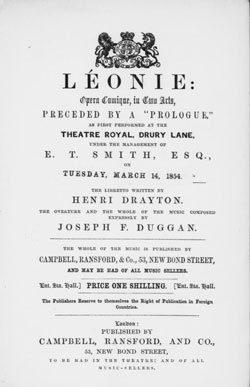
The libretto manuscript is available in the British Library, Add MS 52946 A. It was received on March 3, 1854 and the licence sent on March 4, 1854. An online copy of the printed libretto (London: Campbell, Ransford and Co. 1854) is available at the Library of Congress. The text is almost identical to that in the manuscript.
The British Library has the scores of eleven numbers from the opera.
Recordings
None known
Books, Articles, Online
None known.
 |
 |
 |

 |
|
|