
 |
 |

|

 King Charles the SecondMusic by George Alexander MacfarrenLibretto by Desmond Ryan
Princess's Theatre,
London
|
|
King Charles the Second, Princess's Theatre, London (1849).
From the Playbill Collection,
Cast |
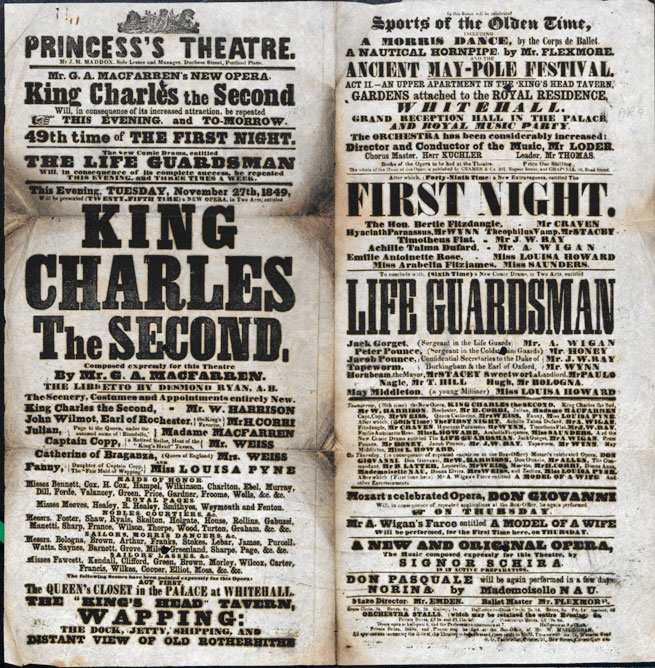
The cast as listed in the printed libretto
|
King Charles the Second
John Wilmot, Earl of Rochester
Julian (Page to the Queen,
Captain Copp (a retired Sailor,
Catherine of Braganza Fanny (Captain Copp's Daughter) |
-
Georgina Barrett |
History
This was the second of four new English operas staged by John Maddox at the Princess's theatre in 1849-1850. Desmond Ryan's libretto was closely based on a successful comedy, Charles the Second or The Merry Monarch, by John Howard Payne,[1] staged at Covent Garden in May 1824. The manuscript score also claims the Ballet of Mary as a source. This was a ballet, Betty, based on the same play with music by Ambroise Thomas produced at the Grand Opéra, Paris, on July 10, 1846 and at Drury Lane on November 16, 1846.
According to the manuscript score, George Alexander Macfarren started work on the opera on February 3, 1847 and got as far as Act 1 before going to the US, where he completed it, sending it back to Britain in September 1848. He was in the US accompanying his wife, Natalia, who had singing engagements there and he included a role for her. It was his third opera to be performed and achieved considerably more success than his earlier ones. By December 6, it had reached its thirtieth performance and continued to run until March 1850. It was then being included in Macfarren's and Edward Loder's benefit night in May 1850. The same cast except for Natalia Macfarren performed the opera in Dublin in June 1850.
A revival at the Haymarket in November 1851 featured many of the same cast, except for Charles Durand in place of Henry Corri, but was much less successful playing for under two weeks. Reynold's Newspaper (Nov. 23, 1851) talked of the "woeful appearance of emptiness" in the theatre. The opera was also given in Manchester in October 1850 with Dolores Nau in place of Louisa Pyne, T.R.Travers (Thomas Romer) for William Harrison, Rosalia Lanza for Mrs Weiss, Rebecca Isaacs for Natalia Macfarren and Mr R Latter for Willoughby Weiss. No other revivals are known, although items appeared in concerts.
[1] Some sources credit Washington Irving as a joint author.
Plot
The Daily News (Oct. 29, 1849) summarised the plot:
|
The subject is what may be called a "lark" of the merry monarch and his favourite the Earl of Rochester, who, disguised as sailors, pay a visit to Wapping, and mingle in the festivities of the "natives", and get into a quarrel with men by being too free and easy with the damsels. Rochester leaves his master in the lurch, and the King, who has been liberal in treating his new boon-companions, finds himself without money to pay the reckoning. Offering his watch in pledge, it is discovered to bear the royal arms, and the unfortunate possessor, suspected of having stolen it, is seized and consigned to durance vile, from which he escapes by jumping out of a window, and finds his way back to Whitehall. The King is led into this |
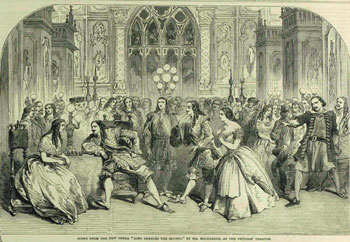
Illustrated London News (Nov. 10, 1849) |
escapade by his friend Rochester, with the Queen's privity, for the not very intelligible purpose of giving his Majesty a moral lesson on the subject of his infidelities and his neglect of his royal consort. The plot is complicated by the introduction of Captain Copp, an old sailor and host of the "King's Head", and of Fanny, his daughter, "the Fair Maid of Wapping", whose reported charms are the bait employed by Rochester to tempt his sovereign to the expedition. There is, further, Julian, a page of the Queen, a lover of Fanny's, who has been in the habit of visiting her in disguise, though it is difficult to imagine how he could have found her out in a sphere so different from his own.
Reception
|
Given that Ryan had closely followed the original successful play there
was little comment on the
libretto, the Daily
News concluding that: The Examiner (Nov. 3, 1849) was "sorry that the language of the songs is such sad rubbish" but was generally positive about Macfarren's music [P]ortions of it are too ambitious... vocal and instrumental combinations much too elaborate and we are fatigued by a vast quantity of music, which wants the life and animation of the drama. On the other hand, this objection made, there remains a greater amount of sweet and effective melody, of pure and beautiful instrumentation, of really simple and picturesque vocal music, than we remember in English operas of recent date.
Lloyd's Weekly Newspaper (Nov.4, 1849) was
similarly impressed: |
|
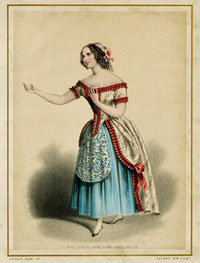 Louisa Pyne
in
in which the action of the drama is carried on - are very numerous, abounding in sweet and pleasing melodies.
The reaction in Manchester when it was revived there the following year was much the same. The Manchester
Times
(Oct. 23, 1850) praising it as:
Light and sparkling, as a comic
piece should be, yet the
musician does not allow it to
degenerate into riot and
confusion, but by throwing in
an occasional touch of feeling
shows skill as well as
scholarship. As an
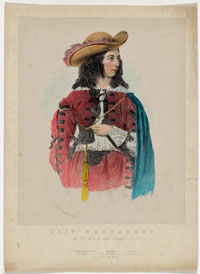
Natalia Macfarren in |
As an indication of the quality of such provincial performances, it did note that the "chorus kept together tolerably well for a first night". With one exception, the verdict on the singers was favourable, particularly Louisa Pyne. According to the Musical World (Nov. 3,1849), this was the first time that she had created a new role. The Examiner commented that "Miss Pyne sang with freshness, ease and brilliancy, acting with quiet simplicity throughout". However, Natalia Macfarren proved a more divisive figure. George Macfarren's close friend, James
Davison, in The Times (Oct. 29, 1849) wrote that |
The Era (Nov. 4, 1849), aware of
Davison's likely bias, [1] countered that the
Egregious and extravagant
eulogies of our daily contemporary (the Times)
render it incumbent on us to denounce his decision on the merits of
Madame Macfarren as erroneous ... We are now compelled to state that
her appearance on the stage of the Princess's Theatre is an injury to
herself and the opera. She has a most unmusical voice, neither pure
soprano nor pure contralto - and the lower notes of which are
insufferable, marring all the effect of her husband's music: her
attempts at execution are ridiculous.
The Examiner was more even
handed,
Mrs
Macfarren was too manifestly nervous and constrained to do
perfect justice to her voice (a contralto of great purity and
extent), but her performance was fairly successful and gave
promise of a graceful, feeling and accomplished dramatic
singer.
As usual the staging was praised, the scene in Wapping and a Maypole dance being particularly noted. The Daily News wrote that "The success of the opera was triumphant". Davison in The Musical World (Nov.3, 1849) concluded that "A more thorough success was never achieved or merited". Apart from its one reservation, The Era was generally happy with the production, "The opera is well put on the stage, and the scenery and adjuncts are of a very superior order. It is repeated every night to crowded audiences, and barring the one great defect, its success is complete". The Examiner summed up that the opera
had all the elements of success - an agreeable story, telling effects in the music, zeal in all the singers, and the charm of freshness and novelty in the heroine. It was presented, moreover, with effective aids of scenery and costume, and the result was a success not more genuine than deserved.
[1] As well as Davison being a close friend of Macfarren, Ryan was Davison's deputy at The Musical World.
Scores and Librettos
|
The libretto manuscript forwarded for approval to the Examiner is available in the British Library, Add MS 43021 ff.642-662b. The covering letter from John Maddox, the Princess's manager, stated that it was sent to be licenced on October 13, 1849, with the plan to perform it on October 20, 1849. The licence was returned on October 17, 1849. As with Loder's Robin Goodfellow and Linley's Francesca Doria, also at the Princess's, it is not clear whether the planned production date was deliberately listed earlier in order to ensure that it was licenced in time or whether the premiere date slipped. Given that it happened with all three operas, it seems likely it was the former. A scan of the printed libretto (London: Chappell and Cramer, Beale and Co., 1849) is available online at the Library of Congress. There are a number of differences between the manuscript and printed librettos and the latter has material that is not in the manuscript and vice versa. In particular the printed libretto has a song for Fanny in Act 2, Scene 1. It is not obvious that any additions had been passed for performance by the Examiner. There are vocal scores of the main numbers in the British Library - you need to search on King Charles II rather than King Charles the Second. |
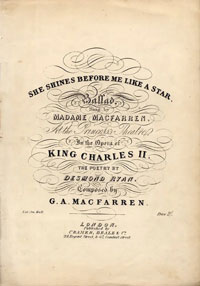 |
The printed libretto, the vocal score and the manuscript score are available in Cambridge University Libraries, see here. They were donated by Macfarren's daughter, Clarina Davenport.
Recordings
None are known
Books, Articles, Online
There is a section on the opera in Russell Burdekin, "Sir George Alexander Macfarren: his life and his operas", British Music. Vol. 32 (2010), pp. 90-91, which can be found online here.
 |
 |
 |

 |
|
|