  |
 |

|
  Domenica or The MotherMusic by John Lodge EllertonLibretto by John Lodge Ellerton
Theatre Royal, Drury Lane, London
|
|
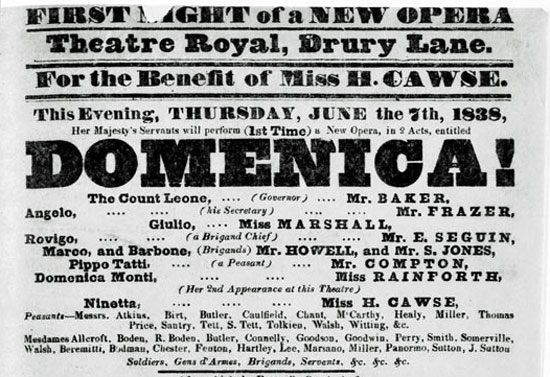
The Count Leone Angelo (his Secretary) Giulio Rivago (a Brigand Chief) Marco Barbone Pippo Tatti (a Peasant)
Domenica Monti Ninetta |
- Mr Baker
|
History
John Lodge Ellerton was a prolific if largely unsuccessful amateur composer in many genres. His only performed opera was Domenica, for which he also wrote the libretto. It was given only one performance. Having been received with great enthusiasm, according to an advertisement in The News (June 10, 1838), a second performance was announced for the following Wednesday but, in the event, it was replaced by Balfe's Diadeste and a comedy, The Poor Gentleman [1]. No other performances of the opera or even numbers from it have been found.
[1] The Theatrical Observer (June 14, 1838)
Plot
Rovigo and his band of Brigands are being pursued by the local government officials. The local peasantry are forbidden to contact the Brigands or to take bread out of the town in case it falls into the Brigands' hands. Increasingly desperate and hungry, Rovigo captures a peasant, Pippo, who is out looking for a lost goat. He forces Pippo to take a note to Domenica asking her to bring him bread. She complies because Rovigo, who is infatuated with her, killed her husband and stole her child years before. She hopes that he will release the child, although, in fact, he has lost the child in a shipwreck. Meanwhile there is a rather querulous subplot between Ninetta and Pippo, who have a very volatile relationship. Domenica is caught with the bread and later Pippo, when the note to Domenica is found. They are due to be hauled up before the governor, who has a ten year old adopted son, Giulio. Rovigo breaks into the place Domenica is being held and offers to free her if she will marry him. She refuses and he escapes again taking Giulio with him. The action ends very quickly when Rovigo is captured, Giulio is freed and, after explanations all round, is found to be Domenica's long lost son.
Reception
Overall there was limited press comment, presumably because it was a benefit night and because that was the only performance. When advertising that a second performance had been cancelled, the Theatrical Observer (June 14, 1838) wrote of the opera that:
Those who witnessed the production of Domenica were by no means profuse in their praise of it; a friend of ours who was present says that several of the pieces of music were in themselves very pleasing, and are likely to become popular amongst amateur singers, but were totally deficient in dramatic effect, indeed so little applicable were they to the business of the scene, that they might with equal analogy be introduced into [any other opera].
Alfred Bunn, the manager of Drury Lane Theatre at the time of its premiere, wrote that "Mr Lodge's opera of Domenica won't do; he is a good musician, but not equal to writing for the stage - perhaps holds himself above it [1].
The Age (June 10, 1838), after noting that at benefits "any absurdities are tolerated", described it as a "meagre affair" and that "The whole was 'flat, stale' and, we fear, to the fair and very deserving beneficiare, unprofitable".
The Morning Post (June 8, 1838) used the opera to mount a more general and bitter attack:
In these days an opera is put in rehearsal and represented with so shameless a disregard of accuracy that it would be difficult for a composer to recognise his own production. A novel system has also been hit upon. Benefit nights are selected to pass off any vapid trash which vanity or ill-judged advice of good-natured friends may vaunt to be prodigiously fine.
Rather snootily, it thought that the dialogue "was essentially of that quality so delightful to the audience south of the Thames [i.e. at the Surrey Theatre]" [2] and that "The whole was a series of unintelligible incidents, crowded one upon the other in the most wearisome manner. The music was monotonous and did little to relieve the tiresomeness of the dramatic portion". Two numbers were felt to have merit and the singers said to have done their best.
The Times (June 8, 1838) commented on "the interesting want of originality in the music", the labyrinthine plot, the fact that it lasted two and a half hours and concluded that it was "fortunate the piece was produced on a benefit night".
[1] Alfred Bunn, The Stage Both Before and Behind the Curtain. Vol. 3. (London: Richard Bentley, 1840), p. 57. Only later did John Lodge add Ellerton to his name.
[2] There was possibly a fear that such a down-market production would damage English opera's claim to artistic status. Something of the same reservations were seen with Zambo's scenes in Balfe's Diadeste.
Comment
It is not obvious why Harriet Cawse chose this for her benefit. Possibly she was
counting on the novelty of the piece to bring in an audience. Possibly Ellerton
paid her to take it. Because Cawse played Ninetta, Ellerton possibly
expanded the rather clumsy and farcical subplot of her and Pippo and
thus unbalanced the opera. He also had little gift for the vocal
lyrics.
One has to wonder just how much
preparation would have gone into such an opera as this. Given the
amount of dialogue, did the singers learn it all or rely on the
prompter or ad lib to some degree, even though they would not be using
the censor approved text?
Scores and librettos
The manuscript of the libretto is in the British Library at Add MS 42946, ff. 741-767b. A transcript can be found here. No printed libretto or vocal items have been found. No scores are known although some numbers might have been published without being linked to the opera.
Recordings
No excerpts are known
Books, Articles, Online
None are known.
 |
 |
 |
  |
|
|