  |
 |

|
  The Daughter of St MarkMusic by Michael William Balfe
Libretto by
Alfred Bunn
/
|
|
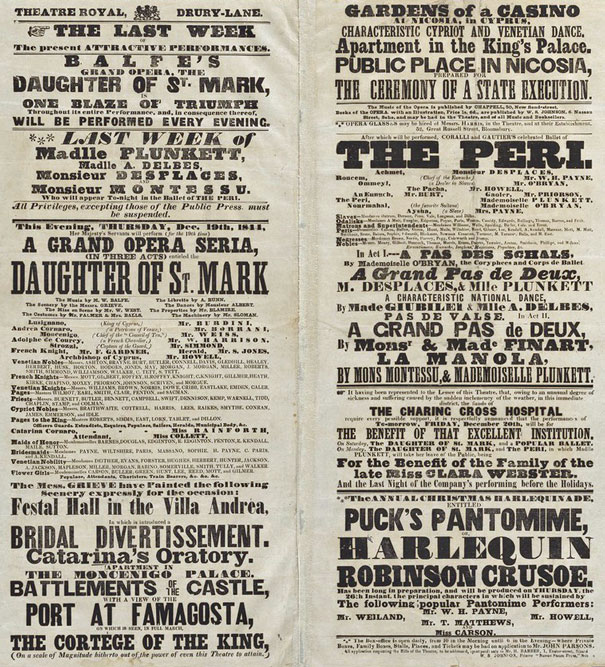
Lusignano (King of Cyprus) Andrea Cornaro (a Patrician of Venice) Moncenigo Adolphe de Courcy (a French Chevalier) Strozzi (Captain of the Guard) French Knight Herald Archbishop of Cyprus
Caterina Cornaro Attendant |
- Elizabeth Rainforth [1] |
Conductor - Michael William Balfe / Francesco Schira [2]
[1] She was replaced by Elizabeth Poole around the start of 1845 but then returned in the role after a few days. Poole was advertised in the press and playbill to appear in the 50th performance on January 27, 1845 but the Morning Chronicle had advertised Rainforth to appear on January 25, so again there was a sudden change.
[2] Balfe conducted the first few performances ending on December 7 (Morning Herald , Dec. 5, 1844). By the 50th performance on January 23, 1845, Francesco Schira had taken over as musical director at Drury Lane, Julius Benedict having resigned in November 1844.
History
|
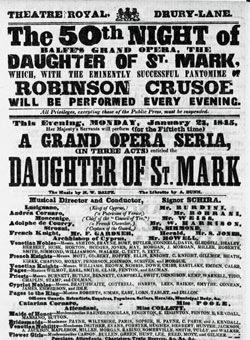
Exactly a year after Balfe's highly popular The Bohemian Girl, Balfe and Bunn premiered The Daughter of St Mark. The opera libretto was by Bunn and was based, as Bunn stated in the libretto preface, on that of Jules-Henri Vernoy de St Georges' libretto for Fromental Halévy's La Reine de Chypre of 1841. Essentially the same text was also set by Franz Lachner as Catharina Cornaro (1841), Gaetano Donizetti as Caterina Cornaro (1844) and Giovanni Pacini as La regina di Cipro (1846). As might be expected Bunn changed the tragic ending to a happy one. In a letter to St. Georges, Balfe claimed that it took "2 months 7 days to compose, rehearse and perform" it [1] Several writers [2] have stated that the opera did not have a long run but, by the standards of the time, if not by the track record of The Bohemian Girl, it was reasonably successful reaching its 50th performance on January 27, 1845, so it must have been performed virtually every night since its premiere. It continued to be given, if less frequently, until the end of March followed by a few performances in June. Thus over the season it notched up over 75 performances. More performances at Drury Lane followed in 1846 and 1847.
It was given in Dublin in 1845, and in Sydney in 1852. Pyne and Harrison gave the first U.S. performance at Niblo's Garden, New York on June 18, 1855. Nicolaou-Konnari (p.426) suggested that both they and the Carl Rosa company toured it after the |
|
New York performances but no evidence of this has been found. Excerpts or isolated numbers were performed occasionally throughout the rest of the century [3].
Elizabeth Rainforth was replaced as Catarina by Elizabeth Poole at the start of January 1845 and then seems to have alternated with her throughout the rest of the run [4].
The Morning Post (Dec. 2, 1844) wrote that Balfe was being paid £1000 for the copyright. If true, then that was twice what he was reported as being paid for The Bohemian Girl.
[1] George Biddlecombe, English opera from 1834 to 1864 with particular reference to the works of Michael Balfe. (New York: Garland Publishing, 1994), p. 103.
[2] For example, Tyldesley (p.123), Walsh (p.197) and Nicolaou-Konnari (p.426). The Morning Post (May 15, 1845) wrote that the opera "has already sunk into oblivion", when it was still receiving performances.
[3] For example, a Promenade Concert at Covent Garden on September 17, 1990 (Morning Post, Sep. 18, 1890)
[4] Possibly Rainforth found repeating the role every night was too draining. Also she might have been having some private problems as The Age (Jan 4, 1845) carried a letter from her mother denying that Rainforth had married Mr Harley (presumably John Pritt Harley) as had been reported.
Plot
|
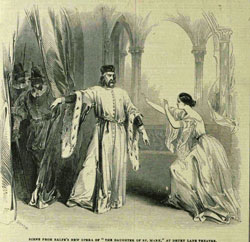
Wedding preparations are in hand for the marriage of Catarina Cornaro and Adolphe de Courcy in Venice. Moncenigo arrives from the Council of Ten, who govern Venice. The Council have decided that Caterina should marry Lusignano, King of Cyprus, in order to further Venice's ambitions. When the wedding to de Courcy is called off by Catarina's guardian, Andrea Cornaro, without a proper explanation it throws the gathering into uproar. Catarina receives a letter from Adolphe with a plan to elope. Andrea enters and Catarina learns why the marriage was called off. Catarina's plan to escape is overheard by Moncenigo, who threatens to have Adolphe killed if she does not send him away. (The illustration shows Moncenigo revealing the assassins lying in wait). Adolphe enraged by her rejection swears to kill her intended husband. Moncenigo, Andrea and Catarina arrive in Cyprus for the wedding to Lusignano. Adolphe also lands in Cyprus, unaware of Catarina's presence. When Moncenigo learns of his arrival, |
 Illustrated London News (Dec.7, 1844) |
he orders his assassination but Adolphe is saved by a mysterious stranger, who is in fact Lusignano, whom Adolphe has sworn to kill. Catarina and Adolphe meet in secret but are arrested for what is deemed adultery. Andrea tries to intercede but they are condemned to death. After the indictment is read, Andrea reveals that Moncenigo is in fact Catarina's father who seduced her mother. Adolphe confesses that he came to kill the King and explains why. He is pardoned, Moncenigo is banished and the couple are allowed to marry.
Reception
The Musical World (Dec. 5, 1844) noted that the opera "has drawn, hitherto, crowded houses - but this is partly due to the mise en scene, which is wholly unparalleled on the English stage". Further "Miss Rainforth sings with surprising energy and exquisite feeling. Harrison is vastly improved, and Burdini is a decided acquisition to the theatre". Weiss was also praised. It opined that "Balfe is an excellent conductor - though somewhat too gesticulatory, and certainly inferior to Benedict"[4]. The Age (Jan 4, 1845) noted that "Miss Poole's version is not inferior to Miss Rainforth's".
The Times judged that the opera differed from many of Balfe's previous efforts in that "he has more relied on it as a complete work, and less trusted to the effect of isolated melodies" and that "he has paid remarkable attention to his concerted pieces, and to the dramatic treatment of his scenes". The Examiner (Nov. 30, 1844)
|
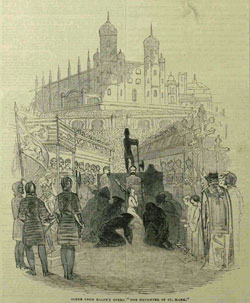
also thought that "It is not a mere ballad opera... but a regular opera seria, in which there is unity and boldness of design, and in which the concerted pieces are among the best portions". It judged the story not too bad, "though the language is trash". The Morning Chronicle (Nov. 28, 1844), on the other hand, wrote that "the libretto is very well written, and creditable to the talents of Mr Bunn". The Times devoted a full paragraph to describing the scene of Caterina's embarkation at Famagusta concluding that the effect was "perfectly unique and really gorgeous". The Morning Post (Nov. 28, 1844), although exhausted by the opera's four hour length, felt that it could not "pass over without remark the splendour of the [same] mise en scene". However, Chorley [1] was more perceptive in his assessment noting how in Paris the procession was used to underline the drama whereas in London, "the procession comes down to show itself, and not to do honour to the Queen, who finally walks down the central passage ... into the midst of the throng, who are staring at the audience, not at her." The Illustrated London News (Dec. 14, 1844) considered the staging of the final scene (on the right) superior to that praised by The Times.
|
 Illustrated London News (Dec.14, 1844) |
The Times wrote that all the singers "exerted themselves most laudably, and though the voices of all were more of less impaired by the labours of rehearsal, they sang with spirit and effect". The Examiner also remarked that "they were not in remarkably good voice when we heard them on the first night". The Literary Gazette (Nov. 30, 1844) wrote that "The ballad [2] by Miss Rainforth did not tell well, as she appeared to be too much fatigued to be able to bestow her powers upon it; but in the finale, a joyous and refreshing rondo, she sang in a captivating manner." As evidence of the hasty preparation of much English opera, it noted that "We have heard that this music was written only one day previously - a fact which says much for the talent of both composer and singer."
The Weekly Dispatch (Dec 1, 1844) judged that "Balfe's popularity is at its zenith" and concluded that it was because "he can write striking and tender melodies, which, being of a simple nature, are hummed about the streets". These bring him success because:
We are not a musical people, and the majority - an immense majority - of our audiences care little for science, indeed dislike it, and think it tedious; they only want something that is catching to the ear.
Its conclusion, which built on these previous ideas, was that the opera "will be considered Balfe's best work amongst the cognoscenti, but with the multitude it will not have that popularity which The Bohemian Girl has excited". While this latter verdict certainly turned out to be correct, it was not really borne out in its description of the opera's immediate reception, "the performance lasted for four hours, yet the audience ceased not their attempts at encores". Even so the opera was considerably shortened by the third night, though it is not clear what was cut [3].
Chorley concluded that Balfe's
strength lies more in comic and simple music; requiring less sustained effort, since with the exception of the morceau in the first act specified, we hardly recollect one movement with the force and amplitude of development demanded by the serious musical drama. In short, we cannot count this as one of Mr Balfe's happiest works.
[1] Athenaeum (Nov 30, 1844). The review can also be found in Michael Burden, London Opera Observed. Vol. 5, 1821-1844 (London: Pickering and Chatto, 2013), pp. 287-291.
[2] Presumably Catarina's "He comes to breathe again each well remembered word", near the beginning of Act 2
[3] Morning Chronicle (Nov. 30, 1844).
Comment
Recitative v Dialogue
The most striking aspect of the opera is that it used recitative rather than dialogue. Bunn on page v of the libretto wrote:
Having been repeatedly blamed, by the ablest critics of the public press, for introducing dialogue in my other Operas, I have determined on presenting on presenting, for the first time, one entirely in recitative.
There were comparatively few remarks about this. The Literary Gazette (Nov. 30, 1844) considered that this "though leading to somewhat of obscurity, is certainly in the true spirit and genius of opera". The Times (Nov. 28, 1844) was also in favour but the Morning Post (Nov. 30, 1844) complained that "The continuity of recitative increases the weight and and strains the attention". This despite bemoaning the use of dialogue rather than recitative in The Bohemian Girl, Morning Post (Nov. 28, 1843). Although there was no vociferous opposition to the use of recitative rather than spoken dialogue, Bunn and other librettists reverted to dialogue for later operas suggesting that audiences were not in favour. Whether this was because the recitative was poorly done, "its effect is infelicitous" [1] or audience conservatism is not clear.
The importance of Spectacle
The importance of the staging has been referred to. Some four days before the premiere, the Morning Post (Nov. 23, 1844) referred to "one scene alone of the extraordinary height of forty-four feet, down which a huge procession passes, attired in the richest costumes, and consisting of nearly 600 personages" That number was half as big again as that of the procession in The Bohemian Girl, which itself had garnered much comment at the time. This escalation suggests that Bunn saw such spectacle as the best way to draw audiences in even at the expense of the music. Chorley in his comments on the opera wrote that he "would gladly dispense with half-a-hundred costume figures, for a dozen more violins in the orchestra". In a later review of Wallace's Matilda of Hungary (1847), Chorley wrote that "Bunn writes for the scene painter, not the composer".
The Problems with Rehearsals
Elizabeth Rainforth's temporary replacement as Catarina by Elizabeth Poole in early January 1845 was never explained. The Observer (Dec 30, 1844) wrote that it was because she was to be married to Mr Harley (presumably John Pritt Harley) but this was vehemently denied by her mother the same day in a letter to several newspapers. Perhaps more likely is that she was exhausted. Papers had remarked on the toll of rehearsals in their reviews and she had been indisposed earlier in November. Chorley in his review elaborated further giving a glimpse of theatre life at that time:
But the merciless use to which she [Rainforth] has late been put (singing on the stage every night, a duty unheard of in the service of any operatic theatre but ours), to say nothing of the fatigue of rehearsals, had so wearied her, that on Wednesday [the premiere], she had but half her powers at command, and the rest were exerted with a distress made the more painful by her good natured and thoroughly artistic determination not to 'breakdown'."
Further evidence of the hasty preparation of much English opera comes from the Literary Gazette review that noted: "We have heard that this music was written only one day previously - a fact which says much for the talent of both composer and singer." Perhaps Balfe became sensitive that such haphazard preparation compromised the potential success of his operas and he tried to ensure a more orderly rollout for his next opera, The Enchantress.
[1] Morning Chronicle (Nov. 28, 1844)
Scores and librettos
The libretto manuscript is at Add MS 42979, ff 833-869. There is a covering letter to the Examiner dated November 15, 1844. Printed librettos (London: W.S. Johnson, 1844) can be found at Google books, HathiTrust and LoC, together with a transcription of it at the University of Virginia. [1] The manuscript and printed libretto are generally in agreement.
The essentially complete manuscript score
is available in the British Library (Add MS 29341-29343). A vocal score is in the British Library (System number: 004190939)
and in
Liverpool City Library. The score for Adolphe's ballad "Oh, smile as thou
wert wont to smile" (We may be happy yet) can be found at https://en.opera-scores.com/D/VocalScore/683/
162061.html. That song as well as three others can be found at
HathiTrust:
here and
here.
The
Carl Rosa Archive have hand
copied orchestral parts.
[1] The LoC appears to be a later print judging by the Johnson address but the texts look identical
Recordings
There is a private recording of the opera made of a performance on June 20, 1973, by the Gala Opera Group conducted by Ken Jones and released on Rare Recorded Editions SRRE 141/2, see https://www.youtube.com/watch?v=LwrUeSWbO7c&t=3025s, https://www.youtube.com/watchv=Vs2tIerO0hk. The performance was reviewed in The Musical Times. no. 114 (August, 1973), pp. 815-816.
A recording of Adolphe's ballad "Oh, smile
as thou wert wont to smile" (We may be happy yet), although sung by
soprano Sally Silver, can be found on Michael William Balfe 1808-1870 - Songs and Ballads Rediscovered. Sally Silver,
Richard Bonynge, Guild 7358. CD. It is also available at
https://www.youtube.com/
watch?v=kIBVHfrLDeA
Books, Articles, Online
William Tyldesley, Michael William Balfe: his life and his English operas, (Aldershot, UK: Ashgate Publishing, 2003), pp. 116-124 goes into the history, influences and structure of the opera, as does George Biddlecombe, English opera from 1834 to 1864 with particular reference to the works of Michael Balfe. (New York: Garland Publishing, 1994), pp. 115-118.
Angel Nicolaou-Konnari, "Melodramatic Perceptions of History: Caterina Cornaro Goes to the Opera", Proceedings of the International Conference in Commemoration of the Fifth Centenary of the Death of Caterina Cornaro, organised by the Institute for Interdisciplinary Cypriot Studies of the University of Munster (Venice, German Centre for Venetian Studies, 16-18 September 2010, pp. 385–447. See here . Nicolaou-Konnari writes about the historical background to the plot and the five operatic versions, including Balfe's.
Michael Burden, London Opera Observed. Vol. 5, 1821-1844 (London: Pickering and Chatto, 2013), p. 288 has a paragraph on other operas using the same basic plot. There are also some references in the books on Balfe by Walsh, Kenney and Barrett (see book list).
 |
 |
 |
  |
|
|