  |
 |

|
  The Barbers of BassoraMusic by John HullahLibretto by John M Morton
Theatre Royal, Covent Garden, London
|
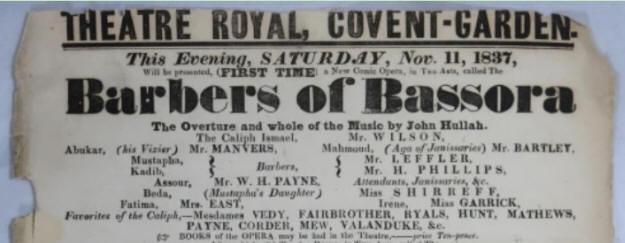
| The Caliph Ismael | - John Wilson |
| Abukar (Grand Vizier) | - Charles Manvers |
| Mahmoud (Aga of Janissaries) | - George Bartley |
| Mustapha (Barber) | - Adam Leffler |
| Kadib (Barber) | - Henry Phillips |
| Assour (Chief of the Eunuchs) | - William Henry Payne |
| Beda (Mustapha's daughter) | - Jane Shirreff |
| Fatima | - Mrs East |
| Irene | - Sarah Jane Garrick |
Conductor - ? [1]
[1] Given the practice of the time, one would have expected Hullah to have conducted the first few performances.
History
Although Charles Dickens was to write no more opera librettos after The Village Coquettes, he must have stayed on good terms with its composer, John Hullah, for, on August 16, 1837, he introduced him to the actor, Charles Macready, who was about to take up the management of Covent Garden. Macready was not at all happy with opera or with singers [1], not least perhaps because it cut down his stage appearances, however, Covent Garden was expected to include some opera. Nor was he very impressed with Hullah, "I do not think his manners argue much genius - if the contrary it can only be musical genius" [2]. However, at some point, he agreed to take the comic opera that Hullah had composed using a libretto by John Madison Morton "with whom I made an excursion to Malvern for the purpose of completing [the opera]" [3]. On November 8, Hullah asked that the opera premiere be deferred, presumably thinking it not yet ready, but Macready refused. Hullah then "insisted on having his name as composer put on the bills; but, after a conversation with [Macready], wished it withdrawn" [4]. In the event, as can be seen above, it was included but not Morton's.
The opera was given seven times but was relegated to a supporting entertainment after four performances. The final performance was on November 27. It does not seem to have been revived.
[1] "So much for these knavish singers", William Toynbee (ed.), The Diaries of William Charles Macready, Vol. 1 (New York: G.P. Putnam's Sons, 1912). p.417. "these opera people are enough to turn one sick, and what are they worth, at their very best?" , Toynbee, Op.Cit., p.442. After the initial postponement of Rooke's Amilie, Macready had written "the singers were sent for; they behaved very well — for singers", Toynbee, Op.Cit., p.419.
[2]Toynbee, Op.Cit., pp. 406-407. Harold Rosenthal, Two Centuries of Opera at Covent Garden. (London: Putnam, 1958), p.52 claimed that Macready had hired Hullah as musical director in 1837 but this was clearly not so from the diaries. George Rodwell was still musical director at that time, Gabriella Dlderiksen, Repertory and Rivalry: Opera at the Second Covent Garden Theatre, 1830 to 1856. (King's College, London: PhD thesis, June 1997), p. 157.
[3] Frances Hullah, Life of John Hullah (London: Longmans, Green & Co., 1886). p. 20.
[4] Toynbee, p.423
Plot
The plot seems to have been based on Charles-Frédéric Kreubé and M. Sewrin's opéra comique, Le Forgeron de Bassora, of 1813 and ultimately from Tales of the Arabian Nights. It was probably chosen as there was a certain vogue for "Turkish" subjects, e.g. Romer's The Pacha's Bridal of 1836. Bassora (Basra) was part of the Turkish Empire at that time. One might wonder at quite what this idea of "Turkish" consisted of. The Morning Chronicle (Mar 4, 1839) quoting the Morning Post, spoke of these operas [1] as possessing "the recommendation of being in strict conformity to the mental, moral and material costume of the diversified population of the Ottoman empire".
The barber, Kadib, is in love with the daughter, Beda, of another barber, Mustapha, but she is about to be married off to an old Aga, Mahmoud. The Caliph is given to nocturnal, anonymous, walks and on one of these encounters Kadib, who tells him his problem. The Caliph tells him to appear at the palace as he plans to appoint him temporary Vizier. Mustapha and Mahmoud meanwhile plan to capture and imprison Kadib, but Beda hears the plot and she and Kadib swaps clothes and it is she whom they unwittingly capture. None the wiser, they take "Kadib" before the Caliph and demand that "he" should be executed. The Caliph agrees to it, only for Mustapha to discover the deception as he is about to behead his own daughter. Having made such fools of themselves they decide to get back in the Caliph's good opinion through the services of the Vizier, the disguised Kalib. They give him gold and promise him the hand of Beda. To their chagrin they discover the Vizier's true identity but the Caliph orders the marriage to go ahead and that the gold should be forfeit as Beda's dowry.
[1] The article actually referred to The Pacha's Daughter but there does not seem to be any work with that title around that time so it almost certainly referred to The Pacha's Bridal, which has a "Turkish" subject.
Reception
Macready noted that the opera "was so inefficient that I could not sit to see it" [1]. Hullah's biography [2] dismissed the opera briefly as "neither so well performed nor so successful as [The Village Coquettes]" and the press certainly supported, at least, the second point. The Morning Post (Nov.13, 1837) wrote of the singers, "There can be no doubt that the music received ample justice at their hands" but was otherwise disappointed.
[The Village Coquettes] had given promise of better things from this young musician; but we regret to add that from the specimen of last night) that promise has not been realised. This last effort is characterised by poverty of thought and feebleness of execution, and though unquestionably the opera contains scattered fragments of pretty pleasing music, there is, it must be confessed, a lamentable deficiency of originality. ... The words of an opera have long been considered wholly unimportant; but, with all our experience, we had not conceived it possible that such execrable trash as we heard on Saturday could have been written or uttered by mortal man.
The Musical World (Nov 17, 1837) spoke of the piece "already declining into the cold shades of oblivion, and solely in consequence of the ineffective character of the writing". It went on that "Mr Hullah furnishes another instance of the necessity we have more than once insisted on, - that the composer of an English opera should make sure that both the plot and dialogue of his drama be ingenious and spirited". It did concede that the work "is sweet, graceful, and polished - particularly in the instrumentation" and that the singers "exerted themselves to the utmost and, indeed, sang charmingly" before concluding that "we heartily wish their good deeds, and the sweet music, had been better rewarded".
The Literary Gazette (Nov. 18, 1837) was more upbeat. It claimed that the second performance had gone off with "greater effect" and that "It is a pleasing, though not important production; rather lively in dialogue and action, and with some sweet and simple ballad melodies" ... but that it was "not sufficient to make any strong impression on the public".
Figaro in London (Nov. 18, 1837) gave its usual sour verdict, the opera "is a downright failure. The music ... is of the very poorest order. There is a want of melody, a want of motive, a want of science, a want of originality, and a want of every thing necessary to constitute a good opera".
[1] Toynbee, Op.Cit., p.424.
[2] Hullah, Op.Cit., p.20
Scores and librettos
The manuscript of the libretto can be found at the British Library Manuscript Add MS 42943, ff. 99-121. It was submitted on November 8, 1837 but there is no sign off date. The Lord Chamberlain's Day Book just lists it under 1837. The printed libretto (London: Chapman and Hall, 1837) is included in Benjamin Webster, The Acting National Drama. vol. 2, and online at Hathi Trust. There are some minor differences between the manuscript and printed libretto, mainly in Act 2. The printed libretto has extra dialogue and verses and a ballad for Kadib in the final scene, all aimed at giving greater detail and support to the plot. There is a vocal score of one song in the British Library, "Home of our youth".
Recordings
None are known
Books, Articles, Online
None are known
 |
 |
 |
  |
|
|