  |
 |

|
  White MagicMusic by Emanuele BilettaLibretto by Henry Chorley
Theatre Royal, Haymarket, London
|
|
Colonel Laval Count de Mericourt M. de Blignac Coralie Rose |
- ? [1] |
Conductor - Alfred Mellon
[1]There are no playbills or documents that give the cast list and the part was too insignificant to be mentioned in the press reviews.
History
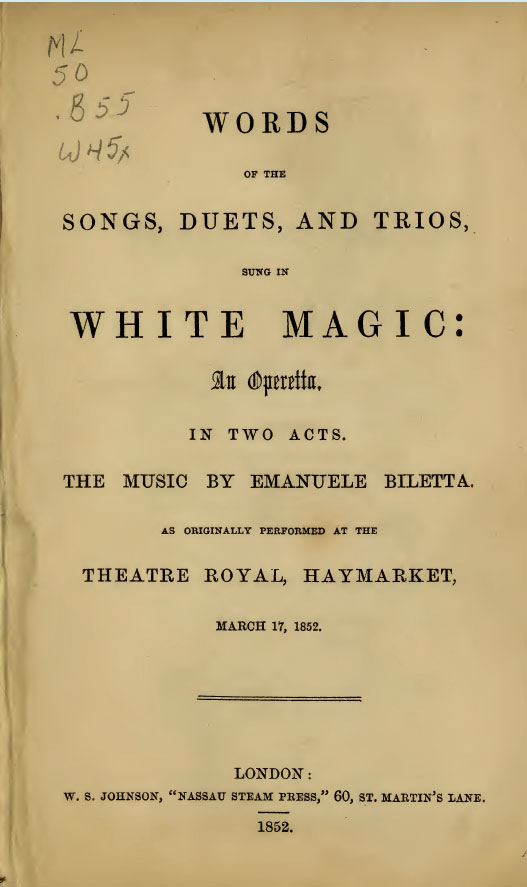
In some reports and in the Words of the Songs, Duets and Trios (London: W.S. Johnson, 1852), the work is referred to as an operetta. However, the manuscript and other writers list it as an opera or comic opera[1]. Somewhat unusually, the libretto appears to be original and not to have been based on previous French or English material. The librettist was Henry Chorley, although this seems to have been a closely guarded secret at the time, probably because he did not want to run the risk of ridicule given, how, as a leading critic, he had so often lambasted librettos in the past [2]. He may also have thought it compromised his position as a critic but he was more open about later libretto efforts.
The opera premiere was delayed by over a week because of Louisa Pyne's illness[3]. Its final performance was on April 16. This was probably because the main stars, Louisa Pyne and William Harrison, began a season at Drury Lane the following week rather than the lack of audiences, as it was generally deemed a success. Clearly Harrison thought so because he chose it for his benefit night on May 17 at Drury Lane. It does not seem to have been revived since nor was staged elsewhere..
[1] See the comments on The Queen of a Day for a brief discussion on the difference between comic opera and operetta.
[2] The Era (Mar. 21, 1852) wrote that "We would tell the author's name if we knew it; but the ordinary channels, in this particular, are silent as if locked in the arms of a Siberian frost". Grove Online confirms Chorley's authorship
[3] The Morning Post (Mar. 3, 1852) had advertised it for March 8, 1852.
Plot
The Weekly Dispatch (Mar. 21, 1852)
noting that "The libretto is very slightly put together" outlined the
plot:
A certain unprincipled Count de Mericourt in
the time of 'the Regency' of France, has turned magician, and has been
enabled, by imposing on the credulity of the Parisians, to earn a
discreditable livelihood. The wealth and beauty of Coralie de
Blanchefleur, a young heiress, excite his cupidity and admiration, and
he schemes to allure her to his house. The cousin of this lady, and
her former discarded lover, one Colonel Laval, a roué and gambler, is
accidentally engaged by the necromancer to further his design.
Coralie de Blanchefleur falls into the snare, and finds that on 'consulting the stars', she has placed herself within the power of the
Count de Mericourt, who threatens her with violence if she does not
immediately promise to marry him. Colonel Laval, however, who has been
an unwilling witness to the Count de Mericourt's disgraceful conduct,
steps forward and rescues his intended victim. The Count, on the
approach of assistance, turns the tables on his companion, and making
Coralie de Blanchefleur believe that Colonel Laval has been the guilty
party all along, and the pretended magician, hands him over to justice.
He is taken to prison, but is rescued from confinement by his
faircousin, who promises to espouse the Count de Mericourt for the
services she thinks he has rendered her. At this critical juncture of
affairs Colonel Laval finds out that the property enjoyed by Coralie has
been left to him by his uncle. This piece of unfavourable news he
conveys to the Count Is Mericourt, who is as anxious now to break his
engagement, as he was before eager to fulfil it. Coralie de
Blanchefleur refused by the designing Count, willingly gives her hand
and heart to her old lover, and now reformed kinsman, Colonel
Laval.[1]
[1] Coralie's initial visit was because she wants the magician (De Mericourt) to decipher a document rather than have her fortune told. De Mericourt loses the document, which Laval finds and deciphers..This document leads Laval to a will that makes him the heir. Laval makes the estate over to Coralie, so as not to put her under any obligation to him, but she now sees Laval in a new light and agrees to marry him.
Reception
Critics, across the board, welcomed the opera, despite their dismissal of the libretto. Notwithstanding a certain amount of similarity to other composers, The Era (Mar. 21, 1852) thought that "There is a more than ordinary amount of freshness running through the whole opera, a correctness of form and dramatic colouring which renders it extremely pleasant to hear".
The Morning Post (Mar. 18) wrote that "The music requires no elaborate criticism. It is for the most part, tuneful and theatrically effective, without, however, having any pretensions to originality of style" and this despite "a most unsuggestive and unlyrical libretto. Obscure in plot, childishly feeble in dialogue, lamentably poor in incidents and situations, though very rich in extraordinary distortions of the Queen's English".
The Weekly Dispatch praised Biletta's efforts:
He
has given us a very pleasing unpretentious piece, in which he has not
attempted more than he was able to perform well. There is no striving
after dramatic effects, without the power to produce them. The
libretto and accompaniments are quite in character. As regards melody
and skilful treatment, the latter possess considerable merit; in style
they are Auberish - light, sparkling, and fanciful, and, if not
strongly expressive of passion or sentiment, they never fail to
gratify the ear.
The Standard (Mar. 18, 1852),
judging the opera "a complete success", wrote that
The vocalists...exerted themselves very strenuously, and secured
several encores by their careful and effective singing. The terrace
and gardens belonging to a French chateau, which constitute the scene
of the second act, is an elaborate 'set', and well deserved the
applause it met with. The period of the opera is that of the Regency
of France; and the costumes consequently, though formal, are bright
and showy.
The Era considered that "We don't know of any English artist capable of executing the rapid and chromatic passages 'writ down' with the grace, fluency, and ease of [Louisa] Pyne". The Morning Post also commented on Biletta's care to showcase Pyne's abilities. The Era thought that "all things considered, the chorus executed their parts pretty well", commented on Susan Pyne's performance, "who looked remarkably arch and saucy" and judged that it "may be regarded as one of the most successful 'hits' of the season". The Weekly News (Mar. 20, 1852), as well as commending the Pyne sisters, thought that "Harrison,"though not in his best voice, sang his music with considerable care" while Weiss "displayed his usual and acknowledged merits".
Vivian in The Leader (Mar. 20, 1852) gives more of a flavour of the performance even thou being rather snide
about Harrison:
On the whole, the execution was
excellent. Louisa Pyne was more charming than ever, the little chubby
dodu syren that she is! Her singing as joyous and gracefully piquant,
and would have saved any music.
...
Her sister played the part of a
soubrette with some drollery. Weiss sang a good part with care and
effect, though occasionally bawling and singing his tenderness, like a stentor, at the pit, instead of singing it in Louisa's ear. As for Mr.
Harrison - the true British tenor - he sang with his throat, his nose,
and his calves. and was much applauded by a delicately discriminating
part of the audience. The opera succeeded although he sang in
it. [1]
The Examiner (Mar. 20, 1852) summed up the opera as having "a spirit and freshness that entitle it to a more permanent success than its very silly story is likely to obtain for it" and being "an altogether pleasant experience".
[1] dodu is a French adjective for chubby. Stentor refers to someone with a very loud voice.
Scores and librettos
The manuscript is held in the British Library at Add MS 52930 L. This was received by the Examiner, William Bodham Donne, on March 4, 1852 and the licence returned on March 5. Donne was standing in for the official Examiner, John Mitchell Kemble. Donne demanded that the phrase "Gospel true" be removed in Act 2, Scene 1 [1].
Benjamin Webster, the Haymarket manager had stated a performance date of March 8, 1852. No printed libretto has been found but there is a printed Songs, Duets and Trios (London: W.S. Johnson, 1852) at Archive.org. There are quite a few differences between the manuscript and the printed Songs etc. including a much extended finale of Act 2 in the latter. A transcript of the manuscript can be found here including the differences from the printed Songs etc..
No vocal score of the opera or individual items has been found.
[1] Lord Chamberlain's Day Books, 1852-1865, Add MS 53703
Recordings
None are known
Books, Articles, Online
None are known.
 |
 |
 |
  |
|
|