  |
 |

|
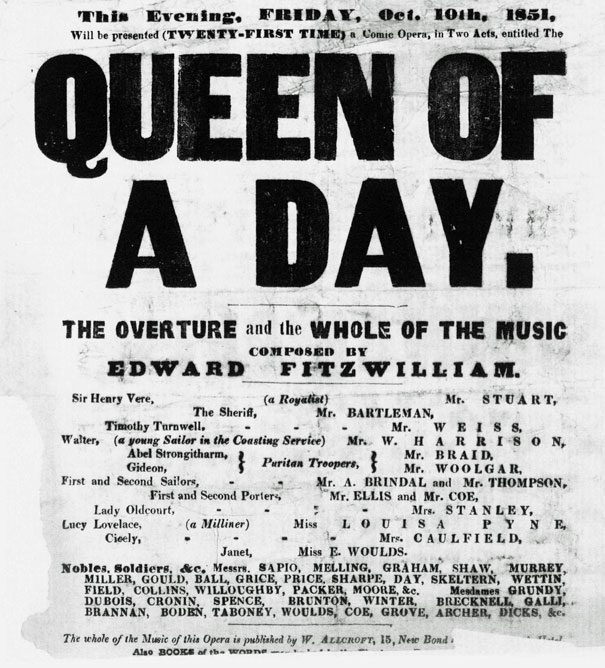
  The Queen of a DayMusic by Edward FitzwilliamLibretto by
John Buckstone after
|
|
Sir Henry Vere (a Royalist) The Sheriff Timothy Turnwell Walter (a young sailor in the Coasting Service) Abel Strongithurm First sailor First Porter Lady Oldcourt Lucy Lovelace (a Milliner) Cicely Janet |
Conductor - Alfred Mellon
History
The Haymarket was not known for putting on opera, its focus being comic works of various types but they did include opera and operetta from time to time. However, the manager, Benjamin Webster, made three attempts at original English opera, one of which was Edward Fitwilliam's The Queen of a Day with a libretto by John Buckstone, the Haymarket's most prominent performer. The libretto manuscript and some newspapers described it as an operetta but the playbill, the 1855 printed libretto and other newspapers called it a comic opera. In fact, what was performed seemed to have been much expanded over what was submitted to the Examiner. This is discussed in the Comment section below.
The libretto was not original but rather an adaptation of an opéra comique, La Reine d'un jour, with a libretto by Eugène Scribe and Jules-Henri Vernoy de St. Georges that had been put to music by Adolphe Adam. This had apparently already been given in French at the St James's Theatre and also at the Princess's Theatre.[1] It was Fitzwilliam's first attempt at an English opera, although he was known for some earlier compositions, particularly a Stabat Mater (1845).
The opera received a good reception and ran until the end of the season achieving 22 performances by October 16. It was revived at the Haymarket in late February and early March of 1852 notching up another three performances. Fitzwilliam also conducted it in Liverpool in late 1852 (Royal Amphitheatre) and early 1853 (Theatre Royal). Pyne and Harrison included a a much expanded version in their repertoire when they went to the US in 1854 for two years but only seemed to have performed it at Niblo's Gardens, New York, in June and July, 1855.
[1] Morning Chronicle (Aug. 14, 1851).
Plot
The Morning Chronicle (Aug. 14, 1851) outlined the plot:
|
A little milliner, affianced to a Dover sailor is passed off by an intriguing cavalier [Sir Henry Vere] for the affianced wife of Charles II, in order to distract the attention of the still existing Puritan Authorities from the real dignitary, who has landed on another part of the coast; the déguisement, of course, calling forth the ordinary mystifications and perplexities common in such cases, leading a time-serving old landlord to keep alternately turning Royalist and Republican as the scale seems to incline to either party, and, of course, bewildering the lover, who is not in the secret, and is tormented with all sorts of doubts and suspicions as to the identity of the pretended queen - a convenient announcement of the Restoration, in the nick of time cutting the Gordian knot of all difficulties, whether of politics or love. |
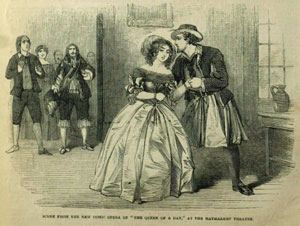 Illustrated London News (Aug. 23, 1851) |
Reception
The Morning Chronicle (Aug. 15, 1851), having criticised the "careless and clumsy English version" of the French original, judged that "The result, if not all that could be wished for, was in many respects highly satisfactory and encouraging". However, it felt that Fitzwilliam had
set to work, in all eagerness, musically to illustrate his subject, and the consequence is that he has written too elaborately, too earnestly, with too much strain after scientific combination and serious effect, so that the music... stands out in odd contrast to the flimsy carelessness of the unidead [1] libretto.
This was in contrast to Adam's attempt to "enliven and buoy up by the airiest and sprightliest music".
The singers were praised, "Miss Pyne played with great archness, and a comic aplomb which is rapidly increasing", the music under Alfred Mellon, played with "decision, energy and spirit" and "the choruses, with one exception, sung boldly, steadily, and correctly". Even though it was a short work, in practice with encores it took up two and three quarters hours and the paper "strongly recommend[ed] curtailment".[2]
The Weekly Dispatch (Aug. 17, 1851), The Standard (Aug. 14, 1851) and the Morning Post (Aug. 14, 1851) all gave shorter, less detailed, reviews but were of much the same opinion, Pyne's performance usually being highlighted. John Bull (Aug.18, 1851) in its appreciation of Louisa Pyne's performance volunteered that Hector Berlioz had urged the manager of the Opéra Comique to hire her.
The Illustrated London News (Aug. 18, 1851) thought Fitwilliam had made "a promising beginning" but that the music was
more that of the drawing-room than of the stage. It is deficient in dramatic impulse and colouring; but there are some very pretty ideas, and the orchestration is elegant if not forcible.
It pointed out the parallel with tastes at the Opéra Comique and that the Haymarket "by affording our composers the chance of producing one or two act operettas, is materially aiding art interests in this country".
[1] Having no ideas
[2] Possibly it was shortened as The Era (Sept 7, 1851) advertised it as one of four items listed for an evening
Comment
The difference between operetta and comic English opera, both of which used simple plots and a dialogue and song format, is essentially one of scale and artistic ambition. Here the original work submitted to the Examiner would best be characterised as an operetta with just nine simple songs and running to under half the length of an opera such as Balfe's The Bohemian Girl. The Pyne and Harrison New York version had nearly double the number of vocal items with many given an additional verse and including choruses and ensembles in varying combinations. The dialogue was more extensive and extra roles, the Sheriff and Puritan troopers, were added and others, for example Lady Oldcourt, expanded in order to include extra scenes, such as the planned arrest of the "Queen". The end result was much closer to mainstream English opera of the time.
As the Pyne and Harrison performances were in New York, it did not matter that they deviated so markedly from the one that had been passed by the Examiner. However, it is clear from the songs mentioned in the Illustrated London News (Aug. 18, 1851) review that most if not all the vocal items included in the Pyne-Harrison version were sung at the premiere even though they did not appear in the manuscript and thus had not been passed or, at least, not recorded to have passed by the Examiner.
Scores and librettos
The libretto manuscript is available in the British Library (Add MS 43036 ff.443-473). No licence date was added. A printed libretto (Boston: J.H. Eastburn's Press, 1855) used by the Pyne - Harrison Company in the United States in 1855 is available at Google books. There are large differences between this 1855 printed libretto and the manuscript with expanded dialogue and additional ensembles and songs both in Act 1 and in Act 2, the latter being increased by well over three times in length. Act 2 as set out in the manuscript can be found here.
There does not appear to be a contemporary British printed libretto for comparison, so it is not possible to say how closely the original performances followed the manuscript. However, it is clear from the songs mentioned in the Illustrated London News (Aug. 18, 1851) review that most, if not all, the vocal items included in the Pyne-Harrison version were sung at the premiere even though they did not appear in the manuscript and thus had not been passed by the Examiner.
The vocal score of, at least, one number from the opera , " When Cavaliers shall bear the sway", is available in the British Library.
Recordings
None are known
Books, Articles, Online
None are known.
 |
 |
 |
  |
|
|