  |
 |

|
  The Spirit of the BellMusic by George RodwellLibretto by James Kenney
English Opera House,
London
|
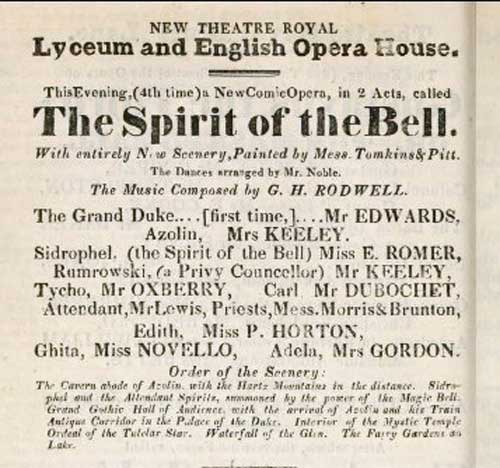
|
The Grand Duke Rumrowski
Azolin Sidrophel Edith Ghita, Azolin's mother Adela |
|
Conductor - George Rodwell? [1]
[1] It would have been usual for Rodwell as composer to have conducted at least the first few performances. Shortly after that, in September 1835, Rodwell became Director of Music at Covent Garden.
History
This was the first opera at the English Opera House since the failure of Sadak and Kalasrade and, while reasonably successful, being given for over a month, it was felt by some commentators to be too weak to restore the credibility of Arnold's endeavour. Shortly after the opera closed, Arnold gave up the management, according to The Spectator (August 15, 1835, p.777). It seems that the audience were offered free ices although it is not clear whether this was an inducement to attend or to offset the hot weather, which must have made the opera house very uncomfortable. The opera is a little unusual in having a preponderance of female soloists with some singing male roles. Perhaps this was influenced by what singers were available rather than the initial intention.
Plot
The Observer (June 14, 1835) recorded the plot as follows:
An old philosopher dying bequeaths to a favourite youth a bell as the most valuable of legacies, and so it turns out to be, inasmuch as it commands a spirit [Sidrophel], which always appears on its being rung, and executes the commands of the ringer. The youth, Azolin, upon discovering this virtue of his bell, uses it to woo the daughter of the Duke of Venice, who is already betrothed to a foolish personage, Rumrowski. After imposing on the Duke by a display of regal pomp, Azolin, is on the point of achieving his happiness, when by negligence, the bell falls even into the hands of Rumrowski. This worthy soon discovers the virtue of his new tintinabulary acquisition, and uses its Spirit, who sullenly obeys such a buffoon, in turning the tables against his rivals and in his own favour. He is as jealous as need be of the bell, but the Princess beguiles him to put it into the hands of a band of sages, in order that they may interpret the meaning of an inscription engraved on its rim. One of the sages is Azolin in disguise, who thus gains the talisman, and matters are again settled to his satisfaction and that of all parties except Rumrowski. For fear of any more vicissitudes the young people are married, and the adventure is brought to a happy conclusion.
Reception
The Morning Chronicle (June 9, 1835) noted that, although it was advertised as a comic opera, there was very little that was comic in it.
The music of the opera… is, at best, but pretty; there are none of those animated and brilliant orchestral effects or piquant melodies we would desire to see established as the characteristic of the English Opera. The principal deficiency in the music consisted in its want of originality. The performers…did ample justice to the parts assigned to them, but their exertions could not make the music good”. It concluded that “the opera was received with approbation throughout.
The Morning Post (June 9, 1835) commented on the amount of plagiarism in the piece, particularly picking out what it saw as borrowings from Lestocq and seemed inclined to call it an operetta rather than opera. The following day it wrote that, on second hearing, it had found only one example of originality but yet more examples of plagiarism and that "It must be [a] matter of surprise and gratulation to them [composer and manager] that the audience received their efforts favourably". Rodwell replied to this accusation in a letter to the Morning Post of June 13, in which he asserted that critics were so down on English music that they naturally assumed that any attractive music must have been copied from foreign sources and that his music had been composed nearly three years previously and thus before the sources they claimed he copied.
The Observer (June 14, 1835) wrote that some of the text
was very feeble in a
dramatic point of view. It wants ingenuity of detail in
its plot and compression ...
Of the music, but little
of a very striking character struck us in performance,
or dwelt upon our memory…. It is neither powerful or
original – neither is it commonplace - a graceful and
refined feeling pervades it.
Credit was given to the management for "the spirited style in which this opera was got up".
Scores and libretto
The manuscript of the libretto is in the British Library, Add MS 42930, ff.303-335 b. A transcription is available here. No printed libretto has been found. A piano score (London: W. Hawes, 1835) of the overture and vocal items is also available at the British Library.
Recordings
There are no known recordings of any of the opera.
Books, Articles, Online
There are no known articles or books on the opera.
 |
 |
 |
  |
|
|