
 |
 |

|

 MinaMusic by Francesco SchiraLibretto by Valentine Morris and George Linley
Princess's Theatre,
London
|
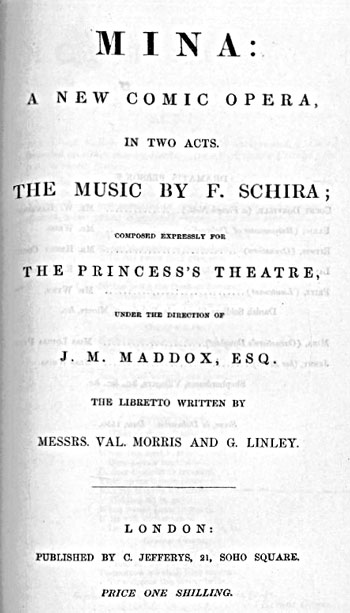
|
Count Dorville (a French noble) Ulric (Burgomaster of Dalecarlia) Ritson (Oxenstiern) Langdorf (Captain of Danish Guards) Fritz (Lieutenant)
Mina (Oxenstiern's Daughter)
Jenny
(Her Maid) |
-
Mr Wynn
-
Georgina Barrett |
Conductor - Francesco Schira
History
Francesco Schira came to London in 1839 and settled here permanently in 1842 when he became the Princess's Theatre's Director of Music. In 1844 he moved to join Alfred Bunn at Drury Lane and later at Covent Garden. It was for the latter venue that he composed his first English opera, Kenilworth, which was to have starred Sims Reeves. This was abandoned when Bunn's management came to an abrupt halt at the end of 1848. Schira's next effort was Mina, which had limited success lasting until January 26, 1850, with around 22 performances in all. It was never revived but occasional numbers appeared in concerts.
Plot
The Era (Dec 9, 1949) sketched
the plot:
The scene is laid in Dalecarlia, during the period that
Gustavus Vasa, King of Sweden, was held prisoner by the Danes. The
Count Oxenstiern and his daughter Mina have taken refuge in the
province. The Count, from political motives, having assumed the name
of Ritson, and the occupation of a miner, his daughter, being ignorant
of her noble birth, is on the eve of marriage with Ulric, a meddling
Burgomaster, when Count D'Orville, a French noble, comes upon the
scene being compelled to fly as a political refugee on account of his
adherence to the cause of Gustavus. He is immediately smitten with the
charms of the fair Mina, and offers her his hand and heart. She is
also captivated the Count, and resolves to renounce the Burgomaster in
his favour. Oxenstiern consents to their union, and all is progressing
favourably, when news of the escape of Gustavus reaches the district.
Count D’Orville is taken up on suspicion, and recollecting that his
life had recently been saved by a noble stranger, he acknowledges
himself to be the Monarch, in order to afford the latter time to
escape from the neighbourhood. Mina, of course, is in despair at the
loss of her lover, and the Burgomaster rejoiced at the absence of his
rival. We are next introduced to the cottage of Oxenstiern, where
D'Orville is brought in prisoner, and placed under the charge of the
soldiery. Oxenstiern makes them intoxicated, and the Count and whole
party (Burgomaster included) make their escape to the muses. The cause
of Gustavus ultimately triumphs, a portion of the mine is blown up,
and the opera terminates, rather abruptly, with the union of the Count
and Mina, and the Burgomaster and Jenny, her waiting maid.
Reception
The Morning Post (Dec. 10, 1849) said of the libretto, "Worse than which, we have never had the misfortune to meet with although we have seen as bad". In the words of the Weekly Dispatch (Dec. 16, 1849), "a plot very scantily conceived and clumsily unravelled". The Illustrated London News (Dec. 15, 1849) thought it "the very worst libretto that ever poor composer was inflicted with. It is an undeniable evidence of Signor Schira's abilities, that, for such a miserable poem, he has composed such elegant and dramatic music".
The Era (Dec. 9, 1849) wrote that the music "is deserving of high commendation for its prettiness (to which it possesses greater claim than for its originality)". Schira's handling of the orchestration was praised except where he fell "into the modern prevailing error of using his wind instruments too freely". It repeated this review on December 16. On December 23 it included a new review although going over much the same ground. It did say that there had "been so many conflicting opinions" about the opera and that although styled a comic opera, "the chief and leading incidents are decidedly dramatic"
The Morning Post after
sounding off at length about
the degeneracy of Italian
music, stated that
The music
of Signor Schira has all the
faults of its (Italian [1] ) school.
It is destitute of all the
qualities required of a great
work of art. Unity of design,
and development of ideas and
contrapuntal skill appear not
to have been included in the
composer's studies. His
attempts at harmonic effects,
although at times very bold,
are frequently faulty, and
always unpleasantly chromatic.
It did admit that there were "occasional gleams of sunshine" with a few pieces "which are creditable to the composer and interesting to the musician".
The Times (Dec. 10, 1849) disagreed. The opera "was not Italian - nor is it French, German, or English. Its first characteristic is a total absence of style". Schira's songs were "too long for ballads and too short for anything of a higher class". Borrowings from various operas were identified but it did admit that "there are evidences of talent ... which hold out a promise of better things".
The singers were generally praised but all particularly highlighted Louisa Pyne's contribution, "that charming vocalist, who so recently has risen to fame, and is delighting the town by vocalisation, which, since the time of Miss Stephens, has had no parallel".[2]
The Times had an interesting observation on the orchestra, which was conducted by Schira. He "changed the ordinary position of the executants, whereby a larger volume of noise was secured, with, as we thought, considerably less accuracy than usual". "The mise en scène was in all respects highly creditable to the management", except that the Danish soldiers were dressed identically to those who had appeared in Macfarren's King Charles the Second a few weeks earlier.
The Weekly Dispatch summed up "Although Sig. Schira has not produced a very striking opera, yet, as a first work, we cannot but accept it as a promise of future excellence". The Times that "To judge by the applause bestowed, and the several encores, Mina must be pronounced successful", adding "The house was crowded". For John Bull (Dec. 15, 1849), "it was coldly received even on the first night, and can have but a brief existence on the stage.
[1] It claimed, incorrectly, that Schira was Italian rather than Maltese. However, both his parents were Italian and he was sent to Milan for his musical education.
[2] The Illustrated London News (Dec. 15, 1849)
Comment
The tension between the dominant, established, Italian opera, with its upper class supporters and the claims of the newer German orchestral music favoured by some in the middle classes, was particularly strong during the 1830s and 1840s. The Morning Post's rather ridiculous critique of the opera showed it at its starkest:
Signor Schira is an Italian by birth; and received, we presume, his musical education in that once favoured land of song. It is not therefore wholly his fault if he should have studied little these great masters who are as sealed books to the modern Italian student. In a country where true musical knowledge is treated as forbidden fruit, where that which can alone nourish and sustain artistic talent, and without which it presently dies, is prohibited and stigmatised as mathematical and unworthy the attention of genius, how is it possible that the computer should advance or arrive at anything like eminence in his art? The modern Italians pride themselves much upon their climate and its influence. They imagine that musical knowledge, like reading and writing, ‘Comes by nature’, hence their degeneracy.
The Illustrated London News in its praise of Schira made a point of disagreeing with those who "consider that the fact that of an Italian birth and name is sufficient to exclude the possessor thereof from musical talent and inspiration".
Scores and Librettos
The manuscript of the libretto passed by the Examiner is in the British Library, Add MS 43022, ff. 854-873b. Printed librettos are available at Cornell and Huntington Libraries but no online examples have been found. A transcript of the printed libretto together with a note of any major differences from the manuscript can be found here. There are comparatively few differences between the printed libretto and the manuscript but there are some lines that appeared in the printed libretto that do not occur in the manuscript. As before, there is no evidence that the additions were signed off by the Examiner, Donne, although he did charge that "God of Mercy" in the final quartet must be changed to "bounteous Heaven", Lord Chamberlain’s Supplementary Plays 1843-1854, Add MS 71565.
There does not appear to be either a full or a vocal score, but there is a vocal score for at least one of the numbers, "Wake me not from my dream" in the British Library.
Recordings
None are known
Books, Articles, Online
None are known
 |
 |
 |

 |
|
|