
 |
 |

|

 Mephistopheles
|
|
Faust (an aged Philosopher) Mephistopheles (a Demon) Valentine (a Soldier, brother to Marguerite) Brander (a Soldier) Siebel (a poor Student in love with |
|
Marguerite (an Orphan) Martha (her Attendant) Madeline (companions of Marguerite) |
Conductor - Meyer Lutz
History
Michel Carré's play Faust et Marguerite, a romanticised and selective adaptation of Goethe's Faust, was first performed in Paris in August 1850. Carré then, in collaboration with Jules Barbier, adapted it in 1859 to form the libretto for Gounod's Faust. In the meantime there were, at least, three English adaptations of Carré's play. One titled Faust and Margaret was performed by Charles Kean at the Princess's Theatre on April 12, 1854. The initial adaptation had been by Dion Boucicault but before it was performed he ran off with Kean's ward, Agnes Robertson, leaving the manuscript behind. Kean or others possibly revised it given the changes and overlays that were made [1]. There was also a version, Faust and Marguerite, by William Robertson that was published by Thomas Hailes Lacy in 1854 [2]. Although the Morning Chronicle (May 29, 1855) implied that Drayton used Kean's version as his starting point, given that he had studied and performed in Paris he may well have gone back to Carré's original play.
Romer opened her short 1855 season with the opera [3] but it only ran until June 17 because Madame Nau had been retained for the closing weeks and sang a different repertoire. However, Drayton and company went to Manchester where it was produced at the Theatre Royal on July 26. It had at least one further performance before the end of August [4]. At the end of September, The Era (Sep. 30, 1855) announced that the opera was in rehearsal by the Nau - St. Albyn English opera company with Lutz as conductor, but it does not seem that they performed it until May 1856 in Sheffield and the following month in Hull [5]. No later productions are known of and the emergence of Gounod's Faust in London in June 1863 would have definitely marked the end of any plans for revival.
[1] British Library MSS Add MS 52946 O. An article on the
play and its origins can be found at
https://intranet.royalholloway.ac.uk/
dramaandtheatre/documents/pdf/lcp/faust/amandaintrofinal.pdf
2] https://lb42.github.io/Lacy/lacyCatalogue.html . The Internet Archive example has 1856? written on it.
[3] The Era (May 20, 1855)
[4] Manchester Weekly Times (July 28, 1855), Manchester Courier (Sept. 1, 1855)
[5] The Era (May 11, 1856), Hull Packet (Jun. 13, 1856)
Plot
The plot was familiar to many in the audience through the various stage plays on the story. The opera was similar to the first four acts of Gounod's Faust but ended with Marguerite's deliverance just after Valentine's return. As in Carré's play, Siebel has a bigger role here than in Gounod's opera.
The opera opens with Faust and his pupil Siebel, who is in love with Marguerite. On Siebel's departure, Faust bemoans his advancing age and calls on Satan, who duly appears. Mephistopheles offers him a potion that will give him youth and shows him a vision of Marguerite. Faust is smitten with love and drinks the potion. The scene than switches to Valentine who is off to war and is busy recruiting Siebel and Martha to look after his sister, Marguerite, while he is gone. The students raise a toast to Valentine and Marguerite but are joined by Mephistopheles to their annoyance. He foretells Brander and Valentine's deaths and that Siebel's flowers will always wilt. Swords are drawn but the sound of church bells leads Mephistopheles to leave them. He is then joined by Marguerite, Martha and Faust for an extended ensemble to end the act.
The second act is initially taken up with Faust and the plans to seduce Marguerite including the gift of jewels but this is interrupted by an episode with Siebel trying to work out how to stop his flowers wilting. Martha encourages Marguerite to take the jewels but they are again interrupted by Siebel who unsuccessfully tries to get Marguerite to stay with his mother. Mephistopheles turns up to distract Martha while Faust speaks to Marguerite and they declare their love.
In the final act, it is announced that Marguerite has been deserted. Martha runs in to say that Valentine has returned. Siebel tries to head him off from going to see Marguerite but with no success. Valentine discovers the truth and encounters Mephistopheles and Faust. A fight begins and Faust kills Valentine. Marguerite comes out of the cathedral and her dying brother curses her. She loses her mind and dies but is carried into the cathedral so preventing Mephistopheles from leading her off to hell as he does with Faust.
Reception
There was relatively little comment on the production, probably because it was at the Surrey. John Bull (June 4, 1855) rather damned with faint praise with a short paragraph that commended Lowe's singing even though "a voice of slender qualities" and that "The mounting of the piece is liberal if not lavish...we should counsel that the money spent on decorations should be turned to the account of extra violins". The Musical World (June 2, 1855), p. 342, thought the opera under rehearsed and was unenthusiastic about Lutz's music deeming him "a votary of modern Italianism; his models, however, are not the best of their kind".
Reynolds's Newspaper (June 3, 1855) was complimentary
The words of the opera, by Mr. Drayton, are cleverly adapted to the
exigencies of a lyrical entertainment. The music is smooth,
unpretending, and most appropriate to the incidents of the
performance. Herr Meyer Lutz is evidently an accomplished musician,
and his present production gives every expectation of yet greater
triumphs.
It was not convinced that Perren was an opera as opposed to a concert room singer but acknowledged that
the singers and the opera received a
warm reception. It added that
The scenery is very beautiful, but the ascent to
heaven was somewhat ponderously contrived. The angels seemed as though
conveying a mangle to the regions above, rather than the fair and
ethereal frame of the betrayed Margaret.
The
Sunday Times (June 3, 1855) was encouraging:
The incidents [of the plot] have been adapted to operatic purposes by
Mr. Drayton with no ordinary ingenuity. The versification of the
various soli, and the arrangement of the dialogue, are above the
general routine of libretto writing.
Herr Meyer Lutz has fallen into many errors, and has shown himself a novice in the art of operatic composition. ...The prominent failings of the work are its lack of originality, and the constant variance which exists between the sentiment to be expressed and the music which expresses it; on the other hand, we are enabled to discern occasional glimpses of lightness and melody which lead us to conclude that experience will not be without beneficial effects, and that the next effort of Herr Lutz will be an improvement on the present.
The ensemble is creditable to all concerned, the scenic decorations are effective and liberal, and the appreciation displayed by the public has been of an unusually warm description.
Perhaps because it was the Surrey,
The Era (June 3, 1855) was
dismissive of the music's quality
We can have little doubt that
[the music] will gratify the unsophisticated
cars of the thousands who are likely to listen to it, on the strength
of its symmetrical rhythm and elegant flow. ... The principal characters are all
provided with airs more or less useful as appeals to the unambitious
tastes of the multitude, and here and there an encore is most cordially
awarded.
It did commend to Drayton's singing and noted that "The choruses and the orchestra are well provided for, and every endeavour has been made to achieve a rich and appropriate ensemble in the matter of scenery and dresses".
The Manchester Examiner (July 28, 1855) reviewed the later Drayton tour. It began with little enthusiasm for "the composition of one Herr Meyer Lutz...we believe resident in London, but whose previous works are
unknown to us", but seemed to warm to the piece.
The libretto, we understand, is from the pen
of Mr. Drayton; and, though much praise cannot be given to the poetry
in which the lyrics are clothed, it must be confessed that
considerable tact is shown in the general arrangement and curtailment
of the subject for dramatic purposes. ...One great fault we cannot
help noticing. We allude to the introduction of the rather vulgar
comic portion in the garden scene [the Siebel additions]. Not only
does this materially lengthen a scene already long enough, but it
disturbs the flow of sentiment which is the great feature of the whole
act.
The music is rather clever than great; but it carries the audience along with it; the writer evidently understanding what is required for the theatre. The instrumentation appeared to us the least worthy of approval.
Altogether the piece went well, and would become a favourite if only a good audience could be prevailed upon to go and hear it.
Comment
Here, as on other occasions with provincial performances, there is the impression of critics willing a largely uninterested and possibly culturally ignorant audience to give opera a try. No doubt they realised that otherwise no one would chance touring to their city.
The Era's review brought up the rivalry between more learned, "scientific", German music and the older, more immediately attractive Italian music.
The music, although presenting evident signs of a Teutonic origin, is far from being of a dry and uninviting nature. We have already spoken of Herr Lutz as having a pleasing melodic vein and we have many instances in this elaborate work of his taste and refinement in this respect. His music is somewhat akin to Conradin Kreutzer, Zumsteeg, Andreas Romberg, and others, whose names are familiar in Germany as composers of merit in whose effusions much of the airy lightness of Italy prevails as regards tune, based on a warmly coloured melodramatic score.
The choice of similar composers is interesting. The last two were active nearly half a century previously. and much of Kreutzer's vocal music was not much later. Perhaps the critic saw them as representative of an earlier ballad style similar to British music of the turn of the century. As seen above the Musical World placed Lutz as tending towards the Italian rather than the German.
Scores and librettos
The libretto manuscript is available in the British Library, Add MS 52954 K. It was received on May 16, 1855 and the licence sent back the same day with the admonition that "Marguerite may be discovered kneeling but not at the altar".
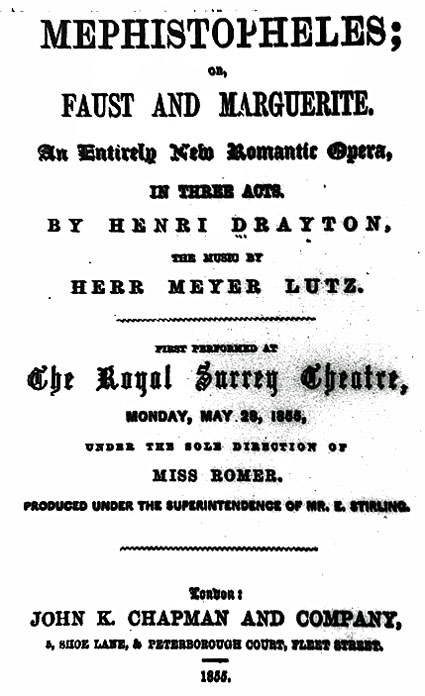
A printed copy of the libretto (London: John K. Chapman and Company, 1855) is available at Yale University and there is a microprint copy at Cambridge University, which is transcribed here. The text is almost identical to that in the manuscript except that the former has much fuller stage descriptions.
No scores of either the opera or individual numbers have been found. Possibly its production at the Surrey meant that publishers were less interested.
Recordings
None known
Books, Articles, Online
None known.
 |
 |
 |

 |
|
|