  |
 |

|
  Mabel or The Gipsy's Vengeancesometimes titled Mabel or The Gypsy's VengeanceMusic by John Marks JollyLibretto by Thomas Herbert ReynoldsonTheatre Royal, Covent Garden, London
|
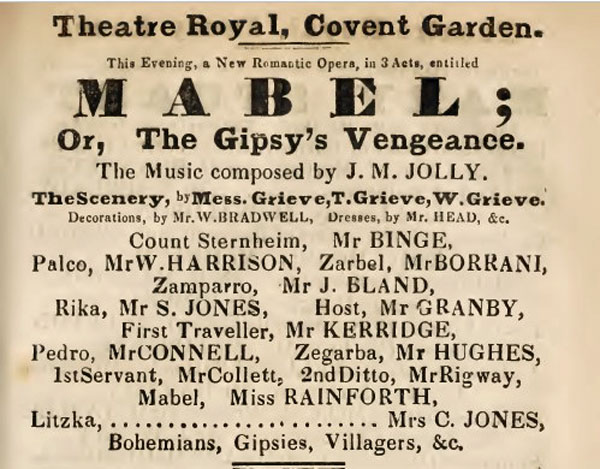
|
Count Sternheim Palco Zarbel Zamparro Rika Host First traveller Pedro Zegarba 1st servant 2nd servant
Mabel Litzka |
- Mr Ridgway [1]
- Mrs C Jones (Eliza Jones) |
Bohemians, gipsies [sic], villagers
[1] The playbill spelt Ridgway's name wrongly
History
On September 30, 1839, Lucy Vestris and Charles Matthews began their first season managing Covent Garden, where they remained for three seasons until May 2, 1842. During that time they staged some continental opera in English and two older English operas, The Beggar's Opera and Arne's Artaxerxes, but only one original English opera, John Jolly's Mabel, which was given only a single performance and never revived. The Planet (Mar. 1, 1840) reckoned that it had been "tried under many disadvantages at a sort of rehearsal at the Surrey". It is a little odd that such seasoned performers as Vestris and Matthews spent a great deal of money in staging the opera, presumably judging that it had a good hope of succeeding, when, in fact, it flopped so resoundingly.
This should not be confused with Verdi's Il Trovatore or The Gipsy's Vengeance which was translated by Charles Jefferys and performed at Drury Lane in 1856.
Plot
The Atlas (Feb. 24,
1840) summarised the plot as:
A new romantic opera, entitled Mabel, or
the Gypsy's Vengeance, was produced at this theatre on Saturday
evening in last week. The materials of its plot may be gathered from
the following abstract:-Mabel, a gypsy, plying her vocation during the
fair at Leipzig, impresses the image of her "dark loveliness" on the
heart of a certain Count Sternheim, who, professing honour - albeit
meaning mischief - persuades her to forsake her companions and
accompany him to his castle in some ummentioned place near the Black
Forest, under a promise to marry her on the instant of their arrival.
Palco, also a gypsy, and a rejected suitor to Mabel, pursues the
fugitives, in the hope of preserving Mabel from her impending fate,
and the first act closes with Sternheim and Mabel in an inn, Palco and
his comrades surrounding it, and the audience utterly unable to guess
the situation of any one party concerned. During an interval of five
years, presumed to occur between the first and second acts, Mabel
discovers the invalidity of her supposed marriage and secretly leaves
the castle of her betrayer; whereupon Sternheim takes unto him a wife,
who dies, bequeathing him an infant daughter.
At the commencement of the second act, Mabel
again seeks her gypsy home, and, maddened with jealousy, stirs up
Palco to revenge her wrong by kidnapping Sternheim's child. This is
accomplished at the expense of Palco's capture by the Count's
retainers, and the second act closes by a conflict of the gypsies and
servants, and the rescue of Palco.
The first incident in the third act is the
capture of Sternheim, who, approaching the gypsy fastnesses in the
hope of recovering his child, is made prisoner and condemned to death
as a spy. Palco now renews his suit to Mabel, but failing, reminds her
of the gypsy law, which proclaims that children betrothed by the
mutual oath of their parents (such was the case with Palco and Mabel)
are bound, at full age, to marry, if either claim it of the other.
Mabel defies the law, and prepares for death as the inevitable
consequence of her decision. At this moment a party of soldiers,
secretly conducted to the spot, attack and overpower the gypsies and
release Count Sternheim: Palco appears with Sternheim's child which he
threatens to sacrifice to his revenge, while Mabel, appealing to
Palco's former professions of love, beseeches of him the infant's
restoration, which being granted,[1] the Count takes Mabel to his
heart and home in earnest, and the piece concludes.
[1] The Atlas's account differs in a few details from the manuscript, probably mainly down to haste in writing the summary. However, there is one major difference. In the manuscript, Palco is shot by one of the other gypsies and the child rescued rather than persuaded by Mabel to give her up. Other newspapers , e.g. Morning Chronicle (Feb. 24, 1840), gave similar summaries to The Atlas, so clearly a change was made during the production.
Reception
There were few positive reviews. The Magnet (Feb. 24, 1840) noted that "some of its passages reflect great credit upon [Mr. Jolly's] talents", while the London Planet (Mar. 1, 1840) thought it "one of the best and most picturesque 'costumed' pieces we have ever seen". Even they judged that "The music, however, is of too level a character ever to become very popular ... the prevailing sameness is of too weak a character ever to attract much attention". It says something that several lines of the review were given over to the non singing role of Litzka by Eliza Jones, "a most amusing and laughable personage", "as excellent a piece of acting as we have seen for a long time".
Generally, the opera met with almost universal
vilification. The Atlas (Feb. 29, 1840) wrote that:
A drama, neither new nor forcible in its story,
and but ill-contrived as to its working out, could only have succeeded
through the excellence of its music; but here, we regret to say, its
dependence was most insecurely based.
The Age (Mar. 1,
1840), as did other publications, commended the performers
but as the
materials were of so slight a character, they could not save it from
condemnation - we never recollect [sitting] out an opera that went off
so flatly, and was so coldly received by an audience.
The Champion (Mar. 1, 1840) wrote
that
It is only in the last
act that there is any thing in the way of incident, and the little
that there is is very hacknied (sic). The language, too, is below the
average order, nor is there even a dash of comedy to relieve the
general dulness of the piece. It is too much the custom with libretto
concocters to disregard the unity of a story that is merely intended
as a vehicle for music; but where the plot is unattractive, one
naturally expects to find its poverty redeemed by the excellence of
the music. This is not the case here.
The Morning Chronicle (Feb. 24, 1840) described it as "a tissue of the merest melodramatic commonplaces, composed of materials worn out in the service of playwrights". Further, "What rational audience can derive any pleasure from such stuff as this spun out to a greater length than a play of Shakespeare's?". While it thought some merit in individual numbers, "the colouring of the whole is too uniform - a languid sweetness pervades it, which produces drowsiness". As might be expected, given Jolly's position as leader of the Surrey Theatre orchestra, "the orchestral accompaniments are written with the skill of a musician and the instruments are frequently combined in a very pleasing manner". Overall there was "a distressing want of originality". The scenery and singers were singled out for praise.
The Standard (Feb. 24, 1840) characterised it as a "'balled opera' in which the composer rather relies on the effect to be produced by simple airs than by elaborate combinations. However, "not a single piece had that charm, character, or spirit, which tells on the popular ear. Every air seemed to remind us of something heard before." It spoke of the audience "silently suffering the piece to die, as it were, a natural death" and recorded that "At the fall of the curtain an attempt was made to call for somebody, but the Quietists, who had been the great and consistent party of the evening, hushed down even this little demonstration".
Comment
Did Zarbel sing the third verse?
As has been noted with other English operas of this period, there seems to have been a few discrepancies between the manuscript passed by the Examiner and what was produced on stage, judged by the printed text for the vocal items that was sold in the theatre. In the absence of any evidence that it was resubmitted, we have to assume that there was a tacit approval to minor changes provided that they were uncontroversial.
There is one discrepancy here of particular interest. Only the first two verses of Zarbel's song in Act 2, Scene 2 (manuscript page 494b) were sent to the Examiner. This is about the old oak tree, a symbol for the aristocracy, and how it was laid low in a storm "by him from whom none can flee". This was clearly showing how all, both high and low, are subject to the whims of heaven. As such the Examiner would have had no problem. The third verse in the printed publication veered much more to the idea of such aristocrats taking up "a good acre or more" and being "all rotten at the core" to be replaced by smaller growths, i.e. the common people. Such a verse might have roused the Examiner if it had been included in the manuscript as it was in the printed songs, printed works not being subject to censorship.. If it was sung, then Mabel's short existence would have meant that it was unlikely to have raised much comment. Possibly it was just included as a defiant gesture at a time when Chartism was at the height of its influence.
The Heroine Trope
George Biddlecombe [1] in his analysis of the conventions of the
English opera libretto noted its close relationship to Victorian
melodrama and its three stock characters: the Heroine, the Villain and
the Hero. The Heroine instinctively understands what is right and
strives unceasingly to achieve it no matter what the obstacles
or the pressure applied and being prepared to die rather than
compromise her vision or her honour. A quick glance down the list of
English operas provides ample evidence of it in action. However, Mabel
does not fit this mould. Firstly, enticed by the promise of
immediate marriage she goes off with the Count. The marriage does not
transpire and "six short months we liv'd in bliss" before he went off and married someone else. This was
not to be expected of a Victorian Heroine even though it was righted
after a fashion when he eventually did marry her, his first wife
having conveniently died. The fact she was tricked into going with the
Count and their life of bliss together perhaps was seen to mitigate
the offence, such happiness being deemed incompatible with immoral
actions.
Further her thirst for revenge was a trait usually found in the Villain and hardly in keeping with the Heroine's innocence and striving for the moral good as neither was the kidnapping of the Count's son. The full effect of her actions are masked by Palco's seizing of the child and his eventual death. Her end state of being in love with and married to the Count is what would be expected of any opera or melodrama at this time but she has got there by a wilful repudiation of the Heroine trope. In effect, the Villain was transformed at the last moment into the Hero by virtue of him marrying the Heroine rather than his implicit goodness, as was meant to be the case.
There do not seem to have been any remarks or objections in reviews about these contradictions perhaps because the situation ended up in the expected, "right", place. In fact, they just saw the libretto as a poor and dated plot, poorly executed, as quoted in the Atlas review above.
[1] George Biddlecombe. English opera from 1834 to 1864 with particular reference to the works of Michael Balfe. (New York: Garland Publishing, 1994). Republished by Routledge, in Abingdon, Oxford, in 2019. The section on the Heroine is on pages 22-25.
Scores and librettos
The manuscript is available in the British Library (Add MS 42954, ff. 470- 509 b). It was received on February 14, 1840 and signed off on February 17. A transcript is available here. The Songs, Duets and Chorusses of the opera (London: S.G. Fairbrother, 1840) are available at the British Library. There are some differences between the vocal items in the manuscript and the printed version. These are highlighted in the transcript.
Recordings
None are known
Books, Articles, Online
None are known.
 |
 |
 |
  |
|
|