
 |
 |

|

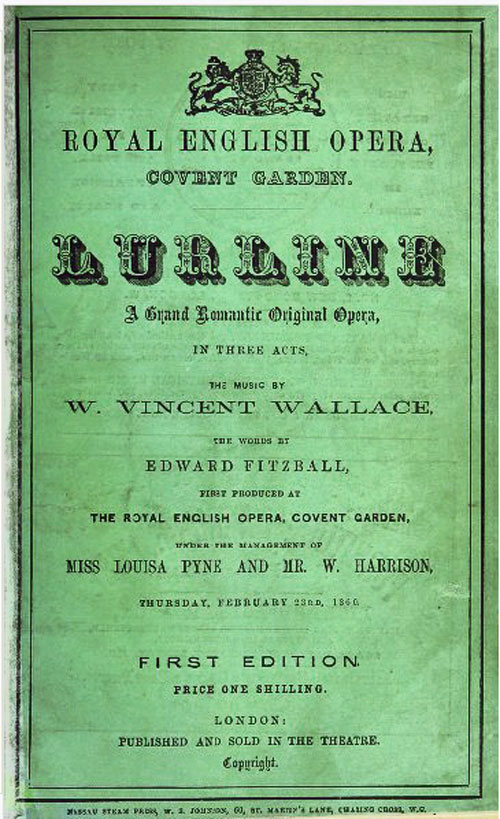
 LurlineMusic by William Vincent WallaceLibretto by Edward Fitzball
Theatre Royal, Covent Garden
|
|
Count Rudolph (a young nobleman) Wilhelm (his Friend) Rhineberg (the River King) The Baron Truenfels Zelieck (a gnome) Conrad Adolphe
Lurline (Nymph of the Lurlei-Berg Ghiva (The Baron's Daughter) Liba (A Spirit of the Rhine) |
|
Conductor - Alfred Mellon
History
This was Wallace's third opera and his most successful after Maritana and, like that, it had a libretto by Edward Fitzball. Its history is somewhat complicated. Wallace started composing the opera in 1847 [1] having been commissioned by Frederick Beale at Covent Garden but Beale withdrew from management after a disastrous year [2]. Alfred Bunn then planned to pick it up when he took over the management of Covent Garden in October 1848 [3]. However, his management lasted barely two months and there was no chance to stage it. From contemporary newspaper reports, it does look like the opera had been completed or was very near to completion. This is supported by Cramer, Beale and Co. in November 1848 offering the score of a piano piece, Lurline Romance, by Wallace, which, presumably, was one of the typical associated items that were produced both to promote and to capitalise on an opera's hoped for success [4]. It was not advertised very widely or for very long, so was probably withdrawn when a production of the opera did not materialise. A piece with the same title was published in 1860 when the opera was finally staged.
Wallace toyed with the idea of having the opera produced in Vienna after the success there of his Maritana but that seems to have fallen foul of internal opera politics and revolution [5]. Wallace was then struck by severe problems with his eyesight that prevented him doing anything further for some months and, on recovery, he set off for a lucrative tour of South America, so that any performance would have had to be postponed. It was not until February 23, 1860, that Lurline was premiered by the Pyne-Harrison company at Covent Garden [6], although there were suggestions that it had been produced on the continent in the interim.
|
Wallace and Fitzball took their inspiration for the opera from the well known Lorelei legend of a siren of the Rhine who lured fishermen into treacherous waters. A prominent rocky outcrop on the Rhine called the Lorelei Rock exists to this day in memory of the water sprite legend. The story had previously given rise to Mendelssohn's Lorelei composition left unfinished at his death in 1847 and Wagner also touched on the same idea in Der Ring. Unusually, the opera was through composed but, in fact, Fitzball's libretto initially had dialogue [7]. That was changed to recitative in stages before the 1860 production. It seems likely that Wallace asked for all the dialogue finally to be changed to recitative when revising the opera ahead of the 1860 production. Another feature of the 1847 version was that the main male character was named Rupert and this was used for the most part throughout the first two acts. However, for some reason it was changed to Rudolph when the third act was composed in 1848 [8] and that was then kept in all the published material. Various other additions and revisions were made to the 1847 version, some of which are discussed below. The opera was tremendously popular. Pyne and Harrison were said to have made £50000 from the opera but Wallace made no money, supposedly receiving 10 shillings which he then gave to the widow of a stage carpenter [9]. Such was the demand that Pyne and Harrison |
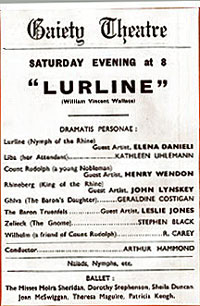 Dublin Revival, April 22 & 23, 1939 |
announced nine additional performances at the end of their regular season on Saturday, March 17, 1860 [10]. Performances soon followed in the UK, Ireland, Australia and the U.S. but interest subsided rather faster than it had for Maritana. However, there were revivals in Dublin in 1917 and 1939 and more recently a recording in 2009 and a concert performance in Dublin on July 26, 2024. The opera gave rise to a number of burlesques and the like.
[1] The first number, No.1, in the autograph score has Vienna, 13 July, 1847, written on it. The autograph score is held at the Royal Conservatoire in Brussels
[2] Andrew Lamb, William Vincent Wallace (West Byfleet: Fullers Wood Press, 2012, p.98. David Grant, "A Reappraisal of W. Vincent Wallace with new documentary information on his death". Journal of the British Music Society, Volume 25, 2003, p.66, included a letter in late 1847 from Wallace about Beale's difficulties and his fears that the opera would not be performed that year.
[3] The Musical World (July 29, 1848) wrote that "Among the first original productions of the new [Bunn's} company will be Mr Vincent Wallace's opera, Lurline - just completed. This may have been over optimistic as the Morning Post (Sep. 25, 1848) wrote that "Mr Wallace is composing an opera; the libretto by Mr Fitzball" for Bunn's forthcoming season. John Bull (Aug. 14, 1848) claimed that the opera "has been finished for some time, having been composed with a view to its production at Drury Lane by M. Jullien", but there seems to be no other evidence for this. Jullien did premiere Balfe's The Maid of Honor at the end of 1847 so might have looked to Wallace to follow it.
[4] Morning Herald (Nov. 21, 1848)
[5] David Grant, "A Reappraisal of W. Vincent Wallace with new documentary information on his death". Journal of the British Music Society, Volume 25, 2003, pp. 61-79. Also David Grant in an article in the programme for the Dublin 2024 performance
[6] The Illustrated London News (Oct 8, 1859) was rather stretching a point when it wrote that the opera "has been composed expressly for this [Pyne and Harrison] company".
[7] Ray Walker in the booklet for the Naxos recording of Lurline ( Naxos 8.660293-94, p.4) reckoned that rather than dialogue being replaced, "long recitatives were shortened". However, there was no music for those sections, their texts, which can be found here, were hardly promising recitative material with word play on "boar" and "bore" at one point and, in 1847, Fitzball would be expecting to use the usual dialogue and song format.
[8] The score of the final number, No. 32, was dated
[9] W.H. Gratton Flood, William Vincent Wallace (Waterford: Waterford News, 1912), pp.27-28.
[10] Morning Post (Mar. 13, 1860)
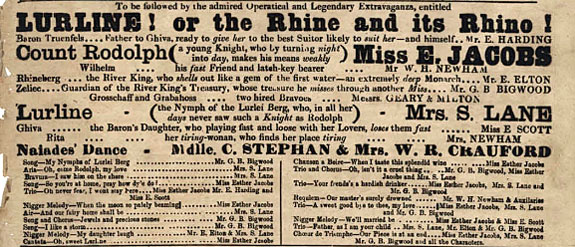
Example of a Lurline spin off at the Britannia Theatre, December 19, 1864
University of Kent Playbill Collection

Plot
The synopsis as set out in the Dublin performance of July 2024.
Act I
Scene: The banks and waters of the Rhine
In his underwater grotto, King Rhineberg laments the absence of his daughter, Lurline, and berates the gnomes for allowing the beautiful nymph to wander in the upper world. Lurline returns playing her harp and sings of having fallen in love with Count Rudolph whom she had seen sailing on the river. Meanwhile, Count Rudolph, an extravagant young man, is hoping to improve his fortunes by marrying Ghiva, the daughter of Baron Truenfels. Unbeknownst to the young Count, Ghiva and her father are not at all wealthy and are hoping to improve their fortunes by her marriage to the Count. When Ghiva discovers their mutual poverty, she calls off the engagement. The Count returns to his life of revelry to drown his sorrows, but Lurline appears and places a ring on his finger. Rudolph immediately falls in love with her. When she leaves, he follows her to the river and sets out in his boat to find her. A large storm arises, King Rhineberg and the water spirits cause the boat to disappear into a whirlpool.
Act II
The magic ring Lurline had given Rudolph allows him to survive underwater, and he is now living in Lurline's palace beneath the Rhine. Lurline and Rudolph sing of their love and happiness. Meanwhile, back in the Baron's castle Ghiva laments having broken off the engagement. Back in Lurline's palace, Rudolph expresses nostalgia for his old friends and his castle. Lurline allows him to return for three days and take with him some of the Rhine treasure. Nevertheless, she is overcome with grief and a sense of foreboding at his departure Act III On Rudolph's return, Ghiva is attracted by Rudolph's new wealth and determines to marry him. She steals the magic ring and throws it into the Rhine. Without the ring, Rudolph goes back to his life of revelry, forgetting Lurline and his promise to |
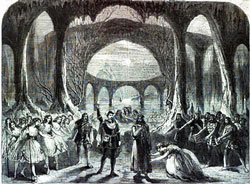 Illustrated London News (Mar. 3, 1860) |
return to her. While Lurline laments Rudolph's broken promise, his friends are envious of his new wealth and plot to murder him and plunder his castle. When Lurline's attendants find the ring and bring it to her, she goes to a feast that Rudolph is holding on the river bank. There, she berates him for his desertion, and he is once again enchanted by her. Ghiva, desperate to win back Rudolph, tells him of his friends' plot and urges him to flee with her and the Baron instead, but he refuses. Lurline then calls on the spirits of the Rhine to save her lover. The river suddenly rises and drowns the conspirators. Rudolph, wearingthe magic ring again, is spared and when the waters subside, he is carried down to Lurline's palace where they live happily ever after.
Reception
The opera took over four hours ending after eleven o'clock leaving the daily newspapers with short and rather general reviews just picking out a few numbers [1]. The Daily Telegraph (Feb 24, 1860) did manage a rather longer piece, although given "the late hour at which we write, we can only say of the third act that it contains two pieces of the highest merit". All agreed that it was a great success.
The Era (Feb. 26, 1860) confined itself essentially to plaudits on different aspects. There was not even criticism of the libretto. "Perhaps there has never been, on the whole, a more effective performance of a new opera on a first night". The musical treatment of various episodes were highlighted. All the singers were praised. The scenery was "picturesque and beautiful", the costumes "new and appropriate, and the general mise en scène highly efficient. The band - increased for the occasion - was magnificent".
The Weekly Dispatch (Feb. 26, 1860) was altogether more tentative. It made some interesting comments on the plot showing that there was growing awareness of its importance in creating an enduring opera. "Whilst the fairy element bestows a poetic interest on the story, it is not humanised to an extent to make the interest highly dramatic. We want action, more anxiety, and more conflict and result of motive; and especially we want this in the presence of modern standards", which the critic saw exemplified in the leading continental opera composers. It did think Fitzball's libretto "very creditable", "far beyond anything of the kind which we have witnessed in his hand". Musically, it found little evidence of great writing but praised its "abundant and original melody" but more importantly "its singularly brilliant orchestration". There was little comment on the details of the production but "The general result was a success as triumphant and well won as any we have witnessed for many years".
The Illustrated London News (Mar. 3, 1860) thought the opera might "challenge a comparison with the best German, Italian, or French dramatic music of the present day" even though the music "suffers from the libretto"; "the subject, indeed, is happy but spoiled by wretched treatment". "The simplicity and wild horror of the tale are entirely lost amid the melodramatic absurdities of the cockney school". Despite this, Wallace "has produced music - beautiful, expressive and picturesque - such as might have been written by Weber or Mendelssohn". The singers were praised while "the orchestra and chorus are everything that can be desired, and scenery and decorations are rich and beautiful"[2].
The Daily Telegraph (Feb. 27, 1860) went again to the third performance so that it could give a more considered opinion. The running time had reduced because "the machinists are more familiar with their duties", so possibly there had been no necessity for cuts. "Of the libretto we cannot speak with much praise; but it has its good as well as its bad points". Contrary to the Weekly Dispatch review, it thought its poetic character a good foundation for an opera. It also remarked on the lack of spoken dialogue, which is discussed below. It approved of the way that Wallace had managed to underline the sentiment of some of the songs, such as Rhineberg's opening number "All is silent", with appropriate accompaniment. The singers, including the newcomer, Miss Pilling, were praised and it spoke again of the opera's success.
The Standard (Feb. 27, 1860) also had a second hearing deciding that, compared with his earlier operas, it "is richer in purer melody and contains finer orchestration... so that Lurline must be regarded as his greatest work". And that "it will take a high position amongst modern operas". "The romance of the story is well expressed by the music". "As much cannot, however, be said for the libretto by Mr Fitzball". Pyne's singing "was characterised by grace and finished execution", "Mr Harrison ... was effective as usual", Mr Corri and Mr Honey, "both acted and sung well", "Miss Pilling... made another advance in her profession" and Miss Fanny Cruise sang the small part of Liba "with great effect". "The highest praise is due to Mr Mellon for the energy and perseverance he has displayed in getting up the opera", which was "placed on the stage in a manner worthy of the reputation of Covent Garden".
It is interesting to contrast the critical response [3] when the work was given by the Carl Rosa company at Drury Lane on April 12, 1890. It spent several lines decrying Fitzball and his libretto and retelling the joke that "the mixture of earth and water... accounted for the muddiness of the libretto". In his defence, it supposed that "the public did not care one iota about an indifferent drama and worse poetry provided they had music to their taste". His orchestration, much praised in 1860, now "sounds to us bare, feeble, unsatisfying - in a word undramatic." However, although the audience had been slow to warm to the piece, by the second act "the old enthusiasm burst forth" attracted once again by his "tuneful ballads".
[1] For example, The Times (Feb. 24, 1860), Morning Chronicle (Feb. 24, 1860), the Morning Post (Feb. 24, 1860) filled out its review with a description of the plot, although did talk of the "inferiority of the book" compared to Maritana.
[2] Whether we would take quite the same view is another matter. Charles Santley, Student and Singer. (London: Edward Arnold, 1893), pp. 186-187, recalled that some of the decor looked like "magnified sticks of red rhubarb". Fitzball reckoned it was meant to represent coral because, even though there was no coral in the Rhine, it was "very romantic". One can get some impression of it from the illustration above.
[3] Daily Telegraph (April 14, 1890)
Comment
A timeline of the opera's construction
The opera started life as a dialogue and song work in 1847 but morphed over time into a through composed work by the time of its first performance in February 1860. The 1847 version had some recitative as well as dialogue. Some further dialogue was converted into recitative for the 1848 version. However, there was still some dialogue as reflected in the manuscript libretto. However, prior to 1860, all that dialogue was crossed out in the manuscript and replaced by recitative in a different hand, as listed here. These changes all found their way into the printed libretto but not all into the first edition of the vocal score, although they did into the second edition. The timeline of these and some other changes can be found here. Thus it seems likely that some dialogue remained in place until quite close to the opera's production.
Considerations of what contributed to an opera's success including the impact of spoken dialogue
The lack of dialogue in the opera was unusual for English opera at this time and, in past examples[1], had often drawn negative responses. Here The Standard (Feb. 27, 1860) commented sardonically that "it is fortunate that the composer has suffered hardly any of the dialogue to be spoken[2], or [the libretto's] poverty would have been more apparent". However, the Daily Telegraph (Feb. 27, 1860) made a more interesting point. The lack of dialogue and little recitative meant that all the vocal items "follow one another very rapidly". "We have always thought that the popularity of some of Verdi's operas was in great measure due to the fact that, even at the risk of dramatic improbability, he passes by a sudden and sometimes brusque transition from one musical situation to another, so as to keep the audience constantly excited". The Weekly Dispatch above saw the key to success in including more action and more drama, in which Lurline was lacking.. Thus in different ways one gets the impression of critics trying to understand why continental opera continued, by and large, to outstrip English opera both in popularity and artistic impact.
Management of the Pyne-Harrison company
As with all Pyne and Harrison operas where the title page forwarding the manuscript to the Examiner was signed, it was signed only by Harrison, possibly indicating that he had more responsibility for the day to day management.
[1] Opposition to recitative was reducing. Recitative had been converted to dialogue on the second performance of Balfe's Catherine Grey because of opposition but by 1844 in Balfe's The Daughter of St Mark comments were more muted.
[2] In fact, there is no reason to suppose that there was any spoken dialogue. Perhaps the critic was not sure whether he might have missed some.
Scores and librettos
TThe libretto manuscript is available in the British Library, Add MS 52990 C. It was received on February 18, 1860 and the licence sent on February 20. The proposed day of representation was February 23, 1860, as indeed happened. The first act is in a different hand to the last two acts. The third act has a title page stating Theatre Royal, Drury Lane, but this was probably a copyist's error as the title page for Act 2 has Theatre Royal, Covent Garden. Further alterations were made to the manuscript with all the dialogue crossed out and replaced by recitative (see "A timeline of the opera's construction" above).
Printed librettos can be found at British Library scan (First edition) [1], HathiTrust (Third edition), HathiTrust (1868) (American edition), LoC (1868 American edition plus vocal score for four numbers) and Naxos (published for the 2010 recording). The updated manuscript and original printed librettos are very similar except that, unusually, there are more stage instructions in the manuscript.
The British Library has two editions of the vocal score as well as scores for individual numbers. The second edition is available on IMSLP. Victorian Opera Northwest offer a vocal score, full score and parts used in the Naxos recording, see here. Retrospect Opera welcome enquiries about their edition used for the Dublin performance, see here.
[1] Because of the British Library's problems, this scan is not available on their site at this time so the file from a previous download has been temporarily uploaded here.
Recordings / Streaming
|
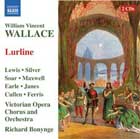
The first recording of Wallace's Lurline was made by Victorian Opera Northwest in Manchester in June 2009 and released by Naxos (Naxos 8.660293-94) in June 2010. The recording reverted to the earlier Rupert as the name of the main male character. Details on the making of the recording can be found at https://www.victorianoperanorthwest.org/Recordings/Lurlinerecording.htm . |
 |
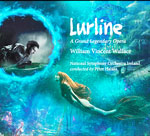 |
The concert performance of Wallace's Lurline given in Dublin in July 2024 is now available to view at https://www.youtube.com/watch?v=nl4cLl0-YTk. A review of the concert can be found here. A CD set of the performance is available from hhttps://una-hunt.com/merch/3cd-box-set-william-vincent-wallaces-opera-lurline |
Books, Articles, Online
Andrew Lamb, William Vincent Wallace (West Byfleet: Fullers Wood Press, 2012), pp. 136-144 has a chapter on Lurline.
George Biddlecombe, English opera from 1834 to 1864 with particular reference to the works of Michael Balfe/em>. (New York: Garland Publishing, 1994), pp. 133-136, has a section on the opera.
Victorian Opera Northwest has pages on the opera and its recording
 |
 |
 |

 |
|
|