
 |
 |

|

 Francesca Doria
|
 |
 |
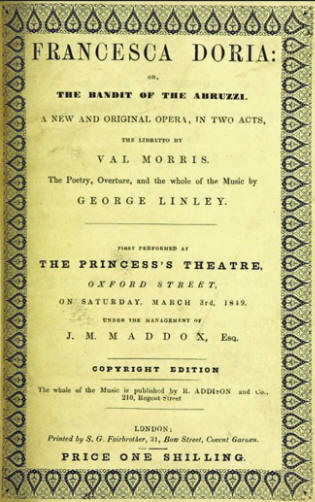
Libretto (London: S.G. Fairbrother, 1849)
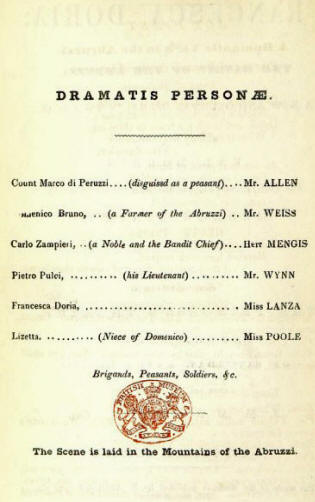
Cast
The cast as listed in the printed libretto
|
Count Marco di Peruzzi (disguised as a peasant) Domenico Bruno (a Farmer of the Abruzzi) Carlo Zampieri (a Noble and Bandit Chief) Pietro Pulei (his Lieutenant)
Francesca Doria Lizetta (Niece of Domenico) |
- Mr Wynn
|
History
This opera appeared with no prior fanfare at the Princess's Theatre on March 3, 1849. Valentine Harris provided the dramatic structure and George Linley did the text and music.[1] It enjoyed reasonable success, holding a place at the theatre until towards the end of April, April 26 being the last advertised performance found. A few numbers appeared in concerts.[2]
[1] Illustrated London News (Mar. 10, 1849)
[2] For example, Hengis was encored in "Oh! gentle lady, hear me" at Brighton on April 5, 1849 (The Era, Apr.8, 1849) and "Moored is my boat" was sang in Manchester in October, 1852, (Manchester Courier, Oct. 16, 1852)
Plot
The Sunday Times (Mar. 4,
1849) set out the plot: [1]
Carlo Zampieri, a noble, also captain of
banditti (Herr Mengis), is in love with Francesca Doria (Miss Lanza),
the ward of the Duke Andrea, whose castle has been burnt and sacked by
the bandits of the Abruzzi. The Count Marco di Peruzzi (Mr. Allen),
who has also been conquered by Zampieri, is disguised as a peasant,
and is seeking to arouse the neighbouring villagers to arms in defence
of their homes and their faith. In the meantime, Francesca Doria seeks
refuge from the pursuit of the brigands in the house of Domenico, an
honest peasant. She here meets with the Count Marco, her betrothed
lover.[2] Lizetta, the niece of Domenico, has a passion for Marco, and,
happening to overhear their mutual protestations, in a fit of jealousy
informs the band that Francesca is domiciled at her uncle's. Zampieri
and his band enter, and vow vengeance upon Domenico for harbouring his
enemies, but promises to spare his life if the lady be delivered up to
him. Francesca heroically presents herself, and is carried off by the
brigand chief.
The Count Marco now summons the peasantry, who are
armed with all sorts of agricultural implements, determined to storm
the stronghold of Zampieri. to save the lady and to put an end to the
sanguinary proceedings of her titled gaoler. Francesca, in his power,
is subject to his advances, but is armed against the worst by the
possession of a pocket pistol, which she is on the point of using,
upon an occasion when Zampieri is about to forget his rank, and what
is due to a lady placed against her will in so peculiarly unpleasant a
dilemma. Lizetta, repentant for the mischief
she has caused, dons the guise of a wandering minstrel, and with her
mandolin gains an entrance into the Castle of Zampieri and gives hope
to Francesca, by the information that Count Marco, through the aid of Pietro, one of the gang, has the clue to guide him to the secret pass
of the castle, and that aided by the peasantry and the military, he
intends to make a sortie, and liberate her. All this is done
accordingly, as in such cases made and provided. Count Marco is no
longer the peasant, but reinstated in his honours and dignities by the
King, and becomes the Duke de Peruzzi, and marries Francesca Doria;
and Zampieri determining, like Bertram, in Maturin's tragedy,[3] " to die
no felon's death," stabs himself, and grandly exclaims, " Zampieri
ne'er will yield to a Peruzzi."
[1] For some reason the paper has some occasional incorrect proper names , which have been corrected
[2] The libretto actually has them as unacquainted at the beginning.
[3] Charles Maturin was an Irish writer, one of whose plays was Bertram or The Castle of St. Aldobrand (1816)
Reception
Unusually, the libretto was quite well received in some quarters. Bell's Life in London (Mar. 11, 1849) wrote that "the dramatist has worked out very skilfully the action, which does not flag - indeed the libretto is rather an improvement on the plots of modern English opera". The Lady's Newspaper (Mar. 10, 1849) talked of Linley having "the advantage of much better poetry than generally falls to the lot of musical writers". However, the Sunday Times thought it "a common place conventional story, crudely wrought", while the Morning Post (Mar. 5, 1849) wrote the it "is rather clumsily constructed and hangs badly together; and the incidents are in themselves so trite, and so worn out by constant repetition, as to destroy all interest in the dramatic personages".
Of the music, Bell's Life in London
was again quite positive:
[The music] though it constantly calls up
reminiscences,[1] is on the whole creditable to the young
composer. If the best parts are not new, what is new is good; and, in
imitating, Mr Linley has copied the beauties rather than the
faults of his models.
The Satirist (Mar. 10, 1849)
judged
Its pretensions to science and originality, are, however,
very small and but for a few pretty ballads well sung by Miss Poole
especially, Mr Weiss, and Herr Mengis, it would be worth very little.
However, it did find the first act finale "worthy of greater opera...clever...full of melody...exceedingly well executed... dramatic, and is decidedly the gem of the whole" but the second act was "weak and trashy". The Times (Mar. 5, 1849) noted that it "Although utterly devoid of originality, the airs, in themselves, are extremely pleasing and well adapted to win the sympathies of the audience".
All of the singers seemed to have done well with Elizabeth Poole garnering most praise. One of the main interests in the opera was the stage debut of Rosalia Lanza. The Weekly Dispatch (Mar. 10, 1849) talked her having "a soprano of some compass, but of no great power" and that "she will, no doubt, become a useful auxiliary to the company" . The Examiner (Mar. 10, 1849) wrote that she won favour "by a rich soprano voice, by a cultivated manner, and considerable cleverness and self-possession as an actress". The Times was similarly impressed, although noting "certain defects of intonation". The Satirist thought that
she possesses good materials for becoming a good vocalist and actress; she has a good soprano voice, and evinces much nerve for so young a debutante, but her style is marked by extravagance which a little more familiarity with the stage will probably soften down.
The Observer (Mar. 4, 1849) summed up that the opera "was 'well mounted', the dresses being new and the scenery perfectly beautiful; and upon the whole it must be pronounced successful". The Era (Mar. 4, 1849) spoke of him being helped with his orchestration by Henri Lavenu. Its verdict overall was that
The success of the opera was as complete as the composer and the management could have desired...The orchestra and chorus have improved considerably under Mr. Loder's direction. The opera was given out for repetition four nights a week till further notice. On the whole, the opera abounds with airs of a light, fascinating style, in which there is nothing forced or laboured, but a flow of easy, unaffected music of its kind, graceful, and in some parts elegant, though not precisely what may be termed original.
[1] The Observer (Mar. 4, 1849) identified some of the sources.
Scores and Librettos
The libretto manuscript forwarded for approval to the Examiner is available in the British Library, Add MS 43017 ff.361-384b. The covering letter from John Maddox, the Princess's manager, stated that it was sent to be licenced on February 17, 1849, with the plan to perform it on February 24, 1849. There is a date of February 23, 1849, at the top of the manuscript, presumably when it was licenced by the Examiner. As with Loder's Robin Goodfellow, also at the Princess's, it is not clear whether the latter date was deliberately listed earlier in order to ensure that it was licenced in time or whether the premiere date slipped.
The British Library have a printed libretto (London: S.G. Fairbrother, 1849). This was available online but that has been currently withdrawn due to the 2023 cyber incident. A copy of it has been temporarily uploaded here. The printed libretto is reasonably close to the manuscript libretto except that some dialogue and vocal items have been removed. Elsewhere the printed libretto has some changes, for example at the end of the opera with a recitative and air for Zampieri, that seem, on the whole, to be aimed at clarifying and tightening the action. There is no evidence that these additions had been passed for performance by the Examiner.
The British Library have a vocal score of some of the numbers.
Recordings
None are known
Books, Articles, Online
None are known.
 |
 |
 |

 |
|
|