  |
 |

|
  Catherine GreyMusic by Michael William Balfe,Libretto by George Linley
Theatre Royal, Drury Lane, London,
|
|
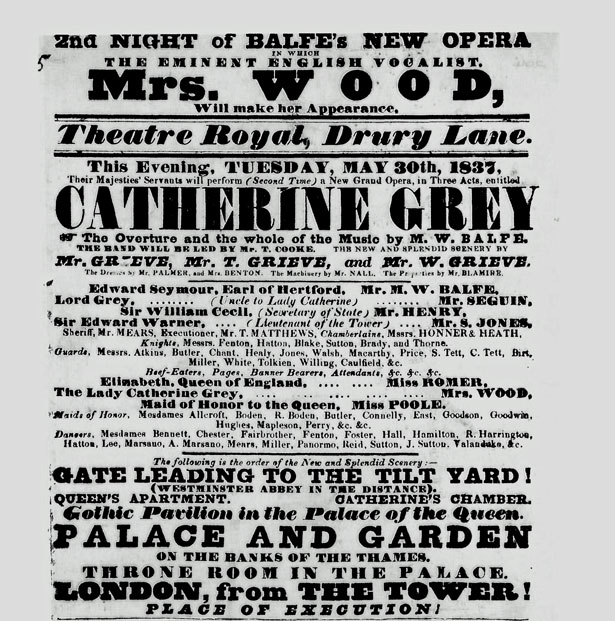
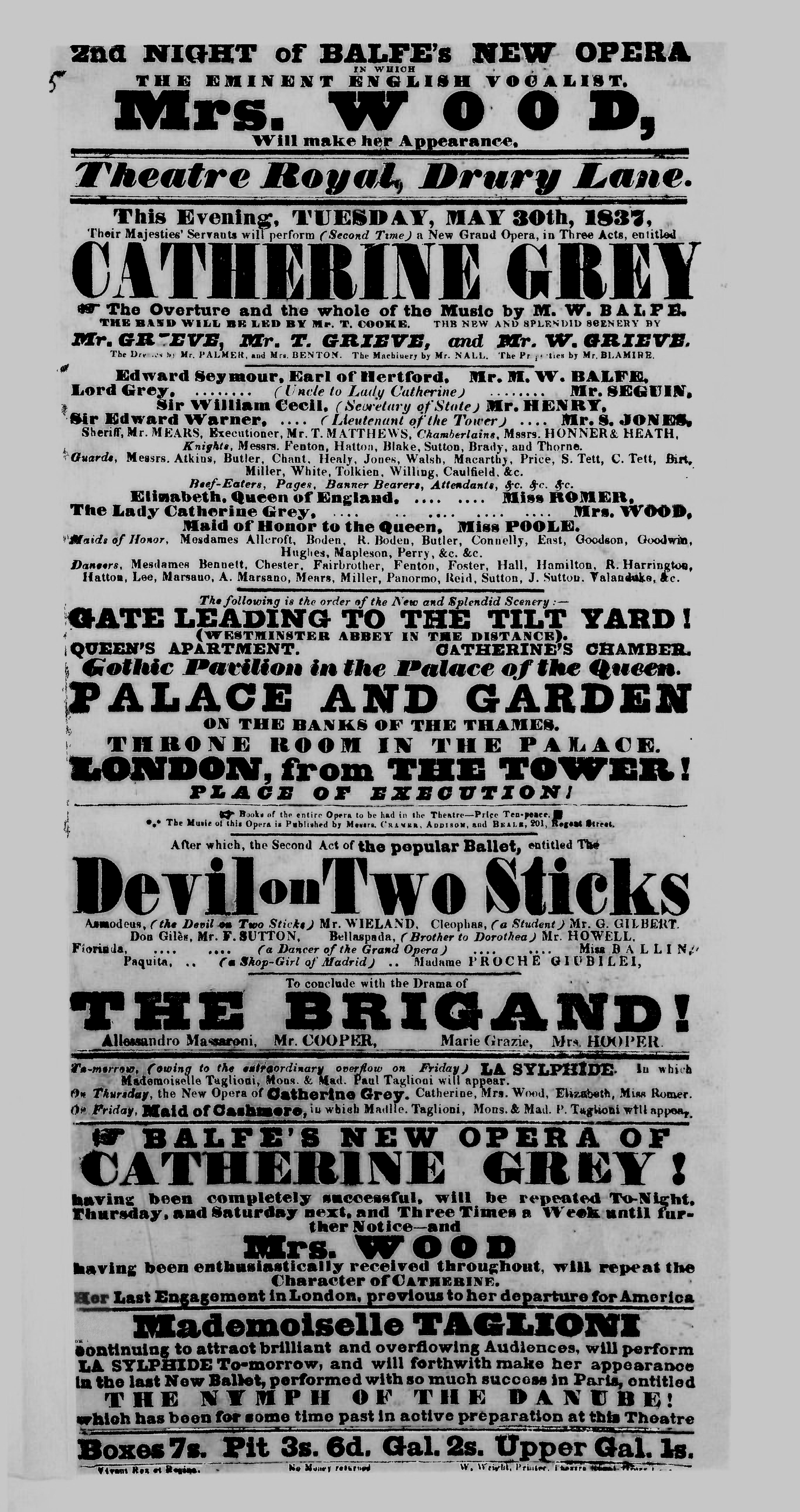
Edward Seymour, Earl of Hertford Lord Grey (Uncle to Lady Catherine) Sir William Cecil (Secretary of State) Sir Edward Warner (Lieutenant of the Tower)
Elizabeth (Queen of England) The Lady Catherine Grey Maid of Honor to the Queen |
-
Mr Henry
|
History
With Balfe already having produced two successful operas for him at Drury Lane, it is not surprising that Alfred Bunn was interested in staging his next work, Catherine Grey, for which it was claimed [1] he was to pay Balfe 500 guineas. For some reason, Balfe decided to replace the usual spoken dialogues with recitatives. Perhaps he thought that English opera was ready to follow continental models, which gave a composer greater musical possibilities. However, adverse reaction led to the recitative being replaced later by dialogue.
Along with Barnett's Fair Rosamond of 3 months earlier, it was one of only two English Romantic operas to use English history as a starting point, perhaps surprising given English opera's nationalist claims. The opera was premiered on May 27, 1837, but after 3 further performances the heroine, Mary Ann Paton (Mrs Woods) left, supposedly to go to the U.S., and the opera terminated at Drury Lane.
When Bunn also took over the Lyceum (English Opera House) for the 1837-38 season, he opened with Catherine Grey on July 24, postponed from July 20 due to Emma Romer's indisposition. Emma Romer took over the part of Catherine Grey from Mrs Wood, Mr Healy took over from Mr Henry and Elizabeth Rainforth took over the part of the Queen from Romer. For these performances dialogue replaced much of the recitative. There were 8 performances ending on August 7.
There do not appear to have been any further performances until Emma Albertazzi included Act 1 in her benefit a year later at Drury Lane on August 20, 1838 [2]. No further performances are known although some items were occasionally given in concerts over the next decade or so, including in Australia [3].
[1] Sunday Times (Sep. 4, 1838)
[2] See playbill below
[3] See Graeme Skinner's Austral Harmony web site - https://www.sydney.edu.au/paradisec/australharmony/
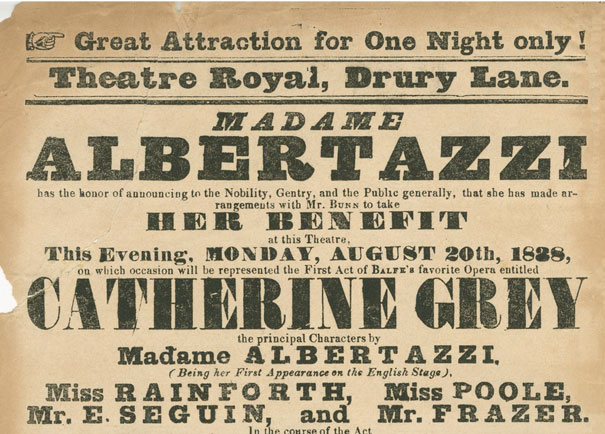
Part of a playbill for Albertazzi's benefit
(wrongly dated 1828).
It was followed by a Grand Concert.
Trinity College, Hartford.
Plot
The plot is very loosely based on historical people and events. The Examiner (June 4, 1837), p. 358 gave the following synopsis:-
Queen Elizabeth falls in love with Edward Seymour, Earl of Hertford; but upon disclosing to him her passion, discovers his heart is engaged to another. Her very wilful Majesty now gives herself very unseemly airs; and blares and storms like the vulgarest of her sex. In the sequel she finds that Catherine Grey, one of her court ladies, has a child; and the quick match of her virtue fires the whole train of her imagination. Catherine is required to name the father of the child, and upon her naming Hertford, to whom she has been clandestinely married, another explosion takes place, and the Queen orders the Earl to the Tower, and subsequently to execution. In the last scene, as he is proceeding to his death (the Queen - dramatically, but not the less ridiculously, being a spectator) Catherine rushes is stark-staring in white muslin, and so works upon the Queen, by her heroism and devotion, that a full pardon and a joining of hands is the instantaneous result.
Reception
As usual, the libretto garnered little praise. The Examiner's unenthusiastic reaction was that "The reader will form his own conclusions of the interest as well as the propriety of such a plot", while The Times (May 29, 1837) had "seldom witnessed a more indifferent piece".
The Examiner particularly disliked that "The whole dialogue is in recitative, and the whole performance is to the last degree wearisome. The music throughout is a 'tenth transmission' of the commonest Italian models, and has not a spark of novelty". However, the Observer (May 28, 1837) reckoned that the opera was "extremely successful" and even though it acknowledged that "it was not received con furore by the audience", "nobody can hear it without considerable pleasure". The singers were complimented including Balfe on one of the few occasions singing in his own opera. The Times was of much the same opinion although it thought Balfe's voice "scarcely powerful enough for the theatre". Such optimistic assessments were all too common and, as too often, quickly proved illusory. As the Sun (July 25, 1837) commented "the plaudits of the first night are no good criterion of the success of a piece".
The Morning Post (May 29, 1837) was also generally complimentary and "happy to say that Mr Balfe has sustained his reputation". However, it felt that "his endeavours to produce a tragic opera on the Italian and German model have not been quite successful" and, as with almost all the newspapers, thought that the use of recitative was part of the problem. In particular "The public generally are not sufficiently advanced to relish the recitative". However, one of that public, Charles Rice [1], disagreed
"the more this legitimate style of composition [recitative] is cultivated the more enhanced will be the taste for English music, for our operatic performers are always such poor actors, that where they produce a striking effect in their vocal display, they invariably supply its opposite in the prose section of their characters".
Rice's main complaint about the opera was the "familiar reminiscences of other authors" and if his memory of the "loud and continued hissing" at the end of the overture is true, others agreed with him. He pointed out that "many of the most stirring parts of the opera bear a strong resemblance to Rossini's Siege of Corinth". He thought that the opera "improved very rapidly after the overture" and noted several of the more successful numbers but even so he had to "withhold from them in almost every instance the claim to thorough originality". The impression is that he did not share the common assessment of the opera, that "was most rapturously applauded". He also highlighted the lack of business sense which so bedevilled English opera at this time: "The opera has been splendidly got up, incurring an expence which I am afraid the present production, coupled with the lateness of the season, will never return with profit to the pocket of Old Drury".
The conversion from recitative to dialogue on the second run did little to improve its success. The Morning Chronicle (July 25, 1837) thought that
it relieved the opera of a heavy dead weight, and made it move with more spirit; but on the other hand, it exposed the insipidity and baldness of the dialogue, which, being written to be sung, was too insubstantial to bear being spoken. In making this change the dialogue ought to have been rewritten. But, after all, no alterations of this kind could have converted a bad piece into a good one; and Catherine Grey, though less tedious than before, is still incapable, dramatically speaking, of giving pleasure or exciting interest. We regret this on account of the excellence of a great deal of the music which Mr Balfe, we must say, has thrown away on it. It is characterised by more originality, more energy, a greater variety of melody, and a more masterly use of the orchestra than any of his former productions; and affords proof of an enlarged acquaintance with the great masters of the German school.
[1] Charles Rice, The London Theatre in the Eighteen-Thirties (London: Society for Theatre Research, 1850), pp.49-51. Rice was an attendant at the British Museum and an avid theatre goer, who wrote about what he saw.
Scores and librettos
The manuscript of the libretto submitted to the Examiner is available in the British Library Add MS 42942, ff.182-215b. It was licenced on May 25, 1837. The printed libretto by W.Wright (1837?) can be found online at the Goethe-Universität, Frankfurt and Google books. The manuscript and printed version are very similar, but, in the printed libretto Hertford has an additional verse in his aria at the start of Act 2 and in the duet at the end of the first scene in Act 2.
The autograph score (Add MS 29329-29330) and the vocal score are available in the British Library, as well as three individual songs.
Recordings
There is a 1980 recording of Hertford's air "Look Forth, My Fairest" arranged as a duet and sung by Pearl Berridge & Raymond Myers, see - https://www.youtube.com/watch?v=sr1V7XHbk1I
[1] Thanks to Jeff Clarke of Opera della Luna for pointing this out.
Books and Articles
Bruce Carr, "The First All-Sung English 19th-Century Opera", The Musical Times. Vol. 115, No. 1572, (Feb, 1974), pp.125-126.
William Tyldesley, Michael William Balfe: his life and his English operas, (Aldershot, UK: Ashgate Publishing, 2003), pp. 70-72, includes a fairly superficial description and history of the opera. There are also a few comments to be found in the books on Balfe by Walsh, Kenney and Barrett (see book list).
George Biddlecombe, English opera from 1834 to 1864 with particular reference to the works of Michael Balfe. (New York: Garland Publishing, 1994), pp. 107-108, has a short section on this opera.
 |
 |
 |
  |
|
|