  |
 |

|
  Aminta, The Coquette
|
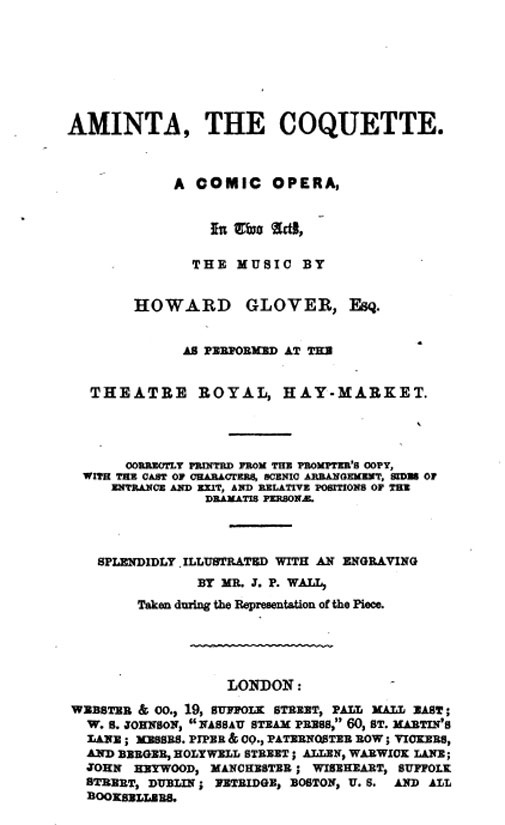
|
Don Alonso Don Tenorio Fernandez Garcias
Aminta Paquita |
|
Conductor - Alfred Mellon
History
This was Benjamin Webster's second original English opera at the Haymarket. It premiered on January 26, 1852, but had a history before then. An unnamed opera, later identified as La Coquette, was announced for performance at the Princess's Theatre, London, in 1845 (Morning Post, Oct.1, 1845) but never materialised there notwithstanding a further announcement the following year. However, an opera of that name by Howard Glover was performed at his brother (or half-brother) Edmund's theatre at the Prince's Theatre, Glasgow, in March 1849 (Glasgow Punch, Mar. 24, 1849). In late April, at least part of Glover's The Coquette was staged at the Liver Theatre, Liverpool (Liverpool Mail, Apr. 28, 1849). This was also referred to as Glover's Aminta (Illustrated London News, May 5, 1849).
The Glasgow and Liverpool performances were, presumably, earlier versions of what was given at the Theatre Royal, Haymarket, on January 26, 1852, as Aminta, the Coquette or, A match for a magistrate, despite being advertised in The Era (25 Jan 1852) as "an entirely new comic opera". The original libretto was by Archer Gurney, but "licked into the shape in which it is presented at the Haymarket" by John Oxenford.[1] Oxenford is usually the only name cited possibly because Gurney was ordained by this time and probably would not have wanted to be associated with a frivolous theatre work [2].
No manuscript with a name resembling Aminta, the Coquette was sent to the Examiner of Plays for clearance until the Haymarket performance. The manuscript, dated January 12, 1852, said that it was to be performed on January 19. The Examiner, William Bodham Donne, wrote on the manuscript that he received it on January 13, 1852 and sent the licence on January 19. However, it was not premiered for a further week and thus, as with other operas, the manager might have put an earlier date on to make sure that he received the licence before the actual intended premiere. The fact that Donne took five or six days to examine a fairly short and pretty trivial script seems to indicate that he did not take the supposed planned premiere date that seriously.
The opera had very modest success, running for under a month and achieving only 11 performances.
[1] Lloyd's Weekly Newspaper (Feb. 1, 1852) referred to him as Mr Archer Gurney rather than Reverend. Augustus Gurney, A Remarkable Clerical Career. ed. David Gurney, (Market Harborough: Troubador Publishing Ltd., 2025), Kindle edition, p.412 states his authorship. This book is a transcription of Augustus William Gurney, Memoir of Archer Thompson Gurney. Unpublished manuscript written in 1887 by Augustus Gurney about his brother, Archer Gurney. (London: British Library: Add MS 81597). An earlier transcription by David Gurney is available at the British Library: Add MS 81598 A and Add MS 81598 B.
[2] Shortly before this time, Gurney had been curate at Holy Trinity, Exeter, from 1850 to 1851. "The leading people in the parish of Holy Trinity were at that time, with a few exceptions, strong evangelicals; and strong evangelicals are not likely - prima facie - to be taken with a Curate who writes Opera libretti", Augustus Gurney, p. 469. Archer Gurney was a High Churchman.
Plot
Lloyd's Weekly Newspaper (Feb. 1, 1852) outlined the plot:
|
There are the usual personages of the comic opera; the smart country girl and her rustic lover, the village magistrate - who of course is the villain of the piece - the customary band of smugglers with their fierce-looking leader, with the necessary adjuncts of peasants, soldiers,etc. to sing choruses, execute figured dances, and form tableaux. Aminta, the heroine, is an arrant little coquette, who flirts with all her lovers, but returns the love of one of them, Fernandez, while she is pursued by the addresses of Don Tenorio, the alcade.[1] She tells them all that she will settle their pretensions by presenting a rose in the public marketplace to the object of her preference - not the most maiden-like proceeding in the world. Her lover looks moody, and she, to plague him, makes a show of presenting the rose to the magistrate; but thinking this may be going too far, she suddenly stops short, and says she will give it to none; whereupon the youth flies off in a passion, and joins a band of smugglers. The smugglers are attacked by a party of troops, and Fernandez is taken. His sweetheart begs his life of the alcade, who promises to grant it on condition of her giving him her hand. She consents in despair; but the worthy magistrate breaks his word, and the unfortunate lover is |
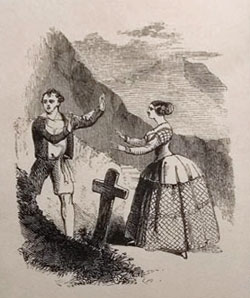
Illustration in the Webster Ed |
about to undergo the sentence of the law. The girl then resorts to the colonel of the troops, who, touched by her distress, yields to her entreaties but the vindictive alcade insists on justice being done, and threatens to denounce the officer to the higher powers. But at this juncture, a number of hampers of contraband wine are brought in, addressed to the magistrate, from which it is discovered that he has dealings with the smugglers. He is glad, consequently, to let the matter rest: and the union of the lovers follows of course.
[1] Spanish term for mayor or chief magistrate
Reception
Lloyd's Weekly Newspaper thought that "There is not the slightest dramatic interest in the plot; it is meagre in the extreme; the dialogue is flat, and what little incident there is is most commonplace". The Morning Chronicle (Jan. 27, 1852) talked of "A tamer, weaker string of bald theatric commonplace than Aminta cannot be conceived".
The Illustrated London News (Oct. 30, 1852) wrote that the author had "prudently concealed his name". However, having made
due allowance for one of the most ill-concocted and dismal books...ever wedded to music, the composition is of that nondescript class which belongs to everybody and nobody. Mr Howard Glover is a composer in search of a style; he borrows from every school, and his music is therefore neither fish, flesh nor fowl.
On the other hand, The Era (Feb. 1, 1852) found that
"The music of Aminta is exceedingly pretty, sparkling, melodious, and full of vivacity, but not strikingly original; though simple, and free from elaboration, it is ingenious and masterly; the concerted pieces evince great facility of composition, and the accompaniments throughout are delicate and skilful.
It also complimented the scenery and care taken over the production, as well as noting the enthusiastic reception, even if doubting that the seven encores were all "genuine and merited".
The Lady's Newspaper (Jan. 31, 1852) did not "remember, for some years past, a more complete success". Somewhat unusually, it commented on the orchestra and chorus that, under "the advantage of Mr. Alfred Mellon's management, seem to be better drilled (though not as strong as they should be) than any theatre we know".[1] While not "a work of the highest class", "it possesses great merit" and the newspaper looked forward to new works from Glover. It left its considered review of the work until the opera had "got into better working order; a first night always has its disadvantages".
Bell's Life in London (Feb. 1, 1852) wrote that "The applause was loud and incessant,... The house was crowded, and the opera may be said to have been decidedly successful". The Leader (Jan. 31, 1852) took a rather different view seeing the fulsome reception as "a vociferous body of friends and a remarkably unmoved public" while Reynolds' Newspaper (Feb.1, 1852) grumbled that "it was surprising ... that such an adept in theatrical quackery as the Haymarket manager did not arrange matters that the 'enthusiasm" of his friends should not display itself so lamentably out of time". The Morning Chronicle (Jan. 27, 1852) warned that "False and fictitious furores, however, react against their contrivers, and such, we fear, will be the case in respect to the future prospects of the work in question". Glover, who was the Morning Post's music critic, succeeded in giving his opera a good plug, noting that it was "received with great enthusiasm by a crowded audience" with "seven hearty encores", while protesting that he "must leave to our contemporaries the task of criticising the work". The Illustrated London News (Oct. 31, 1852) obliged with a pithy verdict, "We fear Aminta will be a waste of time and energy for all concerned".
[1] Reynolds' Newspaper (Feb.1, 1852) was less complimentary "The orchestra, as usual at this house, blared fearfully, stringed instruments being evidently in disfavour".
Comment
In common with many past operas, this opera throws up questions of censorship practice in Britain at this time. Firstly, there are the previous provincial performances apparently staged with no clearance from the Examiner. Secondly there are the differences between the approved manuscript and the printed version in Webster's edition, although, given the time lapse of its publication since the performances, it may reflect later changes despite its protestations as being taken from the prompter's copy.
Scores and Librettos
The libretto manuscript is available in the British Library (Add MS 52929 E). It was received by the deputy Examiner, William Bodham Donne, on January 13, 1852 and the licence sent on January 19. A printed libretto from Webster's Acting National Drama, Volume 5 (London: Webster & Co., ?) is available at Google books, the final script in the book.
The plot and the dialogue are pretty much identical in both sources but the printed version has additional songs, verses and a chorus. Interestingly, three places in the manuscript have a gap with a vertical wavy line clearly showing that a song would be inserted, as indeed was the case in the printed version. Thus the Examiner (William Bodham Donne) was happy to sign off even though not knowing the songs' text but, presumably, being confident that they would not include anything that could be objected to. The gaps showed that Gurney's original libretto, which sufficed for the opera's previous history, did need some work doing to bring it to being an opera suitable for London audiences
No vocal or full score of either the opera or any numbers from it have been located.
Recordings
None are known
Books, Articles, Online
None are known.
 |
 |
 |
  |
|
|