  |
 |

|
  The Rose of Castille [1]Music by Michael William BalfeLibretto by Augustus Harris & Edmund Falconer
Lyceum Theatre, London
|
|
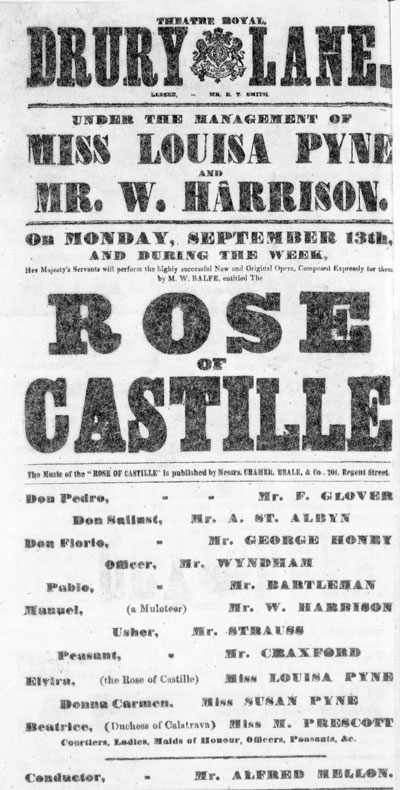
Don Pedro Don Sallust Don Florio de Santa Cruz Pablo An Usher Manuel (a Muleteer)
Elvira (the Rose of Castille) Duenna Carmen Beatrice (Duchess of Calatrava) |
- Marian Prescott (Mary Ann Pyne) |
History
This was the first of six operas that Balfe wrote for Pyne and Harrison that ended when their company was dissolved in March, 1864. According to the manuscript libretto submitted to the Examiner, the original title was The Rose of Leon but Leon was crossed out and Castille substituted. As The Standard (Oct. 30, 1857) pointed out Leon is actually the correct designation. The opera was based, as so often, on French sources, in this case Adolphe d'Ennery and Louis-François Clairville's libretto for Adolphe Adam’s 1854 opera Le muletier de Tolède. Augustus Harris adapted the story and Edmund Falconer wrote the texts for the vocal items [1].
|
According to the last page of the score, Balfe claimed to have begun writing the opera on September 19 and to have completed it on October 11, 1857, 23 days in all [2]. It did include some material from past works. The opera was very successful and when the Lyceum season closed on December 19, 1857, Pyne and Harrison took it on tour. This was interrupted on January 21, 1858, when it was performed at Her Majesty's Theatre in front of Queen Victoria and the Court as part of the celebrations to mark the wedding of the Victoria, Princess Royal and Frederick, Prince of Prussia. The opera was then revived at Drury Lane on September 13, 1858 and had achieved 121 performances in total by the time the season closed on December 9, 1858 [3]. The Pyne and Harrison company then moved to Covent Garden and revived it there with at least one performance every season until they disbanded in 1864. Harrison chose it for his benefit on March 15, 1862 and for his final benefit on March 15, 1864. In all the company performed it 150 times in London as well as on the provincial tours that followed some seasons [4]. From 1861, other companies, such as those of Elliot Galer and Henry Haigh took it up and toured it in the provinces. It continued to be performed throughout the century with J.W.Turner's company and the O'Mara Company still touring it in the |
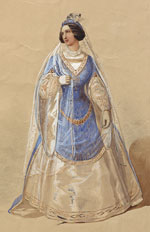 Mathilde Wildauer as Elvira in the Vienna production |
early 20th century. It was performed in the U.S.(New York,1864), Australia (Sydney, 1860) [5] and New Zealand (Dunedin,1864) and a German version was given in Vienna on February 5,1859 [6].
The opera was the first work to be given at the newly formed Wexford Opera Festival in 1951 and the work was revived there, in reduced form, in 2026.
[1] The Era (Oct. 25, 1857)
[2] William Tyldesley, Michael William Balfe: his life and his English operas, (Aldershot, UK: Ashgate Publishing, 2003), p.171
[3] The Times (Dec. 9, 1858). The Illustrated London News (Oct. 16, 1858) warned that "the practice of wearing a successful piece threadbare ... though often resorted to by the cupidity of managers, is often not esteemed good policy. It defeats its own object and may be said to be 'killing the goose that lays the golden eggs' ". Possibly the comparatively few further performances by Pyne and Harrison was evidence of its correctness.
[4] The performance numbers, 29, for the Covent Garden years come from Harold Rosenthal, Two Centuries of Opera at Covent Garden. (London: Putnam, 1958), pp. 686-692. Together with the 121 up to December 9, 1858, this makes the 150. Eric White, The History of English Opera. (London: Faber & Faber, 1983). p. 301 wrongly states the total as 129.
[5] Sydney Morning Herald (Nov. 19, 1860) advertised it "for the first and only time" on November 22 by the Frank Howson Company. Single acts had been given on previous days.
[6] https://collection.theatermuseum.at/objekte/titel-der-serie-figurinen-des-k-k-hofoperntheaters-1490434 . The picture is of the Elvira from the Vienna production, Mathilde Wildauer.
Plot [1]
|
|
The opera opens in the courtyard of a Spanish inn. Elvira, the Queen of Leon, arrives in disguise with her companion, Donna Carmen. Elvira has secretly left her palace to observe her intended fiancé, Don Sebastian, who is rumoured to to be traveling incognito as Manuel, a muleteer. Elvira wishes to judge his character before agreeing to marriage, mirroring his own plan to assess her suitability. Manuel (the disguised Don Sebastian) soon appears and rescues Elvira and Carmen from the unwanted attentions of Pablo and the peasants. Elvira and Manuel engage in flirtatious banter, each hiding their true identity. Manuel expresses his affection, and Elvira tests his sincerity. Their mutual attraction grows, but both remain in disguise. Meanwhile, Don Pedro, Don Sallust, and Don Florio, Elvira’s ambitious cousin and his allies, plot to seize the throne. Don Pedro schemes to force Elvira into marriage or abdication, using her resemblance to a peasant girl (actually Elvira in disguise) as part of his plan. The act ends |
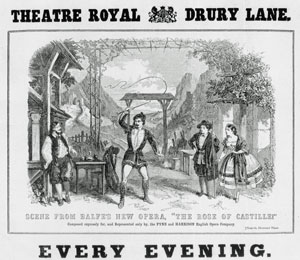 Scene at the Inn, Act 1
with the peasant girl (Elvira) being escorted away by Don Pedro and his conspirators, under the pretence of protection.
The scene shifts to the palace at Valladodid [2]. Don Pedro and his allies finalize their conspiracy: they plan to imprison Elvira upon her return to Leon and, if she refuses to marry Don Pedro, replace her with the lookalike peasant girl. Elvira, now back in her royal role, presides over courtly ceremonies but confides her longing for the simplicity of her former convent life. Manuel manages to warn her of the plot against her and Elvira swaps places with the Duchess Beatrice, who is sent in her stead to the palace at Leon, thus foiling the conspirators’ plan to capture her. Don Pedro is informed that he has captured the wrong woman. He then realises that the peasant girl is actually the Queen in disguise. She refuses to marry him and is |
|
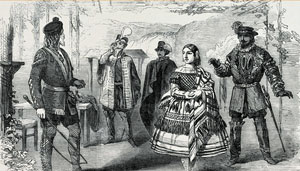
threatened with being sent back to the convent unless she abdicates but the appearance of Manuel gives Don Pedro another idea. The act concludes with a wedding between Elvira and Manuel orchestrated by Don Pedro to disgrace the queen not realising Manuel’s true identity.
The final act opens with a comic subplot of the marriage of Carmen and Don Florio. After confusing Elvira as to whether he is Don Sebastian in disguise or just a muleteer, she asserts that she will remain married to him whatever his status. Elvira faces Don Pedro’s demand for abdication. She refuses, and the conspirators attempt to expose her marriage to a muleteer as scandalous. Manuel reveals his true identity as the King of Castille and the conspirators are unmasked and defeated. Elvira and Manuel are joyfully united, Elvira forgives the conspirators and the opera ends with celebrations.
[1] A revised version of an Acrobat AI summary of the 1857 libretto.
[2] The libretto is in error and the city is actually Valladolid
Reception
Critics and audiences looked forward to Balfe's return to English opera and were, in general, not disappointed. They were also pleased to see how well the new Pyne and Harrison company produced this their first English opera premiere.
The Standard (Oct. 30, 1857) complained that the opera ended so late, nearly midnight, that it would restrict itself to general remarks. The prospect of a new opera from Balfe after many years "created unusual curiosity and excitement" resulting in the theatre "crowded from floor to ceiling". "It was a night of universal satisfaction". While reporting the success of singers, musicians and support staff and praising much of the music, it thought that Balfe had committed two grave errors. Firstly, he had overloaded the score with seven ballads "these pernicious solos, which intrude in every scene, and at times render the performance intolerable". Secondly, he had "assigned too much bravura music to [Louisa] Pyne" and thought it might overtax her. It took her absence early the next week, as proof [1].
The Morning Post (Oct. 30, 1857) had a long review which went into detail on both plot and individual numbers but offered little overall assessment as they had "only time to state that the opera, was, on the whole, admirably performed, and triumphantly successful". The Times (Oct. 30, 1857) was impressed by the production, "we believe a more generally correct and effective first appearance of a new and difficult composition has seldom, if ever, been witnessed" [2]. Otherwise it had little to say except to note the opera's success although it also wondered whether Pyne might be overtaxed by the quantity of decoration but was reassured by the freshness of her final air.
The Era (Nov. 8, 1857) made little detailed comment but would "hardly be surprised to find that The Rose of Castille is considered as the masterpiece of the composer in as much as it is impregnated with all that pure, melodious truth for which [Balfe] is so justly celebrated". The soloists, the chorus and the orchestra were all praised with Louisa Pyne singled out for the beauty of voice and "command over the most intricate forms and varieties of fioriture".
The Examiner (Oct. 31, 1857) while
complementary on the whole saw the opera weakened
by the
predominance of drawing room ballads, which the bad taste of the
public and the demands of the music-shop compel English composers to
produce and multiply. Any one of Mr Balfe's ballads is good, but they
are all as much alike as sheep upon the hills.
Overall
Our impression of
the music we must be content to sum up briefly. At the end of the
first act, in spite of Miss Pyne's brilliant singing, in spite of some
clever concerted music, and a well-wrought finale, there was a decided
sense of dulness left. In the second act this was more than dispelled,
the music became light and sparkling, much of it being as good as
Cimarosa's best. The third act abounded in good matter, and when the
curtain fell we were at ease. If The Rose of Castille be not
Mr Balfe's best opera - and after one hearing we cannot suddenly
assert that it is - we are quite sure that it contains much of his
best music, much music that is in the highest degree creditable to the
English school.
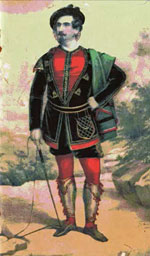
William Harrison as Manuel - |
The Observer (Nov. 1, 1857)
thought that: For once, Harrison came in for praise, although its opening sentiment could be taken in
another way: In summary, "To the 'mounting' of the opera too much praise cannot be given". |
|
The New York Times (July 30, 1864) reviewing the U.S. premiere wrote that:
|
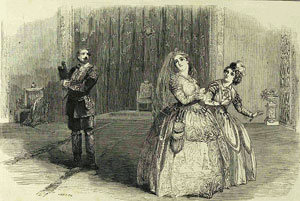 Harrison, Louisa and Susan Pyne - 1858 revival [3] |
[1] The Standard (Nov. 3, 1867). Although no evidence has been found, one wonders whether Pyne might have reduced the amount of decoration as she continued to sing the role most nights over many weeks.
[2]This is particularly impressive given what must have been a compressed rehearsal time given the short time of composition. The Illustrated London News (Nov. 7, 1857) wrote that "The orchestra, under its able director, Mr Mellon, is the best that ever was heard in an English theatre".
[2] This is particularly impressive given what must have been a compressed rehearsal time given the short time of composition.
[3] Illustrated London News (Oct. 2, 1858) The scene is when Harrison and the Pyne sisters sing a laughing trio "I'm not the Queen, ha! ha!" in Act 2.
Comments
The Problem of Dialogue in English Opera
As has been seen with some earlier operas, questions were starting to be asked as to whether the English form of opera could achieve the emotional and dramatic impact that some continental operas were achieving. Here the Morning Chronicle (Oct. 30, 1857) having said how much more difficult it is for the composer to achieve a dramatic conclusion than the playwright because he has to wield the many different resources of
lyric drama "with great care,
skill, and caution".
But when the opera is a mixed opera [i.e. dialogue and
song], success is still more
difficult of achievement; for the phantasy that these singing beings
on the stage can only speak in recitative, or in melodies sung to the
accompaniments of an orchestra, is destroyed when once these
beings are heard to adopt the language and style of conversation of
ordinary mortals.
The New York
Daily Tribune (July 30, 1864) reviewing the New York premiere
was more trenchant:
The objections to the introduction of speaking
into a so-called opera are numerous, but the chief are that the breaks
between the singing and speaking are horribly nasty and disagreeable;
as no voice, not even the best, can stand such clips and cadences as
occur between the sustentations of the singing voice and the
gobbling-up of words in the required manner for English consonants and
all the world of elision with which our language abounds. Another
reason is that vocalists after singing declaim badly, and after
declamation are apt to sing badly. Another is that if a singer be
gifted with a fine voice and good method and style, and is a stick of
an actor, his acting is much overlooked while singing, but not
overlooked at all when acting - and hence he subsides from an artist
into a bore. Another reason is the dreary rubbish which constitutes
about nineteen twentieths of the dialogue of the so-called English
opera.
The Observer (Nov. 1, 1857) saw this from a different
viewpoint
The most busy and animated scenes of the drama, in which
many individuals and groups are in rapid and varied action, are
carried on in concerted and choral music, not only with the utmost
clearness but with a degree of fire and spirit which could never be
given to spoken dialogue,
Harking to the Past
George Biddlecombe [1] noted how in the best known soprano number "The Convent Cell", the "bright, animated, young woman stifled by courtly etiquette, its text sparkling with fast rhythms and wittily unpredictable repetitions" of the French version becomes a lament for her past life with such seriousness "not expressed anywhere else in Elvira's role" [2]. In this it has similarities to "I dreamt that I dwelt in marble halls" from Balfe's Bohemian Girl and in many other English operas where there is a sentimental harking back to some supposed simpler and happier past.
[1] George Biddlecombe, English opera from 1834 to 1864 with particular reference to the works of Michael Balfe. (New York: Garland Publishing, 1994), republished by Routledge in 2019. p.40.
[2] If Elvira was so fond of the convent, then Don Pedro had furnished every opportunity for her to return there. In fact on page 22 of the libretto, when Manuel tells her that Don Pedro plans to confine he to a convent, Elvira responds "Confine me in a convent - horrible". Donna Carmen points out her inconsistency which Elvira explains because her heart is now engaged.
Contemporary Expectations of English Romantic Opera
Today and increasingly towards the end of the English Romantic Opera Era, more attention and merit is given to the ability to sustain a dramatic flow and conclusion than the impact of isolated incidents. However, although the Morning Chronicle review identified some of the problems of English opera in this regard, yet its comment on the song "The Convent Cell" highlighted the tendency just to focus on individual moments however incongruous in the overall scheme. As Biddlecombe pointed out above, the sentiments of the song are out of keeping with the rest of the Queen's behaviour. The Morning Chronicle's response ignored this preferring to judge it in isolation, "The words are so much better than the ordinary run of operatic songs" and that the setting afforded "a striking contrast to the florid music which had gone before, and awakened the sympathy... of the audience". This focusing on a particular effect can also be seen in its comments on the end of the opera as Elvira pardons the conspirators singing "I ordain, I ordain, neither sorrow nor pain", which was "delivered with so much sweetness and tenderness, and with such measured rhythm, as to sink deep into the hearts of all who heard them".
Rising Production Standards
The various reviews paint a picture of all round excellence in both soloists, chorus and orchestra as well as staging. Whereas the latter is an oft praised aspect of earlier productions the former were often criticised, particularly the chorus and orchestra. Perhaps the management by two singers led to greater focus on these elements and the achievement of all round competence.
Scores and Librettos
The manuscript libretto is in the British Library, Add MS 52969 B. It was received on October 24 and the licence sent on October 26. There are many copies of the published libretto online, most from later productions in Australia and the US. The one at the Goethe Universität, Frankfurt looks to be a contemporary version published by Cramer, Beale and Co., presumably in 1857. There are quite a few minor differences between this printed libretto and the manuscript in both dialogue and vocal items. For example, Act 3, Scene 1, has a ballad for Donna Carmen in the manuscript but not in the print, whereas at the end of Act 3, Scene 1, Don Pedro has an air in the print, which is not in the manuscript.
Two vocal scores can be found at Hathi Trust:
London: Cramer, Beale and Chappell, 1857 -
https://
catalog.hathitrust.org/Record/001297253
and London: Boosey & Co., 1860? - https://catalog.hathitrust.org/
Record/100834594
[1]. The latter also has the libretto. There are two full scores as well as vocal scores
in the British Library [2].
[1] The Daily Telegraph (Nov. 3, 1857) advertised the Cramer etc vocal music's availability. No equivalent publication information has been found for the Boosey edition but the fact that it includes their New York address, which wasn't opened until 1892 puts a question mark over the date ascribed by the Hathi Trust..
[2] William Tyldesley, Michael William Balfe: his life and his English operas, (Aldershot, UK: Ashgate Publishing, 2003), pp. 171-172 has details of these. There are other vocal scores at Sefton Library and the National Library of Scotland.
Recordings
|
There is a recording
(Rare Recorded Editions, RRE 192) of the
vocal items from the 1951 Wexford
performance. It has been uploaded to
https://www.youtube.com/watch?v=UQRPOB7AT3E&list= There is a more modern recording with dialogue by the Comic Opera Guild in 2010 but it does not appear still to be available. It was only with two pianos' accompaniment. A Parterre Box review characterised it as "an uneven performance that feels terribly under-rehearsed". Jerry Hadley's recording of Manuel's aria "Twas rank and fame that tempted thee" can be found at https://www.youtube.com/watch?v=mTyIN1Ua4WY and Deborah Riedel sang Elvira's aria "The Convent Cell" on Power of Love: British Opera Arias (Melba Records 301082, 2000). Both are conducted by Richard Bonynge. [1] Youtube has them wrongly labelled. |
Books, Articles, Online
William Tyldesley, Michael William Balfe: his life and his English operas, (Aldershot, UK: Ashgate Publishing, 2003), pp. 170-184 goes into the history, influences and structure of the opera in detail, including several musical examples.
There are also a few remarks in the books on Balfe by Walsh, Kenney and Barrett (see book list).
 |
 |
 |
  |
|
|