
 |
 |

|


|
|
Count de Morville Carwin Fontaine Picard Levine
Therese Countess de Morville
Bridget |
- Mr Wynn
|
Conductor - Francesco Schira
History
|
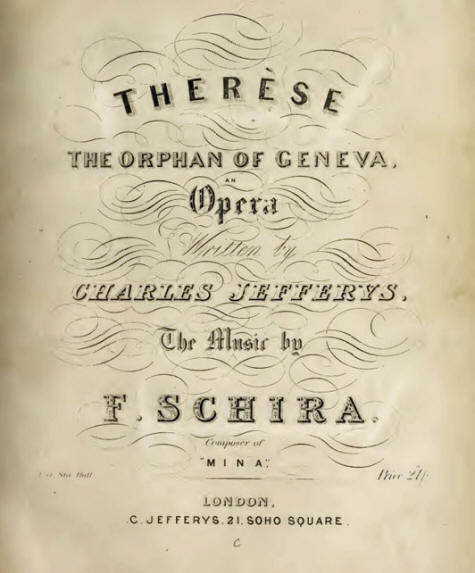
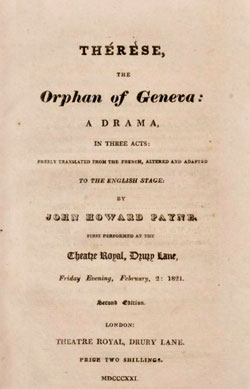
Perhaps being aware that his previous opera, Mina, was heavily criticised for its poor libretto, Schira may have wanted to ensure a firmer foundation by starting from an existing, proven, play. Here, he or his librettist chose John Howard Payne's popular Thérèse or The Orphan of Geneva, based on a play by Victor Henri Joseph Brahaim Ducange. Originally premiered at Drury Lane in 1821, the play was still being performed from time to time. The opera tended to be advertised as The Orphan of Geneva presumably to distinguish it from the play, although sometimes it was given the same title as the play, as in the vocal score title page above. The librettist, Charles Jefferys, was primarily a publisher and perhaps his involvement was an attempt to provide material for his business. Despite its popular source, the opera did not do as well as Mina, totalling just seven performances. This was, at least, partly due to John Maddox giving up the management of the Princess's Theatre on May 17, 1850, so removing the chance for any further performances. Its final performance was on May 10. Two further performances have been found. Schira included the third act for his benefit at Drury Lane on May 20, 1852 and there was a final flourish in January, 1865, in Cork, Ireland, where it was performed by Henry Cooper's British Operatic Association.[1] [1] Cork Daily Herald (Jan. 6, 1865) |
 |
Plot
The Musical World (May 4, 1850),
p.273, gave the following summary:
It is enough to remind our
readers that Thérèse is a young girl, the supposed
foster-child, but really the child, of a noble lady in Geneva; that
through the machinations of a rascally advocate [Carwin], who wishes to obtain
possession of her wealth and person, she is presumed to have forged
the will which bequeathed her all the property of her mother; that
subsequently, through the villany of the same individual, she is
arraigned for an attempt to murder her benefactress, the mother of the
man who loves her; that, as in the course of semi-serious melodrama,
her character and innocence are ultimately cleared up and established;
and that all ends happily to the satisfaction of everybody except the
rascally advocate, the bête noire of the drama, who
encounters the just punishment of his misdeeds.
Reception
The Morning Post (Apr. 27, 1850) thought that Jefferys in his adaptation had "acquitted himself most creditably of his somewhat difficult task, and succeeded in producing something decidedly above the average merit of modern works of this class". The Era (Apr. 28, 1850) also agreed that Schira had the "rare advantage of a good libretto...written with taste and elegance". The Morning Chronicle (Apr. 27, 1850) was a little more ambivalent feeling that Jefferys occasionally fell short by "elaborating the dialogue, and complicating the action" as well as rendering too much in recitative "which becomes flat and sometimes ludicrous, except in the hands of accomplished artists". The Standard (Apr. 29, 1850) also regretted that "a considerable portion of the dialogue is put in recitative, the whole of which we should be inclined to expunge. Familiar conversation, delivered in methodical sing-song is simply an absurdity". It did think the whole "somewhat superior to those which we ordinarily encounter; not that this implies any vast quantity of merit, but there is certainly less of the usual insipidity and silliness". The Daily News (Apr. 27, 1850) was also less enthusiastic reckoning that the play by "turning the dialogue into stilted recitative, and introducing a number of namby-pamby ballads is now turned into an opera; and this process has effectually deprived it of any dramatic interest it may have formerly possessed".
The Morning Post, which had been highly critical of Mina because of its Italian style, was complimentary of his "bringing forth many clever and effective pieces, upon which we are gratified to be enabled to set the stamp of our approval". The Era noted that the music's "most striking features are the purity of its style; the simplicity, grace, and expression of its melodies; its masterly and clever instrumentation, and the absence of unmeaning noise". However, the Musical World (May 4, 1850), p. 273-274, judged that Schira, although he had a good notion of instrumentation", was "too prodigal in his use of the louder instruments - an expedient which invariably fails to conceal the want of ideas". The Weekly Chronicle (Apr. 28, 1850) thought it "a pleasing opera, but very destitute of the merit of originality" and that "the ballad portion ... resembles that of the works of Mr Balfe". The Musical World regretted there was "not even an attempt at embodying the couleur locale, which, in pieces laid in Switzerland, is so tempting and so easy of attainment to a musician of fancy; but to make amends, Signor Schira has produced some exceedingly graceful songs, one or two pretty ballads, and several sparkling choruses". The Globe (Apr. 27, 1850) wrote that "As far as it is possible to judge of this work, produced under such disadvantages,[1] the music ... if wanting in originality, is generally pleasing, and, in many parts, is well instrumented".
The Athenaeum (May 4,
1850), presumably Henry
Chorley, thought it inferior to
Schira's Mina:
The new work contains little or
no melody, as distinguished
from phrases in bars which are
every one’s property, - no
advance in its orchestral
treatment; - and the only piece
possessing a certain
individuality is the effective
unaccompanied morceau, in the
first finale, which, though
very difficult, was well
executed.
The singers were generally praised. The Morning Post, as well as highlighting Louisa Pyne's singing, thought that she had improved "mightily in acting and a little more warmth and abandon would place her on a fair level with many of her foreign rivals". For the Daily News, "Mr Weiss was a sentimental villain of the genuine Adelphi school, full of fine words and black deeds, and of course had to sing in his very deepest bass".
The Morning Post wrote that "the band ... requires a complete reorganisation... on more than one occasion ... the success of the new opera was endangered by its inefficiency". The Weekly Chronicle also complained that "we cannot say much for the orchestra and chorus". The Morning Chronicle thought that, of Schira's music, "it would be unfair to speak critically, because the musical resources of the theatre, are, with a few exceptions, utterly inadequate to even a respectable rendering of any opera".
The Morning Post, despite its reservations, wrote that "there can be no question whatever of the effect produced upon the audience, or that the success in that quarter perfectly triumphant". The Era noted that "the success of the opera was as complete as the composer and management could have desired". The Weekly Chronicle sounded more sceptical, "A very friendly audience were loud and liberal in their applause and encores". Similarly the Daily News talked of "all the signs of a triumphant success" but that "we sometimes hear of an argument proving too much; and the same thing is sometimes the case with these violent demonstrations of enthusiasm".
[1] The "disadvantages" probably refer to the poor quality of the orchestra and chorus, see other comments.
Comment
The Morning Post had been particularly scathing of Schira's Mina with a strongly prejudicial view of its Italian style. Here, although it was much more positive about Schira's effort, it did make the proviso that it was speaking "comparatively, and with reference to the composer's previous work and the works of other writers of his (i.e. Italian) school, rather than absolutely (i.e. German school)".
In an interesting comment on contemporary practice, the Morning Post noted that the singers "notwithstanding the fatigues of a long rehearsal, and the anxieties of a first night, exerted themselves with unusual energy and effect".
The Athenaeum saw its overblown
reception as typical of the
problems besetting English
opera:
In truth, the
production is one to have been
passed over in silence had not
the audience resolved
otherwise. More brilliantly
received a new ‘ Barbiere’
could not have been. So long as
- and wherever - such welcomes
are possible to such music,
there is no chance for English
- or for any - opera. Trash
cannot be accepted as though it
were treasure, without harm all
round; and such pain as our
open protest may give to Signor
Schira is chargeable on his
friends and the public, - not
on any ill-will of ours.
Scores and Librettos
The manuscript of the libretto passed by the Examiner is in the British Library, Add MS 43027, ff.137-175. It was sent by Charles Jefferys (the publisher) to the Examiner on April 17, 1850, with a date for the first performance of April 24, 1850. Again, as with other operas at the Princess's, the actual first performance was later but only by two days.
The printed libretto is available at the Library of Congress. There are some differences between the manuscript and the printed libretto with the latter showing material that apparently was not signed off by the Examiner. For example, there are extra verses in some numbers, including the ensemble at the end of Act 1 (page 11 of the printed libretto) [1], Thérèse's song and scena (pages 24 and 25) and a trio on page 26. There are also omissions from the manuscript but, in general, there is a reasonable match.
A vocal score published by Charles Jefferys (London: 1850) can be found online at IMSLP. The British Library has a physical copy together with vocal scores of, at least, one number, "She shall be mine!", from the opera. The vocal score does not include all the extra items included in the printed libretto, for example, the scena in Act 3 is not included.
[1]This was just four lines of dialogue in the manuscript
Recordings
None are known
Books, Articles, Online
None are known
 |
 |
 |

 |
|
|