  |
 |

|
  The Village Coquettes
Music by
John Hullah,
|
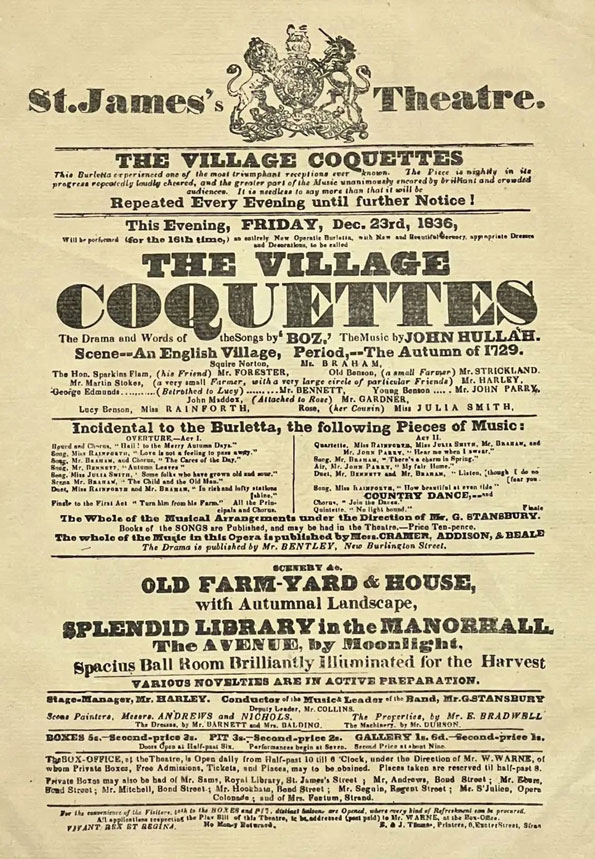
|
Squire Norton Hon. Sparkins Flam (his friend) Old Benson (a small farmer) Martin Stokes (a very small farmer with a very large circle of particular friends) George Edmunds (betrothed to Lucy) Young Benson John Maddox (attached to Rose)
Lucy Benson Rose (her cousin) |
- Morris Barnett *
|
Conductor George Stansbury
* according to S.J. Adair Fitzgerald, Dickens and the Drama. (London: Chapman & Hall, 1910), p.60, "After a few nights Mr. Barnett was replaced, owing to the slating he got in Figaro in London for this performance, by Mr Forester" (Henry Forester). Some versions of the libretto have Forester rather than Barnett in their cast list.
History
|
The Village Coquettes' main claim to fame is that it was the only libretto to be written by Charles Dickens. Its composer, John Hullah, was at the Royal Academy with Dickens's older sister, Fanny, and through her met Dickens. They decided to write an opera together and had made a start when it received a great impetus through John Braham, the best known British tenor of the day and manager of the St James's Theatre, taking an interest. The work was quickly completed and scheduled for production with Braham in the lead role. It was not a great success but notched up a total of 27 performances by the time of its final withdrawal on May 17, 1837 [1]. About a month before that Dickens had asked for his pen name, "Boz", to be removed from the playbills and subsequently strongly took against the work. It was claimed that "…when about a year before his death, Frederick Locker asked him [Dickens] whether he possessed a copy of the Coquettes, he replied: ‘No; and if I knew it was in my house, and if I could not get rid of it in any other way, I would burn the wing of the house where it was!’"[2]. Frances Hullah gives a short history of the opera in her Life of John Hullah (London: Longmans, Green and Co., 1886), pp.15-18. A letter to John Braham claimed that Dickens only received £30 for the libretto, a sum that he himself had asked for [3]. The orchestral score was lost. "The circumstances are not clear, but it may have happened during a residential fire in Edinburgh (Dec 27, 1836), which destroyed a large collection of theatrical music, belonging to the Theatre Royal’s librarian"[4]. However the date of the fire does not seem correct as the opera |
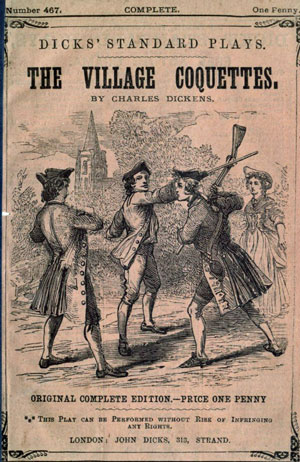
Cover from the Dicks' edition (1885?) |
was performed in London after that date. Frances Hullah stated that the opera was given in Edinburgh and while there that the theatre caught fire. However, there is no record of either any performances or the theatre catching fire in the local Edinburgh newspapers around that time. Whatever the reason, the full score has never been found, although others have since attempted to recreate it from the vocal score, such as Sir Frederick Bridge (1924), Edward Chadfield (1937) and Clifford W. Reims and Christopher U. Light (1992). The opera has had occasional performances using one of these editions. A version devised by David Owen-Norris was given at Southampton University on October 26, 2012, see here for the flyer.
[1] http://www.dickens.jp/etexts/dickens/others/sonota/coquettes.pdf. Frances Hullah, Life of John Hullah (London: Longmans, Green and Co., 1886) , p.16 claimed that it ran for about 60 consecutive nights.
[2] http://www.dickens.jp/etexts/dickens/others/sonota/coquettes.pdf
[3] The letter was in the possession of John's son, Charles. (Daily News, (Feb. 23, 1884))
[4] http://www.dickens.jp/etexts/dickens/others/sonota/coquettes.pdf .
Plot
The opera has a rustic setting. Lucy Benson, flattered by the attention of Squire Norton, has thrown over her intended, George Edmonds, while her cousin, Rose, has done the same to John Maddox in favour of Mr Sparkins Flam, a friend of the squire. The squire plans to elope with Lucy but her father finds out and strongly remonstrates with him. The squire threatens not to renew his lease. The next morning, the squire is in a more reflective mood when Lucy and Rose visit and get him to agree not to make good his threat and to bring an end to his attentions to Lucy. In the meantime Flan receives a summons to return money he won by cheating at dice and conceives the idea of abducting Lucy during a party that the squire is holding. In this way, he hopes to gain favour with the squire and so get his debts paid off. After the girls have gone, the squire realises the problems his attentions have caused and vows to repair the damage that he has done. Flam's plans are thwarted and he is arrested, order is restored and the two couples go off to be married.
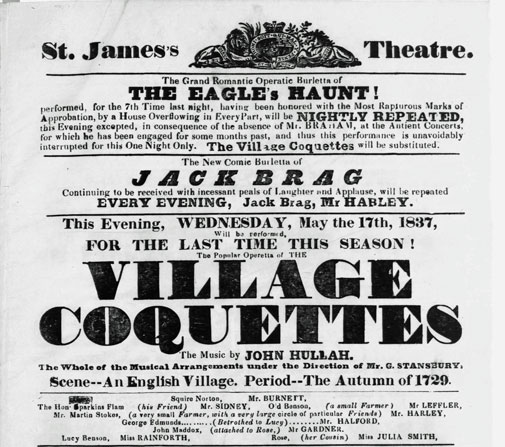
Part of the playbill for the last performance of the 1837 revival
British Library Playbills
Reception
According to Hullah's wife [1], the opera was, "notwithstanding the various opinions expressed as well on the book as on the music, was a success, and that of a very decided kind". This was perhaps an understandable exaggeration. The Sun (Dec. 7, 1836) was probably the most positive:
It is a light and elegant comedy, in which a great deal of gaiety and humour are blended with scenes of great interest, and many sweet and natural touches of tenderness and feeling. The music is admirably in accordance with the subject; simple, unaffected, and full of beautiful, expressive, English melody.
This reminds us that the opera came at a time of great hope in some quarters that English opera would prove a worthy rival to Italian. Similarly, The Observer (Dec. 18, 1836) after noting that "the music reflects great credit on the composer" emphasised that "the great merit of the piece is that it is purely English, both as regards plot and music"
In general, reaction was more mixed. The music did garner approval but there was clearly disappointment with Dickens's text. The Morning Post (Dec. 7, 1836) talked of "unqualified success" and that it was "happy to congratulate [Hullah] on his triumph" but could not "congratulate [Dickens] on his dramatic skill". The Standard (Dec. 7, 1836) wrote that "The plot is devoid of incident, excites no interest, and leads to nothing. Of the music a more favourable notice may justly be written". The London Courier (Dec. 7, 1836) similarly: "A few glimpses of "Boz's" better manner are caught here and there ... but upon the whole the piece is tedious, and is far from answering the expectations raised from the known humour of the author.... The music deserves a much more favourable notice". Figaro in London (Dec. 10, 1836), p. 204 was very positive about the opera, other than a hostile attack on Morris Barnett for essentially always playing the same part (Monsieur Jacques from Shakespeare's As you like it).
John Forster, later to become a close friend of Dickens, was altogether more dismissive in The Examiner (Dec. 11, 1835) [2]:
The plot and dialogue are totally unworthy of Boz... Not to speak of the lack of originality which this piece presents, it has the demerit of having incidents, such as they are, most clumsily hung together... The disappointment was deeply and generally felt.
We have now to say a word of the music, and we are compelled to state that its utter insignificance makes our task a brief one", although he did pick out a few points for praise, including the song "Autumn Leaves" ... The instrumentation throughout the opera is not appropriate. ...
In contradiction to the views of the Sun and Observer mentioned above:
We think [Hullah] has completely mistaken the genre of English music. We must conceive it to be an error to set English words to music after the manner of any foreign school.
While most reviewers had praised the singers, the orchestra and the mise-en-scène, Forster found little to endorse. If believed, his comments on the orchestra give a vivid flavour of the standards of the day.
the band of this theatre is so inefficient, that it can hardly do justice to any music. In this band there is a little boy who beats the drums, but never tunes them. He should be whipt.
[1] Frances Hullah, Loc. Cit.
[2] The whole review can be found at the end of http://www.dickens.jp/etexts/dickens/others/sonota/coquettes.pdf
Scores and librettos
The manuscript of the libretto submitted to the Examiner is available at the British Library Add MS 42938, ff.346-447. It was sent on November 11, 1836, but there is no signoff date. It was unusual in giving the running time: "Two hours and three quarters".
There are at least two printed librettos: Richard Bentley (1836), available at HathiTrust and John Dicks (1885?), available at Archive.org. The two printed editions look to be identical. The manuscript shows only a few differences from the 1836 printed libretto, the main one being a page in the manuscript in Act 1, scene 2, that was omitted in the printed libretto. An interesting point is that the word "God" was used several times in the manuscript but only twice was it was crossed out and replaced by "Heaven" in a different hand, although the printed libretto still showed "God". Clearly the new Examiner, Charles Kemble did not have the same exaggerated sensitivity about the word as the recently deceased George Colman, the previous Examiner.
Copies of the vocal score as well as individual scores for some of the songs can be found in various libraries including the British Library. David Owen-Norris has his own edition - https://www.davidowennorris.com/ .
Recordings
Three songs from the opera were sung at a Gresham College "Sullivan Song Day" concert on September 24, 2011 and can be found at https://www.youtube.com/watch?v=9c7O3cuHBoc
Books, Articles, Online
'X', "From My
Study", Musical Times.
(Jan.1, 1896), pp. 11-15 describes
the reaction to the opera as well as
describing the plot in some detail.
The Preface to the libretto (
http://www.dickens.jp/etexts/dickens/
others/sonota/coquettes.pdf )
includes details of its history and
reception. Frances Hullah's Life of
John Hullah (London: Longmans,
Green and Co., 1886), pp.13-18, gives
a history of the opera but it is
unreliable.
George Hall, "An Old Curiosity", Opera (Dec., 2020), pp. 1433-1437, describes the history and current state of the opera. Older articles include Walter Dexter, "A Stage Aside: Dickens's Early Dramatic Productions", The Dickensian, Vol. 33 (1937), pp.163-69, T.W. Hill, "Dickens and his 'Ugly Duckling' ", The Dickensian, Vol. 46 (1950), pp. 190 - 196 and summaries of two lecture by Sir Frederick Bridge, The Dickensian, Vol. 14 (1918), p. 64.
Alison Mero, The Quest for National Musical Identity: English Opera and the Press, 1834-1849. (Indiana University: PhD thesis, 2014), pp. 171-206, has a chapter on the opera and in particular the Englishness of its subject, a rare example amongst English operas.
 |
 |
 |
  |
|
|