  |
 |

|
  Love's AlarmsMusic by Edward FitzwilliamLibretto by John Buckstone
Theatre Royal, Liverpool
|
|
Colonel St. Ernest Joseph Tony
Lolotte The Countess Leonora [1] |
Liverpool -
|
Haymarket
|
Conductor - Edward Fitzwilliam
[1] Romer was not explicitly listed as playing
this part but as she was the only other singer listed in
advertisements and this is the next
most important character it seems
likely that this was her part.
History
Fitzwilliam and Buckstone had had a successful opera with Queen of a Day in 1851 at the Haymarket. This second attempt was, presumably, also intended to premiere at the Haymarket, where Buckstone had taken over as lessee and manager in March 1853. However, Fitzwilliam, the Haymarket musical director, who was touring with a company that included William Harrison and Louisa Pyne, first put it on in Liverpool for two nights[1]. Possibly this was to try it out and identify changes that needed to be made ahead of the Haymarket performances a little over a month later, although it is impossible to be sure as there is no text for the Liverpool performances. The manuscript libretto was not submitted to the Examiner until November 12 and returned on November 14 in time for the Haymarket performances. Thus the Liverpool performances had not received permission.
The opera was a one act afterpiece and was sometimes referred to as an operetta but the manuscript libretto titles in an opera. It was not particularly successful even though various changes were made and it only ran until December 2, 1853 [2]. Overall, commentators felt that Buckstone did not have the resources for opera [3].
[1] Liverpool Mercury (Oct. 14, 1853)
[2] Lloyd's Weekly Newspaper (Nov. 27, 1853) wrote that "It has been altered, reduced, shifted about, and is wonderfully improved in every respect." but that did not help preserve it for much longer.
[3] The Era (Nov. 20, 1853) "t
Plot
The Observer (Nov. 20, 1853)
outlined the plot:
A certain French colonel, who is quartered in
the chateau of a certain countess, has conceived a violent dislike to
women in general, and to matrimony in particular. The lady is
afflicted with the same oddity of view as regards the male sex. The
orderly of the colonel, on the other kind, carries on a correspondence
with the soubrette of the countess, and when they
respectively ask the authorities for permission to be married they are
peremptorily refused. The orderly has conducted his assignation by
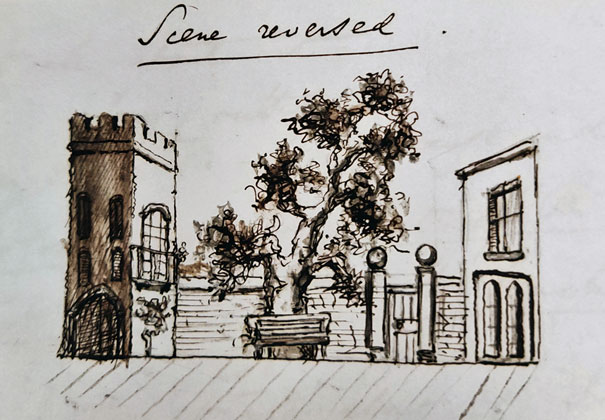
means of a tree, from the branches of which he obtains nightly access
to the grounds of the countess, much to the scandal of a silly
gardener, who, finding out his mode of entry, hangs the tree with
bells; one fine midnight, therefore, the delinquent perpetrates a
noise loud enough to awaken the seven sleepers. He is not discovered,
however, for he slips into the trunk of the tree, at the foot of which
the countess and the colonel presently seat themselves. The soft and
balmy air makes them sentimental, and. adamant as they are as regards
love, they yield insensibly to the influence of the hour. The billing
of the gentleman is, consequently, met by some very tender cooing on
the part of the lady; and the orderly, who is within an inch or two of
them, not only hears all that passes, but also manages to kidnap the
cap of one and the hat of the other. He thus has them virtually in his
power, arid, when broad daylight comes, be produces both hat and cap,
and little difficulty does he now find in getting leave to wed his
soubrette.
Reception
No reviews of the Liverpool premiere have been found. Of the Haymarket performances, the Morning Advertiser (Nov. 18, 1853) wrote that "The libretto is poor, even for that meagre kind of drama; and flat and forced beyond the power of any acting to vivify". "The performers did all they could for this operatic farce; but we are bound, in truth, to say, to very little purpose". "Miss Featherstone's rich natural voice ... produced most of the sensation" while "Miss Ormonde gained on one occasion a genuine call for a repetition". However, "as the curtain went down marks of disapprobation were unmistakably heard".
The Morning Post (Nov. 18, 1853) in a long review laid out the ground rules for this type of opera, building on the French experience. "All should be simple and natural enough though brightly coloured; and a naive and intimate style of expression should be preferred to the lyrical". It then went on as to why the opera had not succeeded. "The plot...is very poor". It contained "few genuine situations for music". It "was not remarkably well acted or sung" and although the score showed "considerable skill", it was "too heavy and ambitious for so humble and slender a subject". While many songs were applauded and two or three encored, "as a whole, the operetta was very coldly received, and long before its termination that bird of evil omen, called in theatrical parlance 'the goose' began to flap its unhallowed wings, and send forth prophetic sibillations".
The Era (Nov. 20, 1853) thought similarly: the plot quite mediocre and trifling in character", the company "by no means competent for opera detail, as was most forcibly illustrated on this occasion", and overall that it "signally failed in making a favourable impression upon the audience, whose mingled disapprobation at the close was sufficiently indicative of its non-success".
The Examiner (Nov. 19, 1853) was particularly exercised by the two women neither of whom "does justice to her voice by anything like a judicious management of it; and Miss Featherstone in especial, who has a very beautiful contralto, is in danger of utterly spoiling it by putting it to violent feats and tricks which it cannot perform".
The Standard (Nov. 18, 1853) had a similar unenthusiastic opinion of the opera to the above but did think that "The best... that could be done last night was done" and that Featherstone "shone the more brilliantly from the palpable incapacity of her coadjutors".
Comment
As has been seen with other English opera, there were sometimes comments on the singers' poor articulation. The Daily News (Nov. 18, 1853) in its generally downbeat review of the opera and the "trivial and insipid
dialogue" wondered that
Perhaps there was more meaning in
what was sung than in what was spoken; for, according to the general
and laudable custom of English singers, they took care that not an
intelligible word should reach the audience.
Scores and librettos
The libretto manuscript is available in the British Library, Add MS 52943 U. A transcript can be found here. No printed libretto has been found.
The British Library has vocal scores for eight numbers: "Farewell to love", "Hope is still a fair deceiver", "When should lovers breathe their vows", "Oh, oh, 'tis cruel, my lady", "Heart undaunted", "Attention, attention", "March to the field of glory" and "You've been well paid".
Recordings
None are known
Books, Articles, Online
None are known
 |
 |
 |
  |
|
|