  |
 |

|
  Keolanthe
|
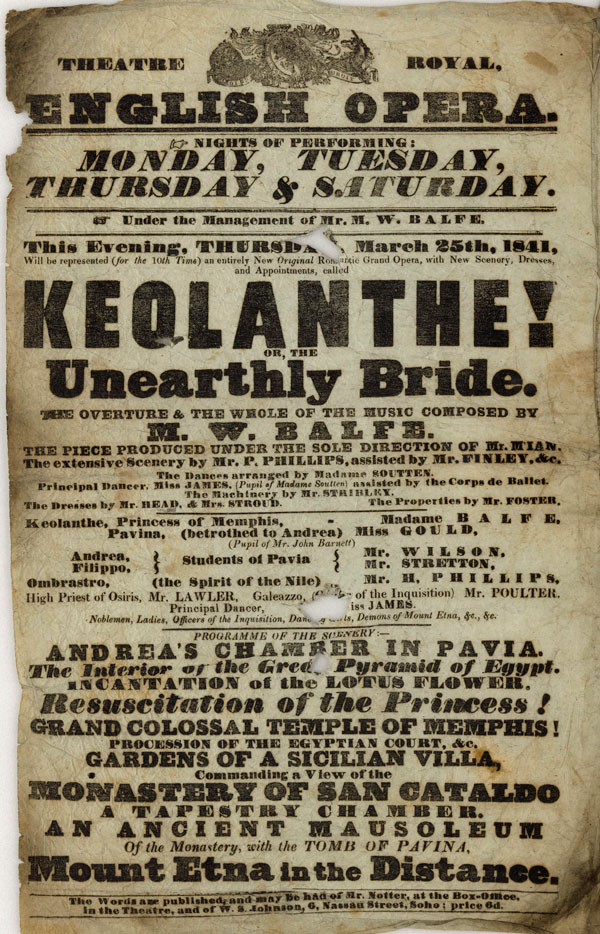
|
Andrea Ombrastro (Spirit of the Nile) High Priest of Osiris
Galeazzo (Officer of the
Inquisition)
Keolanthe (Princess of Memphis) Pavina (Betrothed to Andrea) |
-
John Wilson - Henry Phillips *
|
* The printed Songs, Duets, etc. lists John Hatton but he never sang the part, see below. The printed Songs, Duets, etc describes Ombrastro as "The Guardian Spirit of Keolanthe, Attendant on the Sacred Flower".
History
Balfe was, fleetingly at least, the nominal manager of the English Opera House in 1839 as head of a consortium hoping to reopen the theatre after its collapse under Montague Penley's management. Otherwise he had no management experience. After an encouraging start on March 9, 1841, his efforts eventually foundered on May 15, 1841 and ended up in his bankruptcy. The causes were essentially twofold. Firstly, there seemed to be a lack of knowledge about the economics of running a house and of the control of expenses. The production was lavish, Edward Fitzball, the librettist, claimed that it cost over £1000 [1], although that might partly be down to Lina Balfe's inexperience in ordering stage material, costumes and props (see here). Inevitably, he ran out of money to pay the singers. One of them, Miss Gould, refused to sing precipitating the theatre's closure and causing Balfe to promise that he would never involve himself again in management.
Secondly, he was badly let down by Henry Phillips. Phillips should have been back in London on March 3 for rehearsals for an opening night on March 6 but, instead, he was away singing in Dublin. He said he could not fulfill his London engagement because he had medical problems. This was supported by a doctor's certificate saying he needed complete rest. Balfe sent his solicitor to Dublin and found Phillips singing there. Phillips returned to London but the opera's premiere had to be postponed until March 9, which occasioned losses for Balfe.[2] This inauspicious start was aggravated further by Phillips's demand that Balfe employed a particular singer, whom Balfe did not. On April 6, Phillips sent a letter giving notice that he was withdrawing from the company which he did despite threats of legal action against him. From April 15, Balfe had to stand in for him. Not only did this affect Keolanthe but hindered producing any new works. Balfe set out the whole quarrel and the letter exchange in a small pamphlet: English Opera House. Statement and correspondence between Mr. Balfe and Mr. H. Phillips, relative to the affairs of the above theatre (London: W.S. Johnson, 1841) [3].
The Era (Mar. 7, 1841) advertised John Hatton as singing Ombrastro in the second performance of the opera on March 8 but this was obviously overtaken by the postponement. It is rather odd that it was advertised as "his first appearance in London", given that he had already appeared in the premieres of The Maid of Artois (1835) and Diadeste (1838) as well as many other shows. However, The Songs, Duets etc from the opera (London: W.S. Johnson, 1839) also named Hatton in the part. According to the Lloyds Companion (Dec. 15, 1844), when Balfe learned of Phillips's absence he signed up Hatton, "a very clever musical gentleman, but who knew nothing of the stage...the attempt was so impotent, that the thought was abandoned". Again this was incorrect; Hatton had quite a few years of stage experience. Possibly Balfe realised Hatton was not suitable and resigned himself to wait three days for Phillips's return and so postponed the opening night until March 9.
After this debacle, the opera was never performed again [4], although numbers were sung in concert for several decades, the bass solo, "From Rushy Beds"[5], and the duet, "List" dearest list", being particularly popular. However, the opera in a revised German version, Keolanthe, oder Das Traumbild, was given at the Kärntnertor Theatre in Vienna [6] from August 1853 through to January 1854.
[1] Edward Fitzball, Thirty Five Years of a Dramatic Author's Life. (London: T.C. Newby, 1859), Vol. 2, p. 170
[2] Morning Post (Mar. 6, 1841)
[3] Available in the British Library and reproduced in Michael Burden (ed.), London Opera Observed, 1711-1844. Vol.5 (Abingdon: Routledge, 2013), pp. 271-283. Contemporary accounts of the quarrel can be found in The Musical World (April 22, 1841) and The Observer (April 18, 1841)
[4] Alfred Louwenberg, Annals of Opera. 3rd Edition (London: J. Calder, 1978), p.815, claimed that it was given in Melbourne in May 1855 but no trace has been found of any Australian performance at all. The Melbourne newspaper, The Age, listed no opera in Melbourne in May 1855. Some numbers appeared in concerts in Australia.
[5] For example, The Daily Times [Mamaroneck, New York] (January 17, 1924)
[6] Edward Fitzball, Op. Cit., p.172, says that it was given in Berlin and the Freeman's Journal (December 11, 1849) quoting the Musical World wrote that a performance was planned. However, no supporting evidence has been found.
Plot
There appears to be no extant copy of the English libretto nor the full score so that the details of the opera are not known. However, the Morning Post (March 10, 1841) carried a very detailed description, although with the proviso that "some minor details ... have been varied or omitted upon the stage, but the story is in substance the same" [1]:
Andrea, a student of Pavia, is betrothed to a young girl named Pavina. The opera opens with the evening prior to the day appointed for the celebration of their union, on which Phillippo, the future bride’s brother, accompanied by the other students of the university, appear to congratulate him on the coming event. Phillippo, after this ceremony has been brought to a conclusion and the others have retired, remains behind, and tells Andrea that he is injuring his health, of which traces are already perceptible on his countenance, by a continued poring over some Egyptian manuscripts, which at that very moment are as usual on his table before him; and at the same time also reminds him that he is from morning till night dwelling either on the papers in question, or gazing with strange and incomprehensible earnestness on the portrait of an Egyptian lady which is hanging in his study. To this latter remark Andrea replies that the fears are ridiculous, and that the portrait is merely one that he has copied at the museum. Phillippo then says that he knows of a lady (his own sister) who is sitting to have her portrait taken, with the view of presenting it to a certain individual. At that moment Pavina herself enters the chamber, and, chiding her brother for betraying her secret, places her miniature in the hands of her lover. Andrea, on receiving the precious gift, is about to swear that he will never part with it, when Pavina, in a balled, commencing "No oaths for me," intreats him to do no such thing. The brother and sister bid him good night and retire.
Left alone, Andrea resumes his occupation of reading the manuscripts already named, and eventually falls asleep. When he is buried in a deep slumber, from a vase in the room rises a spirit of the Nile, Ombrastro, who is no sooner in safety landed on terra firma, than he introduces he himself to the audience through the medium of a song, beginning with the words "From the rushy banks of the Nile come I" in the course of which he causes the portrait of the lady to become animated in the person of Keolanthe. Andrea starts with astonishment, and inquires of Ombrastro who she is; to which query he receives for answer that she is Keolanthe, a Princess of Memphis, who died some 1000 years since. Andrea, in his rapture, expresses a desire that he had lived 1,000 years ago, in order that he might have existed in the days of the beautiful Keolanthe. Ombrastro upon this tells him that he shall see her living, on condition that he will utter a spell. To this condition Andrea instantly accedes, whereupon Ombrastro informs him that the spell must be performed in the great Pyramid of Egypt. To this intimation Andrea consents and a beautiful duet between the parties binds the contract to perform. The scene then changes, and we find them in the grand vault of the Great Pyramid. On one side is an Egyptian mummy, on the lid of which is inscribed the word "Keolanthe," whilst on the other side of the vault is an urn bearing the name "Andrea". The spirit proceeds to direct his attention to these things, and tells him that 1000 years ago Keolanthe had fallen in love with a young Christian warrior, named Andrea, the very counterpart of himself, who was pursued and slain; that Keolanthe had gathered up his ashes, and caused them to be placed in the urn which they then beheld; that she had been accustomed to go and weep over them every morning; and that, upon one occasion, being absent longer than usual, her maiden attendants had gone in search of her, and found her dead in the vault.
After uttering the spell as dictated by Ombrastro he gives Andrea a withered lotus from his cap, desiring him to take with his hand some of the ashes out of the urn and to scatter them about in a circle, and therein to place the urn containing the lotus, which, he says, will bloom as soon as the moonbeams shall have fallen on it, observing that, when that result shall have come to pass, Keolanthe, like the flower, will re-bloom and come to life. The experiment is tried, and the promised triumph achieved; the sarcophagus gradually disappearing, until Keolanthe, in all her beauty, stands visible to the eye. The heroin then sings "Why is my heart so cold?" and goes up to the urn as was her wont, when it disappears, and Andrea is seen, whom she instantly imagines to be her lover. The spirit then gives her to understand that she shall be united to Andrea, and that so long as they live only for each other they will be happy. The lovers assent to this condition.
The lovers are subsequently seen at their Sicilian villa, where their arrival is in course of celebration, when a gentleman claims hospitality for his sister for the night. They are willingly received, but Andrea is horror stricken when he perceives that they are his deserted Pavina and Phillippo. Pavina utters a cry of despair, and is carried into the palazza [sic], where she presently dies. In the meantime, Phillippo returns, and upbraiding Andrea, challenges him to mortal combat. This the latter refuses, but on the former quitting him to accompany the bier of his sister, he reminds him that he shall meet him at the mausoleum of San Cataldo. They subsequently meet, when Phillippo having called Andrea a coward, the latter draws his sword, which he points irresolutely at the heart of his opponent. Ombrastro rushes in, and, by a movement of the hand, forces the sword into Phillippo’s heart. The officers of the Inquisition enter, and but for the intervention of Keolanthe would at once drag him away. She, however, waves the lotus, and they become torpid stricken; but the lotus fades, when she is convinced of his perfidy, and leaving him to the cares of the Inquisition, vanishes. These officials then turn into demons, Mount Etna throws up her lava and ashes, and Andrea is cast by Ombrastro on to the tomb of Pavina. The scene here changes, and Andrea, in his study, is at the moment awoke by the knocking of Phillippo, who, conducting Pavina, reminds him that it is the morning of his wedding,
"and so ends a libretto which presents numerous opportunities for good music and for admirable stage and scenic effect".
[1] This account differs from the brief synopses given in William A. Barrett, Balfe, his life and work.(London: William Reeves Bookseller Ltd., 1883), pp. 131-132 and William Tyldesley, Michael William Balfe: his life and his English operas, (Aldershot, UK: Ashgate Publishing, 2003) , pp. 82-83. It does roughly agree with that in the Zeitung fur die Elegante Welt (June 25, 1841).
Reception
Despite having spent considerable space on the synopsis, the Morning Post's verdict on the libretto was that, probably, "such incomprehensible rubbish, such irredeemable nonsense, was never before perpetrated, but that it is without parallel even among the horrors of literature". However, "Keolanthe ... as a musical composition has greatly raised our opinion of Mr Balfe's talent. It is, in fact, a fine treatment of a good subject, full of unity of purpose in its construction, and of beautiful melody in its development". It went on that it was "scored with more care and science than Mr Balfe seems to have bestowed upon his previous productions". Only the overture disappointed. Julia Gould created a favourable impression in her first major stage role as did Lina Balfe, although seemingly labouring under "anxiety and trepidation", which the critic thought would dissipate after a few performances. Phillips got a somewhat hostile reception due to his responsibility for the delay in opening the new venture but "he sang them, however, into good humour". The review also expressed "our particular approval of its orchestral performance", under Balfe.
The Morning Chronicle (March 10, 1841) thought the libretto "not very well written, the poetry especially being prosaic enough; but there is a wild interest about it, and it furnishes good materials for music". It was also very complimentary about the music, except for the overture. "Indeed we feel convinced that there are more original and beautiful things in this than in any of his previous operas". The singers were praised, although it had doubts about the music for Phillips. "The scenery was beautiful, and the spectacle not only gorgeous, but got up with admirable taste. The chorus and orchestra ...are powerful and excellent; though the stringed instruments are not sufficient to contend with the great strength of the brass band". It followed up with another review on March 17, concluding that "we do not remember to have seen an English opera so perfectly performed", although again thinking that Phillips's part "might be greatly improved by the substitution of something else for the would-be comic but ponderous and ineffective song in the second act"..
The Weekly Chronicle (March 14, 1841) was of a similar opinion on the lack of merit of the libretto and while it liked some of the music thought that "in many parts, the composer seemed to be labouring without any fixed purpose, except to fill up with bars of music the chasm between different songs of real excellence". It liked Lina Balfe and Wilson and thought that Gould made a successful debut, although having "very little power of voice, and her action is indifferent". It did not think Phillips suited to the part of Ombrastro.
The Times (March 10, 1841) thought the libretto to have been constructed as "a knot thrown to composer and audience, that they may try their brains in making something of it" and that this had hampered the composer in creating something more memorable. It was less enamoured of Lina Balfe than some papers.
The Spectator (March 13, 1841) offered much the same sentiments as those above but went into some detail complaining that Balfe wrote as if for an Italian opera. "English opera is not Italian music set to English words" giving as an example that "The rapid articulation of syllables, easy to Italians, is a toil if not an impossibility to the English one". It noted favourably Balfe's apology that the opera had had "only three weeks' preparation" and contrasted this with the fact that some operas were "produced with only a single full rehearsal; our managers having always regarded the time and money employed in this sort of preparation as a useless waste of both". As a result of Balfe's care, "We have never witnessed so finished a first performance of any opera in any London theatre".
A German account of the original production in the Zeitung fur die Elegante Welt (June 25, 1841) was generally complementary about Fitzball's libretto but thought he should be more selective about his subjects. It said little about Balfe's music but noted that it was "Weniger eine Oper als ein Melodrama mit Musik (Less an opera than a melodrama with music)".
Fitzball was, no doubt, fairly used to such criticism of his librettos but here he was comforted by the "unqualified praise" he received from the Earl of Westmorland [1]. Fitzball asserted that is was "unquestionably, the best of Balfe's operas, that it to say, his finest original composition, and advances nearer to the stars" [2].
***
The Rheinische Musik-Zeitung (Dec 31, 1853) reviewed the Viennese 1853 German production and was not impressed. "Etwas schlechteren ist uns lange nicht vorgekommen (We haven't seen anything worse for a long time)". The writer gave up trying to explain the libretto as it was so far fetched and could not understand why Balfe had treated it so seriously and dramatically rather than "ein bagatelle a la Haymonskinder", a reference to Balfe's Die vier Haymonskinder given in Vienna in 1845, the German version of his Le Quatre Fils Aymon. The review concluded with the complaint that time, money and effort had been wasted on the opera when there were better German works trying to get a hearing.
[1] Edward Fitzball, Op. Cit., pp.171-172
[2] Edward Fitzball, Op. Cit., pp.168-169
Scores and librettos
Although the Lord Chamberlain's Day Book (Add 53702) states that the opera was signed off on February 23, 1841, no manuscript seems to have been included in the main collection. No printed libretto has been located. The printed text of the Songs, duets, choruses, etc. (London: W.S.Johnson, 1841) is available in Harvard and McMaster University libraries. A transcript can be found here.
According to Tyldesley[1], there is no full English vocal score, despite this being the only Balfe opera to star his wife, who left the bulk of his scores to the British Museum. Instead, there is a Cramer, Addison & Beale collection of vocal scores for eight numbers from the opera at the British Library as well as two individual scores for "While I hear thy Voice Dear" and "From rushy Beds of silver Nile". Liverpool City Council also had this collection.
There are vocal scores of a few songs online including "Vows too oft are broken", "From rushy Beds of silver Nile" and "While I hear thy voice dear" . The words for "List! Dearest list" can be found in an 1858 book of popular songs (pp.23-24) and for "While I gaze on those dear eyes", pp. 50-51, from Lloyds Song Book (1846).
The text of the German libretto is available. There is a full score in the Österreichische Nationalbibliothek, Vienna.
[1] William Tyldesley, Michael William Balfe: his life and his English operas, (Aldershot, UK: Ashgate Publishing, 2003), p. 82
Recordings
None are known
Books, Articles, Online
Edward Fitzball, Thirty Five Years of a Dramatic Author's Life. (London: T.C. Newby, 1859), Vol. 2, pp 167-173 gives his view of the opera.
William Tyldesley, Michael William Balfe: his life and his English operas, (Aldershot, UK: Ashgate Publishing, 2003), pp. 80 - 85, includes a sketchy description and some points about the opera. There are also sections giving some background to the opera in the books on Balfe by Walsh, Kenney and Barrett (see book list).
 |
 |
 |
  |
|
|