
 |
 |

|

 Grand English Opera Company
|
|
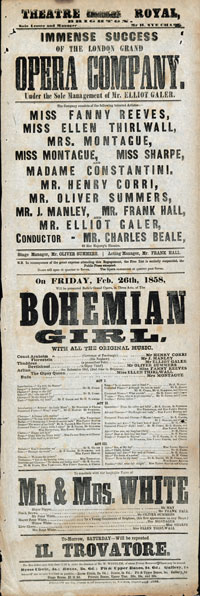
Elliot Galer [1] managed
several companies between
1854 and 1862 which came
under a variety of names
although usually including
the word "Grand".
His initial effort, billed as
coming from Drury Lane, consisted of Galer, Henry Corri,
Oliver Summers, Fanny Reeves
and Julia Harland. They
appeared in Plymouth in
November 1854 and then
toured in England through to
June 1855, when they took up
residency in Drury Lane with
J.H Tully as musical
director. Their
repertoire included
continental opera in
English, Balfe's The
Bohemian Girl,
Wallace's Maritana and
Dibdin's The Waterman.
restricted by the licence conditions. At Bradford the previous week, because the St. George's Hall was "under the dramatic license", full staged performances were given. Such licence anomalies were a perpetual irritant to Galer, who campaigned publicly against them (see here). The Sheffield Independent (Mar. 8, 1862) went into more detail: The orchestra, although not large, was sufficiently powerful for the purpose. Two violins, violincello, contra-basso, flute and cornet, were wonderfully assisted by the conductor, Herr Meyer Lutz, who certainly deserves a special meed of praise for his indefatigable and multiform exertions. Playing the piano with one hand, and the harmonium with the other; blowing his pedal-bellows with one foot, and no doubt, putting his other to some direct use; turning over his own music, and conducting the orchestra and chorus at any odd time when he had a hand to spare; ready withal to listen to any suggestion from any member of the corps, and to reply; all this was accomplished without ever making a stumble or losing the perfect command of the entire performances". Both Sheffield papers praised the singers and were generally complimentary about the performances but regretted the scant attendances, which had also been the case in Bradford. In May 1862, Galer became manager of the New Royalty Theatre in London but by the autumn, he was again on the road with an opera company for a short tour before bringing it to the Pavilion Theatre in Whitechapel in the November. 1863 saw his operetta company performing at Crystal Palace but in the May he suffered a bad accident when he was thrown from a carriage. However, by the end of the year he and Reeves were back with a "New Opera Lyrique Entertainment", a small company plus pianist and ran a season of operettas at the Polygraphic hall. Although no longer touring opera, he was clearly jealous of his past reputation advertising in The Era (Oct. 16, 1864) that "Mr Elliot Galer begs to intimate to Managers and the Public that he is in no way connected with an Opera Company now in the Provinces, and making use of his Name". This was probably a reference to G.B. Loveday's English Grand Opera Company. The early part of 1865 was spent at Sadlers Wells, followed by the Pavilion Theatre and the New Royalty, which the Galers again took over the management of in September. As before, it did not seem to have gone well and by April 1866 they had joined Annie Thirlwall's Grand English Opera Company with Elliot Galer becoming part manager. Another accident shortly afterwards might have led Galer to start phasing out his touring companies. In 1869 he had taken a lease on a theatre in Reading and his attention became increasingly focussed on managing theatres there and in Leicester, although, in the 1880s, he did organise some touring drama companies. [1] Galer was one of the few singers of this era who seems to have made and held onto a considerable fortune., although a sizeable bequest no doubt helped [2] The Era (Oct. 12, 1856) [3] The Era (Jan. 11, 1857) [4] The Era (Oct. 31, 1858) [5] Kurt Gänzl, Victorian Vocalists, (Abingdon, UK: Routledge, 2017), pp. 590-600, has a chapter on Rudersdorff. She had a command of several languages in which she sang. [6] Leeds Intelligencer (July 13, 1861) |
 |
 |
 |

 |
|
|