
 |
 |

|

 Julius Benedict's Early Career
|
|
1836: On Wednesday 22 July, Benedict gave what he now called his "ANNUAL Concert", which ran about three hours; they expanded yearly to four to six hours. These became celebrated and crowded annual events, despite (or because of) their tremendous length as they presented many famous British and European musicians all at once. (Artists in the 1844 concert at the Hanover Square Rooms included Sigismond Thalberg, young Joseph Joachim, and Felix Mendelssohn in a programme consisting of thirty-nine selections). Benedict played few piano solos but accompanied nearly every solo artist. The concerts moved into successively larger venues, eventually adding full orchestra and occasionally a chorus, and the last – a two-day affair celebrating Benedict’s fifty years before the public – took place at the Royal Albert Hall in 1884. 1836 – January 1838: John Mitchell engaged Benedict as conductor at the Lyceum Theatre’s "Opera Buffa" in November. Benedict was travelling then (location unknown) and unable to conduct the opening on December 10th, L’elisir d’Amore (Donizetti). "BALFE, in the absence of BENEDICT, who is [sic] not arrived,officiate[d] as conductor" (The Spectator, 17 December). Repertory included |
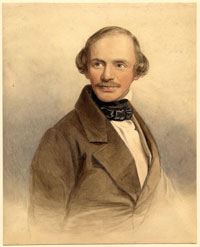
Portrait by Charles Baugniet (1844) © The Trustees of the British Museum |
Chiara di Rosenberg (Luigi Ricci), Betly (Donizetti), L’Italiana in Algeri (Rossini), Elisa e Claudio (Mercadante), and other operas. Benedict led a performance of his last Italian opera, Un anno ed un giorno (1836), on 31 January 1837.
1837– 38: Benedict first appeared at Drury Lane on 30 January 1837 (billed as "Pianist to the King of Naples"), conducting part 3 of a lengthy concert which began with Part I of Haydn’s The Creation led by Thomas Simpson Cooke (1782-1846), Drury Lane’s music director. Benedict conducted other events there, including many performances of his The Gipsy’s Warning (1838).
1839 – May 1843: Madame Vestris engaged Benedict to conduct Italian opera at Covent Garden; Bunn took over from Vestris in mid-December 1842 and retained Benedict through his brief five-month management.
1843 – June 1844. Alfred Bunn became Drury Lane’s manager in August 1843, succeeding actor-manager William Charles Macready, with Benedict as conductor for the 1843-44 season, opening 30 September with Balfe’s The Siege of Rochelle. Works Benedict directed included his own The Brides of Venice (1844), Balfe’s The Bohemian Girl (1843), the 1843 London premiere of La favorite (Donizetti; in English), Burgmüller’s ballet La Péri in 1843 with legendary dancers Marius Petipa and Carlotta Grisi, and Guillaume Tell (Rossini) and La favorite in 1844 with tenor Gilbert-Louis Duprez, who sang in French while the cast sang in English. Critics praised Benedict but noted the orchestra needed more strings to balance with the winds and brass.
1845: In mid-March Benedict was appointed musical director of the Norwich Triennial Music Festival, organizing and conducting all of them (save 1851, when it was not held) until 1878.
1848: On 15 December, Benedict conducted Mendelssohn’s Elijah at the Exeter Hall for Jenny Lind’s first appearance in oratorio; the money raised went to the Royal Academy of Music to establish the Mendelssohn Scholarship, intended to send gifted students to the Leipzig Conservatory for advanced studies. The first Mendelssohn Scholar was Arthur Sullivan in 1856.
1850: On Monday 11 June, Benedict played the first performance of his
First Piano Concerto in C minor (opus 45; dedicated to Liszt) with the
London Philharmonic Society’s orchestra under Michael Costa.in the 8th
(and final) concert of their 1850 season. It was Benedict’s only
appearance with the Philharmonic Society.
Phineas T. Barnum engaged Benedict as Jenny Lind’s accompanist and
conductor (by Lind’s request) for Lind’s American tour, paying him
$25,000 (£780,000 to-day). Benedict, Lind and
supporting artist baritone Giovanni Belletti departed Liverpool aboard
the Collins Line’s steamship
Atlantic on 20 August, arriving in New York on 1 September.
Their first concert was on 11 September at Castle Garden (New York’s
largest auditorium) with a 60-piece orchestra. Benedict began with
Weber’s Oberon overture and
his overture to The Crusaders
opened the second half; he also wrote Lind a "Greeting to America" to
words by Bayard Taylor. 4476
tickets sold for $24,753; Lind gave her $10,000 fee to twelve New York
charities.
On 23 November, Benedict and New York pianist Henry Christian Timm played his
Concertino for Two Pianos and Orchestra (op. 29) with
the New-York Philharmonic Society’s 62-member orchestra under George Loder (Edward J. Loder’s cousin) on the 9th concert of
their 1850-51 season. Lind, Benedict, Belletti, Barnum, and a core
group of ten instrumentalists left New York on 25 November on a
grueling tour of the South, with a side trip to Havana, and then went
as far West as Louisville, Kentucky.
1851: While in New York in May, Benedict supposedly received an offer
from Her Majesty’s Theatre or decided he needed to be with his family
(which is more likely); he remained with Lind until his replacement
Otto Goldschmidt arrived from Germany. (Goldschmidt married Lind on 5
February 1852.) Lind also parted with Barnum after 93 concerts to
manage her own touring. Benedict and Belletti left New York on the
Collins Line steamship in which they arrived, the
Atlantic, on 6 August,
reaching Liverpool on 17 August.
There is no real
evidence that Benedict was wanted at Her Majesty’s. However, Benedict
was now a wealthy man and decided to take a vacation with his family.
In early September he took his wife Adele (whom he had married in
1833) and their five children for a European trip to visit Stuttgart,
Paris, and then Naples to see his wife’s family. On 4 October they
were on a Rhone steamboat, with the river running high, when its
funnel hit the arch of a bridge, broke in two, and fell to the deck,
crushing his 12-year-old son Edward. Adele’s shock and grief shattered
her health, and after a rapid decline she died in Pisa on 17 April
1852, aged 37. To add to his woes, Benedict’s father died on 8 July in Stuttgart,
aged 81.
Understandably, these deaths brought a pause to Benedict's career but he gradually resumed it with even more success culminating in his knighthood in 1871. The main page on Benedict can be found at https://www.englishromanticopera.org/composers/benedict.htm
 |
 |
 |

 |
|
|