|
This was the best known and longest lasting
English opera touring company. It was founded in 1873 by Carl
Rose, a German violinist and conductor and his wife,
Euphrosyne
Parepa. Possibly its longevity was
partly due, perforce because
of Parepa's death, to it not
being built around one or
two star singers, as were
most touring companies at
this time. Rosa met his wife while on an opera
tour of America and married
her in 1867. They continued
to tour the US and, in 1869,
together with the Chicago
theatre manager, C.D. Hess,
set up the Parepa-Rosa
Grand Opera Company with Parepa
as its star performer.
The Rosas returned
to the UK in June
1870 but by
September the
following year, they
were back in the US
with their own
re-formed company
and stayed until
April 1872 (see
here for the 1869-1872 itineraries). Towards
the end of 1872, they went
to Egypt where Parepa had
been hired for the 1872-1873 season in Cairo.
On their return,
Rosa set up the Carl
Rosa Company
(initially called
the English Opera
Company) with a tour
of provincial cities
beginning in
September 1873 [1], Parepa
being absent through
pregnancy. Unfortunately, Parepa
died after complications
with childbirth in January 1874 but
Rosa continued to run the
company until his death in
1889. It regularly toured
the country together, often,
with a short winter season in
London. Eventually it set up
a permanent home in
Liverpool in 1884 as a place
to hone new productions but
its focus was still on
touring. At the height of its
success, it had three
separate companies touring. The original company gave
its last performance in 1960
but a new company was
re-launched under the Carl
Rosa name in 1998. |

Carl Rosa Trust |
|
Rosa's formula was to stage
popular continental operas
in English, together with
some older English operas,
such as Balfe's The
Siege of Rochelle, The
Bohemian Girl and
Satanella, Wallace's
Maritana and
Lurline,
Benedict's The Lily of
Killarney and
Macfarren's Robin Hood.
He came under quite alot of
pressure in the press to
commission new English
operas and did so fairly
cautiously, but without
lasting success with any of
them. 19th century
examples included Frederick
Corder's Nordisa
(1887), Frederick Cowen's
Pauline (1876),
Arthur Goring Thomas's Esmeralda (1883)
and Nadeshda (1885,
Alexander Mackenzie's Colomba (1883)
and The Troubadour (1886)
and Charles Villiers
Stanford's The
Canterbury Pilgrims (1884).
Following Rosa's death
further new operas were
tried but again without
marked success: Cowen's
Thorgrim (1890), Goring
Thomas's
The Golden Web
(1893) and Hamish MacCunn's Jeanie Deans
(1894) and Diarmid
(1897).
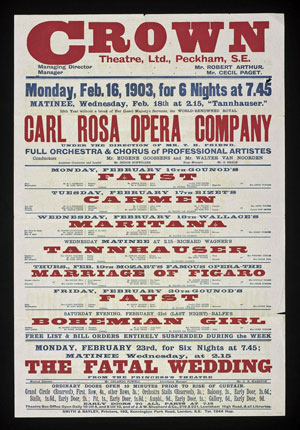
The poster on the right from the
V&A Museum shows that the company were still
offering Maritana and Bohemian Girl
along with operas that are still in the regular
international repertoire today.
The current Carl Rosa
Company can be found at
http://www.carlrosaopera.co.uk/, while the archives of the
original company are held by
the Carl Rosa Trust (https://www.carlrosatrust.org.uk/).
Articles reflecting the
company's history at various
times in the past can be
found in The Musical
Times.
|
 |
|


