  |
 |

|
  William Vincent Wallace1812-1865
Wallace's Life and WorkWallace was born in Waterford, Ireland on March 11, 1812 to a bandmaster father, who taught him to play the instruments of his regimental band. When the family moved to Dublin, William was in his teens and before long became second violinist in the Theatre Royal pit orchestra, where on occasions he deputized for the leader. He studied the piano with W.S. Conran, and the organ with Haydn Corri that led to an appointment as organist of Thurles R.C. Cathedral and Professor of music at the cathedral convent in 1830. A year later he returned to Dublin, and its Theatre Royal orchestra, where he was impressed by a visit by Paganini.
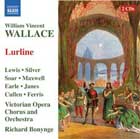
of musical styles and felt he was ready to write an opera. With a libretto by Edward Fitzball, the composer set to work on Maritana, which was first performed at Drury Lane's Theatre Royal on November 15, 1845. Both public and press were enthusiastic and soon its music was published and heard everywhere. The opera toured widely and became as strong a hit as Balfe's The Bohemian Girl. Although it followed the same dialogue and song model as Balfe's, Wallace's more ambitious and musically more learned approach was seen to offer a way forward for English opera, which was felt in some quarters to be becoming narrower and less relevant. Ultimately this never happened. See the section in Maritana for more details. Following Maritana, Wallace set to work on more ambitious operas, the first of which was Matilda of Hungary (1847), which failed to achieve the success of Maritana. He then began writing Lurline again to a text by Edward Fitzball. It was intended for production by Alfred Bunn but this time at Covent Garden. However, Bunn gave up theatre management before it could be performed and Wallace's absence, first with eye problems and then on a prolonged visit to South America hardly helped his cause. Eventually, it was February 23, 1860 when Lurline was premiered by the Pyne - Harrison company at Covent Garden with tremendous success. Unusually for English opera of the time, it was through-composed. Lurline toured firstly with the Pyne - Harrison, and later with the Carl Rosa and Moody-Manners opera companies. Wallace followed it up a year later with The Amber Witch using a text by Henry Chorley, critic of the Athenaeum magazine. However, he altered some of Chorley's words and introduced a cheery Rondo at the end to replace the plaintive solo Chorley had provided. The premiere, conducted by Charles Hallé, was well received, but the vagaries of the theatre world cut the run short and it never had the exposure it should. The work went touring, however, and was last picked up by the Moody Manners company in 1899. Love's Triumph (1862) with libretto by Planché, and The Desert Flower (1863) with book by Harris & Williams were his last works to get to the London stage, but both were not widely reported and never became part of any repertoire. Wallace retained his interest in opera writing, and was working on an opera Estrella in 1864 when he became seriously ill (with heart attacks). He retired to Passy, in Paris and ended his days at the Chateau de Haget on October 12, 1865. His body was returned to London and he was buried in Kensal Green Cemetery on October 23, 1865. Cecil Forsyth summed up his impact on English opera as having "a certain elementary vigour and dramatic spontaneity which were unknown till his day" [1] [1] Cecil Forsyth, Music and Nationalism (London: Macmillan and Co., 1911), p.163
Recordings of Wallace's WorksCommercial Opera Recordings
Maritana, RTE Concert Orchestra. Proinnsías O'Duinn, Naxos 8.660308-09.
Private Opera Recordings Maritana, Beaufort Opera, Joseph Vandernoot, Rare Recorded Editions 148/149. This audio recording is available on https://www.youtube.com/watch?v=AXst_hcux30&t=13s and https://www.youtube.com/watch?v=wdTAzip6f5A . There is also a rather hazy video of a 1987 Kinsale Opera performance of Maritana on https://www.youtube.com/watch?v=_OaBfi7YB2Y and of a St John's Musical Society, Waterford, 1981, performance at https://www.youtube.com/watch?v=NyQ17jmUva4
A private recording of the Italian
version of Maritana
originally performed at Her
Majesty's Theatre in 1880 and here
performed by the Glasnevin
Musical Society at the Gaiety
Theatre, Dublin, in October 1976, is
available at
https://www.youtube.com/watch?v=rMERxr4rBRg, https://www.youtube.com/watchapp=
Ballads, opera excerpts and other works
Excerpts from an historic recording (1931) of Maritana featuring Heddle Nash, Denis Noble, Miriam Licette and Clara Serena available on Cavalcade of English Singers, Volume 2, Dutton CDBP 9802, 2010. Excerpts from Wallace's Maritana, Balfe's The Bohemian Girl, and Benedict's The Lily of Killarney, Orchestra conducted by Havelock Ellis reissued on EMI Classics 0094633594821 in 2005. A selection of arias from Wallace operas (as well as from Balfe, Faraday and Sullivan) sung by Deborah Riedel with Richard Bonynge conducting on The Power of Love, (Melba MR301107 , previously 301082), 2000. Joan Sutherland sings "Scenes that are brightest" from Maritana on Decca 425 048-2. Rosemary Tuck plays some of his piano works on Cala Records CACD88042, Cala Records CACD88044, Naxos 8.572774 and Naxos 8.572775. A few excerpts from Maritana as well as some piano music can be found on http://www.youtube.com/ - search on William Vincent Wallace. Some fascinating early 20th century cylinder recordings of Wallace items from the University of California Cylinder Preservation and Digitization project can be found here .
A list of his compositions, some
with lyrics and MIDI files can be
found at
https://dirkncl.github.io/pdmusic_
Books and articles on Wallace
Andrew Lamb, "Long Way from Tipperary", Opera (March 2012), pp. 282-285 is a short article on the composer drawn from his book. Older accounts include a short memoir by W.H. Gratton Flood, William Vincent Wallace, written in 1912, recently reprinted, and a short book, William Vincent Wallace: A vagabond composer by Robert Phelan, (Waterford: Celtic Publications, 1994). Both are available from Cheshire Opera Enterprises. John W. Klein, "Vincent Wallace (1812-65): A Reassessment", Opera. (October 1965), pp. 708-716. Kathleen Hellyar Myers, William Vincent Wallace: life and works. (Ph.D dissertation, Bryn Mawr College, 1980) Michael Walters, "From Maritana to Yeoman. An examination of Wallace, his bizarre life, and his opera which was the inspiration for The Yeomen of the Guard", Gilbert and Sullivan Pamphlets, No. 1, May 1998. Available at https://www.gsarchive.net/yeomen/wall.pdf includes material on Wallace's life, on Maritana and with short descriptions of Wallace's other operas. The Journal of the British Music Society, Volume 25, 2003 includes an article by David Grant, "A Reappraisal of W. Vincent Wallace with new documentary information on his death". David Grant, "William Vincent Wallace and Music in Australia 1835-38" in Ireland, Australia and New Zealand : history, politics and culture. eds. Laurence M. Geary and Andrew J. McCarthy (Dublin: Irish Academic Press, 2008). The programme for William Vincent Wallace's Bicentenary Festival, edited by Una Hunt, can be found here William Spark's Musical memories. 3rd edition (London: W. Reeves, 1909), pp. 144-158, has a short biography. Spark knew him but even so it is not particularly insightful. Perceval Graves, "William Vincent Graves", The Gramophone, July 1928, pp. 49-51, gives a short biography and appraisal but is not always accurate, e.g. Lurline was 1860 not 1853.
Scores and librettosReferences to librettos for particular operas will be found on the relevant opera page and on the librettos page.
Web pageshttp://pdmusic.org/wallace.html has an extensive list of songs, including their lyrics and instrumental pieces as well as listings of the opera numbers. Graham Skinner's Austral Harmony site has a web page on Wallace's Australian career and his family connections there, as well as some sections from 19th century articles on Wallace. Basil Walsh's Irish Classical Music Pioneers includes a section on Wallace and his operas. David Grant article in the Dictionary of Irish Biography - https://www.dib.ie/biography/wallace-william-vincent-a8860 |





 |
 |
 |
  |
|
|